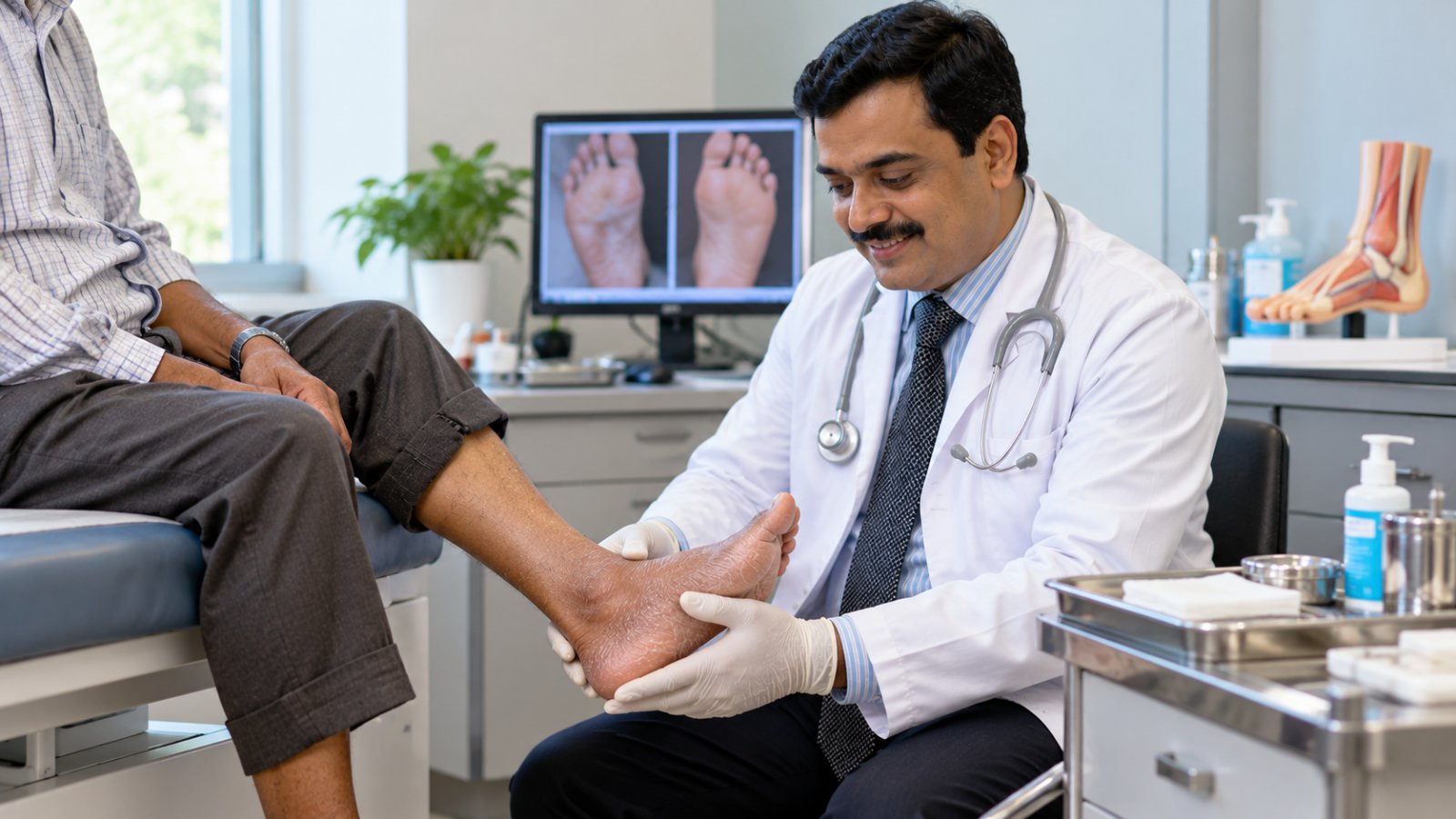
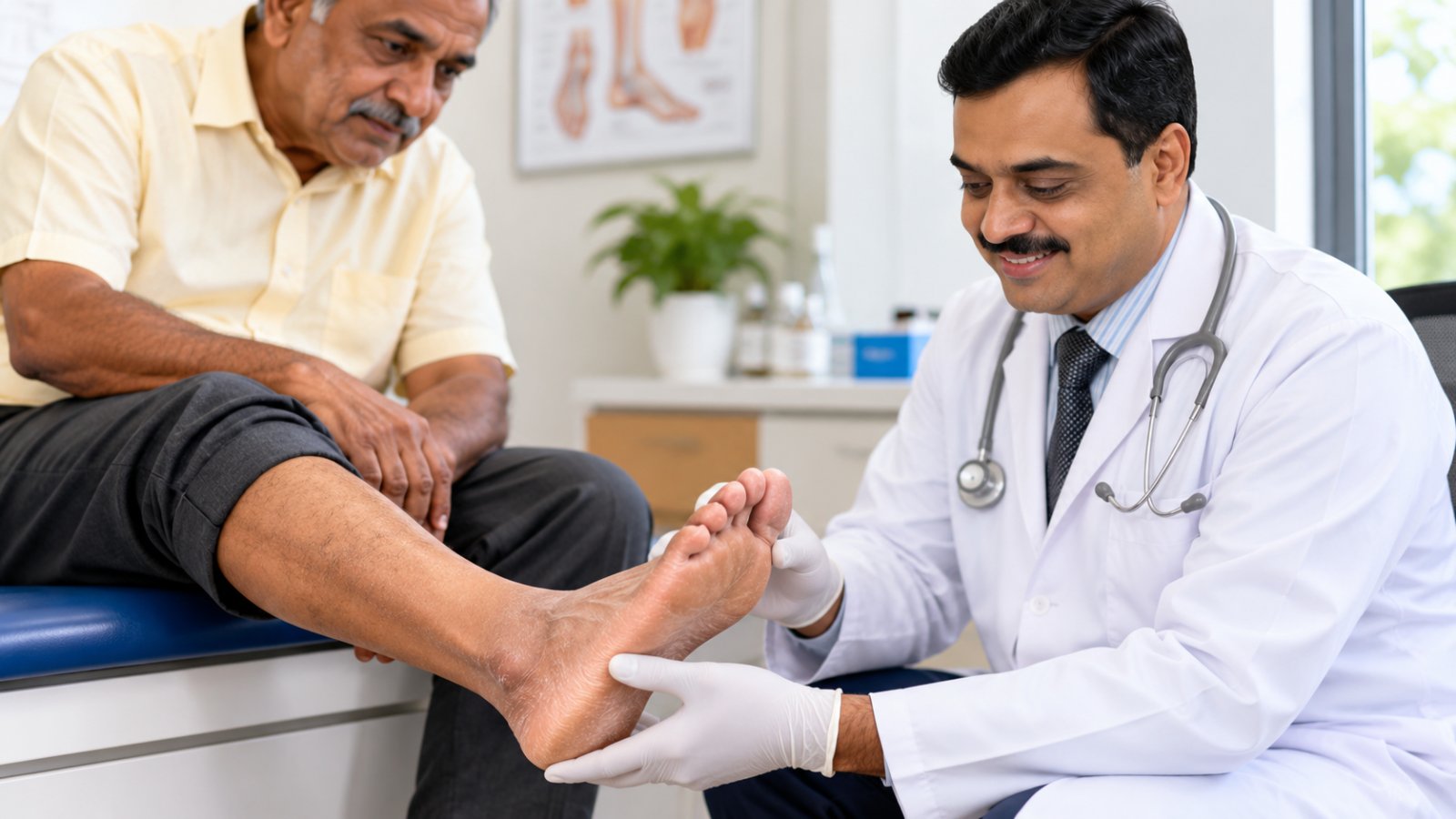
Diabetic foot treatment in Jamnagar works in steps: a medical evaluation, wound cleaning and debridement, infection control, pressure relief, blood sugar and circulation management, then regular follow up. Daily self-care prevents most ulcers, a clinic should treat any wound within days, and a hospital is needed for spreading infection or a cold, blackening foot.
Diabetes can damage the nerves and blood vessels of the feet, so a small blister can turn into a deep wound without hurting. This guide explains what each step of diabetic foot treatment involves, which level of care you need right now, what drives the cost, and where patients from Jamnagar can get specialist help.
What is diabetic foot treatment?
Diabetic foot treatment is medical care for foot problems caused by diabetes, such as ulcers, infections and slow-healing wounds. It treats the wound and the diabetes behind it at the same time.
A diabetic foot is a foot at risk because long-term high blood sugar damages the nerves (neuropathy) and narrows the leg arteries (peripheral arterial disease). Together, these mean you may not feel an injury, and the wound gets too little blood to heal. An ulcer is an open wound that breaks through the skin and does not heal on its own.
What warning signs should you not ignore?
See a doctor within days for any new wound, and the same day for signs of infection or poor blood supply. Painless does not mean harmless, because nerve damage hides pain.
- Any open wound, blister or crack that is slow to heal.
- Redness, warmth, swelling or pus, which suggest infection.
- Numbness, tingling or burning in the feet or toes.
- Black or darkening skin on a toe or the foot, a sign of possible tissue death.
- Foul smell or a wound that suddenly grows larger.
- Pain at rest or cramping in the calves while walking.
- Fever together with a foot wound.
Which level of diabetic foot care do you need right now?
Diabetic foot care works on three levels: what you do yourself, what a clinic must do, and what needs a hospital. Most harm happens when a problem stays at the wrong level too long, usually a wound dressed at home for weeks that needed a clinician.
Level 1: what should you do yourself every day?
Prevention, inspection and protection. These steps need nothing more than a mirror and good light.
- Inspect both feet daily, including the soles and between the toes.
- Never walk barefoot, indoors or outdoors.
- Check inside shoes for stones, seams and worn patches before wearing them.
- Wash and dry the feet gently, testing water temperature with your elbow.
- Moisturise dry skin, but not between the toes.
- Keep blood sugar controlled and stop smoking.
- Photograph anything new so you can see whether it is changing.
Treating an open ulcer does not belong at this level. Nor does cutting callus, digging at nail corners or using chemical corn removers. Move up a level if you find any wound, blister, crack or colour change, however small.
Level 2: what should a clinic do?
A clinic finds the cause of the wound, removes dead tissue and takes pressure off it. These are the steps that decide whether a wound heals.
- Circulation testing: pulses, Doppler and ankle brachial index.
- Sensation testing with a monofilament.
- Debridement of dead tissue and callused wound edges.
- Offloading with a cast, boot, insoles or footwear.
- Wound measurement and photographs at every visit.
- A culture from the right site, so antibiotics are chosen, not guessed.
If four weeks pass with no reduction in wound size, the plan needs to change rather than continue. Move up a level if there is fever, spreading redness, pus, a cold or blackening foot, or exposed bone.
Level 3: what needs a hospital the same day?
Anything that threatens the limb or the person needs inpatient care, imaging and often surgery.
- Spreading infection or sepsis, with fever, chills or confusion.
- An abscess needing surgical drainage.
- Wet gangrene or rapidly blackening tissue.
- A cold, pale or blue foot suggesting blocked blood supply.
- Bone infection (osteomyelitis) needing imaging or surgery.
- Revascularisation, such as angioplasty or bypass, to restore blood flow.
| What you have | Level | How soon |
|---|---|---|
| Healthy feet, some numbness, no wound | Level 1 plus periodic check-up | Daily checks, review every few months |
| Callus, dry cracks, thick nails | Level 2 | Within weeks |
| Any open wound or blister | Level 2 | Within days |
| Wound not smaller after four weeks | Level 2, plan must change | Reassess now |
| Fever, spreading redness, pus, foul smell | Level 3 | Same day |
| Cold, pale, blue or blackening foot | Level 3 | Same day |
What are the steps of diabetic foot treatment in Jamnagar?
Diabetic foot treatment in Jamnagar follows the same structured order used in specialist centres: evaluate, clean, debride, control infection, offload, then manage sugar and circulation and follow up. Skipping a step, especially offloading or a circulation check, is the commonest reason wounds stall.
Step 1: Medical evaluation
The doctor reviews your diabetes history and sugar levels, examines both feet, tests sensation, checks foot pulses and looks at your footwear. A full foot assessment and diagnostics visit may add X-rays, blood tests or a vascular scan to rule out bone infection or blocked arteries.
Step 2: Cleaning the wound
The wound is cleaned with sterile technique to remove dirt, bacteria and loose debris, then covered with a dressing chosen for that wound rather than by habit.
Step 3: Debridement
Debridement is the removal of dead, damaged or infected tissue so healthy tissue can grow. It is often repeated over several visits.
| Debridement method | How it works | Often used when |
|---|---|---|
| Surgical (sharp) | Dead tissue is removed with sterile instruments. | Larger wounds or heavy dead tissue. |
| Mechanical | Dressings or irrigation lift away debris. | Wounds with loose or moist debris. |
| Enzymatic | A medical ointment breaks down dead tissue. | Slow, controlled cleaning is preferred. |
| Autolytic | The body's own fluids soften dead tissue under a dressing. | Smaller wounds needing gentler care. |
Step 4: Infection control
If infection is present, treatment starts immediately with oral or intravenous antibiotics guided by a wound culture, plus drainage of any abscess. Antibiotics should never be stopped early just because the wound looks better.
Step 5: Pressure relief (offloading)
Offloading means taking weight off the wound so it is not crushed with every step. Options include total contact casts, offloading boots, custom insoles and therapeutic diabetic footwear, and crutches or a walker in severe cases.
Step 6: Blood sugar management
High glucose slows healing and raises infection risk, so medication may be adjusted alongside meal planning and more frequent sugar monitoring.
Step 7: Improving blood circulation
A wound with poor blood supply will not heal with dressings alone. If testing shows narrowed arteries, vascular treatment such as medication or angioplasty restores flow so every later step can work.
Step 8: Advanced wound care and surgery
Slow wounds may need negative pressure wound therapy, growth factor treatment, skin grafts or flaps. When infection or dead tissue threatens the limb, limb-saving diabetic foot surgery aims to remove only what is necessary and keep the foot functional.
Step 9: Regular follow up
Scheduled visits track wound size, change dressings, catch early infection and adjust the plan. After healing, follow up continues because a healed ulcer can return without the right footwear and checks.
How much does diabetic foot treatment in Jamnagar cost?
The cost of diabetic foot treatment in Jamnagar depends mainly on how advanced the wound is when treatment starts. Early, outpatient care costs a fraction of hospital admission or surgery, so affordability is really about timing, not the cheapest dressing.
| Stage of foot problem | Typical treatment | Relative cost and effort |
|---|---|---|
| At-risk foot, no wound | Screening, footwear, education | Lowest, a few clinic visits |
| Early surface ulcer | Dressings, offloading, infection control | Low, outpatient and non-surgical |
| Infected or deep ulcer | Debridement, antibiotics, advanced dressings | Moderate, longer course of care |
| Limb-threatening wound | Surgery, reconstruction, vascular repair | Highest, yet far less than amputation and rehabilitation |
Exact pricing varies with wound depth, infection and circulation, so a fair estimate can only be given after examination. Eligible patients can also check whether surgery is covered under government health schemes, explained in our post on Ayushman Bharat PM-JAY and the MA card.
How can you prevent diabetic foot problems?
Most diabetic foot ulcers can be prevented with daily foot checks, proper footwear and steady blood sugar control. International IWGDF diabetic foot guidelines recommend structured foot care and regular screening for exactly this reason.
- Inspect both feet every day, using a mirror if needed.
- Wear well-fitting, protective shoes and never go barefoot.
- Cut nails straight across and leave callus to a professional.
- Get any new wound checked within 24 to 48 hours.
- Attend scheduled foot reviews even when the foot feels fine.
When should a Jamnagar patient see a diabetic foot specialist?
See a specialist immediately if you have an open wound, spreading redness, fever, black skin, or a foot that suddenly changes shape or colour. For fever, pus or a cold foot, go to local emergency care first, then arrange specialist review.
A specialist opinion is especially worth getting if a wound has not shrunk in four weeks, or if amputation has been suggested without a circulation test. Our guide on choosing a diabetic foot clinic in Jamnagar lists the questions to ask any provider.
Where can you get diabetic foot treatment in Jamnagar from EDFC?
Elegance Diabetic Foot & Ulcer Clinic is opening a Jamnagar centre at 112, Summair Club Road, opposite Shiv Hotel, Government Colony, Jamnagar 361006. Until it opens, Jamnagar patients can send wound photos on WhatsApp for an initial review and be seen in person at our Surat clinics in Adajan and Vesu.
Care is led by Dr. Ashutosh Shah, a Plastic & Microvascular Surgeon who handles wound care, vascular assessment and reconstruction within one coordinated plan. In our clinic we commonly see wounds that started as a small, painless blister or crack and were dressed at home for weeks, which is why we push for early review. Current addresses are on our centres page, and you can book a diabetic foot consultation or call +91 832 050 0350.
Do not wait for a foot wound to hurt
Most diabetic feet are lost slowly, through weeks of care at a level that could never solve the problem. If you have diabetes and a wound in Jamnagar, act within days and book an assessment with Dr. Ashutosh Shah.
Medical disclaimer: This article is for education only and is not a substitute for professional diagnosis or treatment. Fever, spreading redness, pus or a cold, painful foot needs immediate local emergency care. Please consult Dr. Ashutosh Shah or a qualified diabetic foot specialist about your condition.
This article is general education, not a diagnosis. If you have a diabetic foot wound, please have it assessed in person. Send a photo on WhatsApp or book a consultation.
About the Author

Dr. Ashutosh Shah, Plastic, Reconstructive & Diabetic Foot Surgeon, Elegance Diabetic Foot & Ulcer Clinic, Surat
Dr. Ashutosh Shah is a board certified plastic and reconstructive surgeon with over 22 years of experience and more than 10,000 limbs and feet saved. He founded Elegance Diabetic Foot & Ulcer Clinic, India's first chain of clinics dedicated to foot care, with centres in Surat and OPD partners across South Gujarat. He is known for a limb first approach, safe wound care and ethical, natural results.