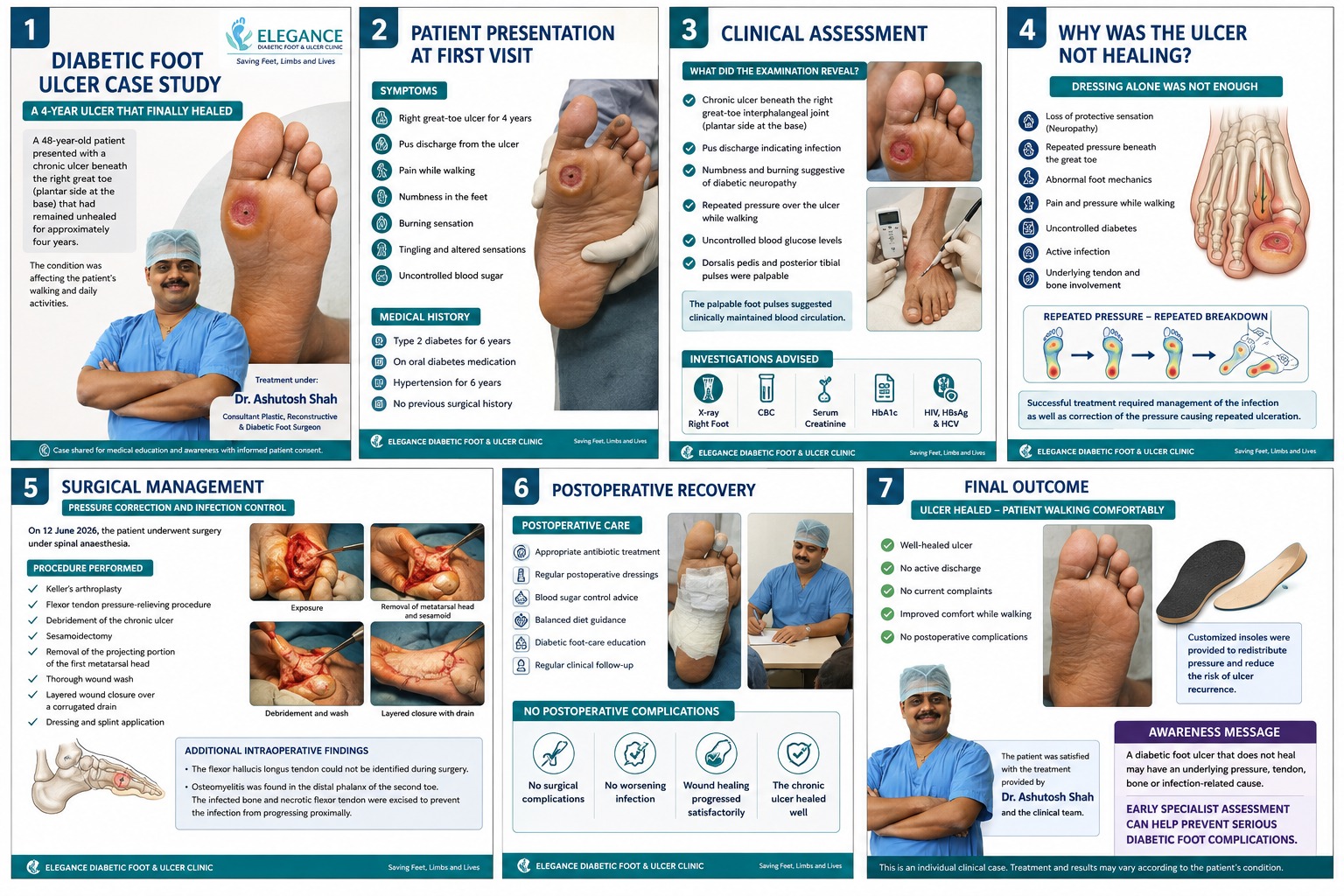
Written by Dr. Ashutosh Shah, Plastic & Microvascular Surgeon - Diabetic Foot & Limb Salvage Specialist, Elegance Diabetic Foot & Ulcer Clinic (EDFC), Surat. Practising since 2004 (22+ years). Read full bio.
Medically reviewed by Dr. Ashutosh Shah
Choosing a diabetic foot clinic in Jamnagar comes down to capability, not signage. A foot at risk needs circulation testing, infection control, debridement, offloading and reconstruction available together. If a service cannot do all five, ask early who does the parts it cannot.
Diabetic foot care goes wrong in a predictable way: the wound gets dressed for months while the circulation is never tested and the pressure is never taken off. This guide gives you eight things to check, each verifiable by asking one question, so you can judge any clinic or hospital for yourself.
Why does the choice matter so much?
Because outcomes in diabetic foot disease depend on how fast the right steps happen. The same wound can heal in weeks or end in amputation depending on whether blood supply was assessed early, infection was properly controlled and pressure was removed.
Time is the resource you cannot get back. Months spent on dressings alone are months during which infection can reach bone and circulation can worsen. That is why the first question is not who is nearest, but who can do the whole job.
The eight capabilities to check
1. Can they test your circulation properly?
Ask: will you check my pulses, and do you have Doppler or toe pressure testing? Blood supply decides whether any wound can heal, and it is the most commonly skipped step. A service that treats wounds without testing arteries is treating in the dark.
Ankle readings alone can mislead in long-standing diabetes because calcified vessels give falsely high values, so toe pressures or waveform assessment matter. This is the assessment we run through our vascular services.
2. Can they test sensation?
Ask: will you do a monofilament test? It takes a minute and tells you whether you have lost protective sensation, which changes your whole footwear and checking routine regardless of what the wound is doing.
3. Can they debride properly, and how often?
Ask: who removes the dead tissue and callus, and how frequently? Wounds do not heal under slough or a callused edge. Sharp debridement by a trained clinician, repeated as needed, is a core part of treatment rather than an occasional extra.
4. Can they offload the wound?
Ask: what will you use to take pressure off this wound? A wound crushed with every step cannot close, however good the dressing. Acceptable answers include total contact casting, a removable boot, or custom insoles and footwear.
If the answer is only "rest the foot", that is not offloading. Where deformity is the cause, corrective surgery may be needed instead, which is part of diabetic foot surgery.
5. Can they investigate bone infection?
Ask: how will you know if the bone is infected? A wound that will not heal for months often has osteomyelitis underneath. X-ray alone is not enough early on, since bone changes take weeks to appear, as explained in our post on bone infection of the diabetic foot.
6. Can they culture the right specimen?
Ask: where will the sample for culture come from? Surface swabs frequently grow bacteria that live on the wound rather than the ones causing deep infection, which leads to repeated ineffective antibiotic courses. Deep tissue or bone samples guide treatment far better.
7. Can they reconstruct, not just amputate?
Ask: if this wound cannot close on its own, what are the options? A service that can only offer dressings or amputation is missing the middle of the pathway, where skin grafts, flaps and corrective surgery sit. This is covered in our post on choosing a reconstructive foot surgeon.
8. Can they keep you healed afterwards?
Ask: what happens after this heals? Recurrence is common without custom insoles, protective footwear, regular callus care and scheduled review. A clinic that discharges you at wound closure has done half the job, which is why preventive foot care matters as much as treatment.
Clinic or hospital: which do you need?
It depends on how sick the foot is, not on preference. A stable ulcer can be managed in an outpatient clinic. Spreading infection, fever, wet gangrene or a threatened limb needs a diabetic foot hospital in Jamnagar or the nearest facility with inpatient surgery and imaging.
| Situation | Where to go |
|---|---|
| Callus, dry crack, thickened nails, no wound | Outpatient foot care |
| Stable ulcer, no fever, not spreading | Diabetic foot clinic, regular review |
| Ulcer not healing after four to six weeks | Specialist assessment including circulation and bone |
| Fever, spreading redness, pus, foul smell | Hospital, same day |
| Black or blue toe, cold painful foot | Hospital, same day |
What should you take with you?
Take everything that saves repeating tests. A complete file lets the first consultation reach a decision instead of ending with "come back after these investigations".
- All imaging and reports: X-ray, MRI, Doppler or angiogram, with films or CDs.
- Discharge summaries from previous admissions or surgery.
- Recent blood tests, including sugar control, haemoglobin and kidney function.
- A written list of your medicines.
- The footwear you wear daily.
- Dated photographs of the wound, which show whether it is improving.
When is a second opinion worth the travel?
When amputation has been advised without circulation testing, or a wound has stalled for months. Those are the two situations where another assessment most often changes the plan, and both are time-sensitive.
- Amputation recommended without a Doppler or angiogram having been done.
- A wound open for months with no cause ever named.
- Repeated antibiotic courses without deep culture or imaging.
- Exposed bone or tendon with no reconstruction discussed.
- Recurrent ulcers in the same spot with no correction of the pressure point.
The one exception: if there is fever, spreading redness, swelling or foul discharge, do not travel for an opinion. That needs treatment locally today. Our post on limb preservation surgery covers what a salvage assessment involves, and non-healing ulcer treatment covers why wounds stall.
Where is EDFC, and how can it help someone in Jamnagar?
Elegance Diabetic Foot & Ulcer Clinic is in Surat, not Jamnagar. We do not have a branch there, and we would rather say so than have someone with a threatened limb delay care on the assumption that we are local.
What we can offer someone in Jamnagar is a remote review of photographs and reports for non-urgent problems, guidance on which of the eight capabilities above your current care is missing, and an in-person assessment in Surat where a reconstructive or limb salvage opinion is genuinely needed. For anything urgent, use local emergency care first.
You can send clear photos of the foot with your reports to our team on WhatsApp and book a consultation. Wound care and surgical services are described under non-surgical wound management, and the conditions we treat under foot conditions we treat. Follow EDFC on Facebook, Instagram and YouTube.
Judge the capability, not the distance
Nearest is right for an emergency and for routine dressings. For a wound that is not healing, what matters is whether someone has tested your circulation, named a cause and taken pressure off the wound. Take the eight questions above to whichever clinic you choose.
Next step: if a wound has stalled or amputation has been advised without circulation testing, send your photos and reports to Dr. Ashutosh Shah at Elegance Diabetic Foot & Ulcer Clinic, Surat for an initial view on whether an in-person assessment is worth the journey.
Medical disclaimer: This article is for educational purposes only and is not a substitute for professional medical diagnosis or treatment. Elegance Diabetic Foot & Ulcer Clinic is located in Surat, Gujarat, and does not operate a facility in Jamnagar. Fever, spreading redness, swelling, foul discharge or a cold painful foot needs immediate local emergency care and should not wait for a remote opinion. Please consult a qualified specialist about your condition. For further guidance, see the NHS diabetes care information and the IWGDF diabetic foot guidelines.
quiz Frequently Asked Questions
This article is general education, not a diagnosis. If you have a diabetic foot wound, please have it assessed in person. Send a photo on WhatsApp or book a consultation.
About the Author

Dr. Ashutosh Shah, Plastic, Reconstructive & Diabetic Foot Surgeon, Elegance Diabetic Foot & Ulcer Clinic, Surat
Dr. Ashutosh Shah is a board certified plastic and reconstructive surgeon with over 22 years of experience and more than 10,000 limbs and feet saved. He founded Elegance Diabetic Foot & Ulcer Clinic, India's first chain of clinics dedicated to foot care, with centres in Surat and OPD partners across South Gujarat. He is known for a limb first approach, safe wound care and ethical, natural results.