Written by Dr. Ashutosh Shah, Plastic & Microvascular Surgeon - Diabetic Foot & Limb Salvage Specialist, Elegance Diabetic Foot & Ulcer Clinic (EDFC), Surat. Practising since 2004 (22+ years). Read full bio.
Medically reviewed by Dr. Ashutosh Shah
Affordable diabetic foot treatment in Jamnagar works on three levels: what you do yourself every day, what a clinic must do, and what needs a hospital. The most protective steps sit at the first level, and knowing when to move up is what prevents small problems becoming surgical ones.
Diabetic foot care is not one service. It is a tiered system, and most of the damage happens when someone stays at the wrong level too long, usually treating a wound at home that needed a clinician weeks earlier. This guide sets out who does what.
Level 1: what should you be doing yourself?
Prevention, inspection and protection. These steps prevent most ulcers from ever forming, and they need no equipment beyond a mirror and good light.
- Inspect both feet daily, including soles and between the toes, using a mirror or asking someone to look.
- Never walk barefoot, indoors or outdoors.
- Check inside footwear before wearing it, feeling for stones, seams and worn patches.
- Wash and dry the feet properly, especially between the toes, testing water temperature with your hand or elbow.
- Moisturise dry skin, avoiding between the toes.
- Wear footwear that fits, with room for the toes, and break new shoes in gradually.
- Keep blood sugar controlled and stop smoking, both of which change how a foot heals.
- Photograph anything new so you can tell whether it is changing.
What does not belong at this level: treating an ulcer. Home dressing of an open wound without clinical review is the commonest reason a small wound becomes a deep one. Also excluded are cutting or filing callus, trimming into the corners of nails, using chemical corn removers, and applying any home remedy to broken skin.
Move up a level if: you find any wound, blister, crack, dark spot or colour change, however small and however painless.
Level 2: what should a clinic be doing?
Assessment and active treatment. A clinic does what cannot be done at home and what decides whether a wound heals: finding the cause, removing dead tissue and taking pressure off.
- Circulation testing: pulses, Doppler, ankle brachial index or toe pressures, through services such as our vascular services.
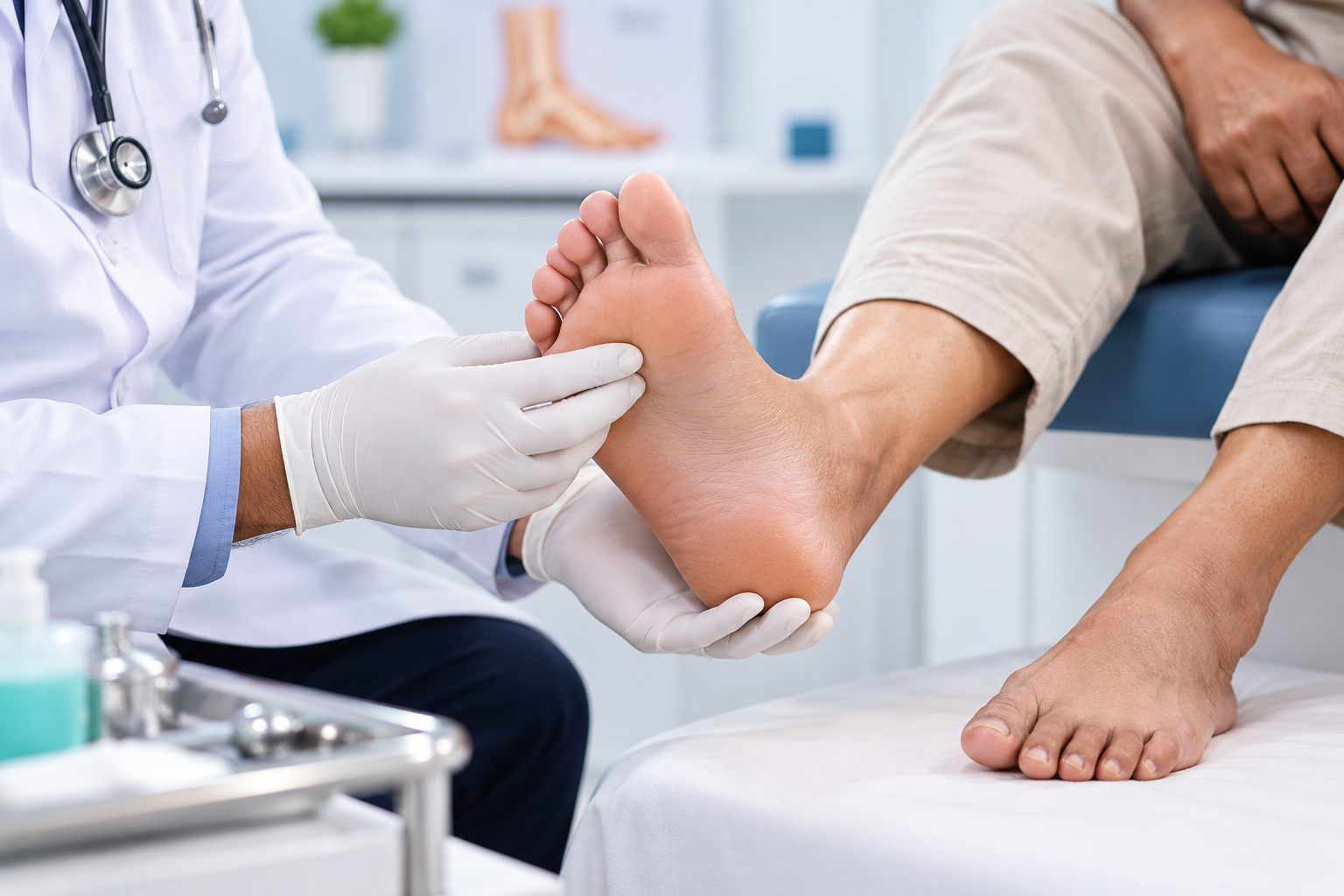
- Sensation testing with a monofilament, to establish whether protective feeling is intact.
- Sharp debridement of dead tissue and callused wound edges, repeated as needed.
- Offloading: casting, a boot, or custom insoles and footwear so the wound is not crushed with every step.
- Wound measurement and photography at each visit, so progress is objective.
- Appropriate dressings, chosen for the wound rather than by habit, as described under non-surgical wound management.
- Culture from the right site, with antibiotics guided by the result rather than given blind.
- Professional nail and callus care as part of preventive foot care.
What does not belong at this level: months of dressings with no cause named and no circulation test. If four weeks pass with no reduction in wound size, the plan needs to change rather than continue. That pattern is explored in our post on non-healing ulcer treatment.
Move up a level if: there is fever, spreading redness, swelling, pus, foul smell, a cold or blackening foot, or exposed bone in the wound.
Level 3: what needs a hospital?
Anything that threatens the limb or the person. These situations need inpatient care, imaging and surgery, the same day rather than at the next available appointment.
- Spreading infection or sepsis, with fever, chills or confusion.
- Abscess or pus under pressure needing surgical drainage.
- Wet gangrene or rapidly blackening tissue.
- A cold, pale or blue foot suggesting critically reduced blood supply.
- Bone infection needing imaging, bone sampling or surgery, covered in our post on bone infection of the diabetic foot.
- Revascularisation, where angioplasty or bypass is needed to restore flow.
- Reconstruction or limb salvage, including grafts and flaps through diabetic foot surgery, and discussed in our post on limb preservation surgery.
How do you know which level you are at right now?
| What you have | Level | Timing |
|---|---|---|
| Healthy feet, no wound, some numbness | Level 1 plus periodic review | Daily checks, review every few months |
| Callus, dry cracks, thick nails | Level 2 | Within weeks |
| Any open wound or blister | Level 2 | Within days |
| Wound not smaller after four weeks | Level 2, but the plan must change | Reassess now |
| Fever, spreading redness, pus, foul smell | Level 3 | Same day |
| Cold, pale, blue or blackening foot | Level 3 | Same day |
Why does staying at the wrong level cause harm?
Because every level has a ceiling. Daily inspection cannot heal an ulcer. Dressings cannot heal a wound with no blood supply. Antibiotics cannot clear pus trapped under pressure. When a problem exceeds the level treating it, time passes while the foot gets worse.
The commonest version is a wound dressed at home for months. Nothing visibly dramatic happens, which is exactly the danger: the wound deepens slowly, infection reaches bone, and what could have been settled by debridement and offloading becomes a surgical problem.
What makes treatment work at every level?
Consistency, not intensity. The steps that protect a diabetic foot best are unglamorous and repeated: looking at your feet, wearing the right footwear, treating small wounds early and keeping review appointments.
- Daily inspection, done properly rather than occasionally.
- Wearing the prescribed footwear all the time, not only outdoors.
- Reporting new wounds within days, not weeks.
- Attending scheduled reviews even when the foot feels fine.
- Blood sugar control, which affects healing at every level.
- Not stopping antibiotics early because the wound looks better.
Related problems across all three levels are listed under foot conditions we treat.
Where is EDFC, and how does that help someone in Jamnagar?
Elegance Diabetic Foot & Ulcer Clinic is in Surat, not Jamnagar. We have no branch there, and we would rather say so than have someone with a threatened foot assume local care is available from us.
For someone looking into affordable diabetic foot treatment in Jamnagar, the practical use of this page is knowing which level your foot is at, and insisting that whoever treats you does the Level 2 steps properly. If you want help judging a local provider, our companion post on choosing a diabetic foot clinic in Jamnagar gives eight questions to ask.
We can review clear photographs and reports remotely for non-urgent problems, and see patients in person in Surat where a limb salvage or reconstructive opinion is genuinely needed. You can send photos and reports on WhatsApp and book a consultation. For anything at Level 3, use local emergency care first. Follow EDFC on Facebook, Instagram and YouTube.
Do Level 1 every day, and move up early
Most feet are lost slowly, through weeks of care at a level that could never have solved the problem. The daily checks take five minutes and prevent most ulcers. When something appears, move up promptly rather than waiting to see.
Next step: if you have a wound that has not improved in four weeks, or amputation has been raised without circulation testing, send your photos and reports to Dr. Ashutosh Shah at Elegance Diabetic Foot & Ulcer Clinic, Surat for an initial view on what level of care your foot needs.
Medical disclaimer: This article is for educational purposes only and is not a substitute for professional medical diagnosis or treatment. Elegance Diabetic Foot & Ulcer Clinic is located in Surat, Gujarat, and does not operate a facility in Jamnagar. Fever, spreading redness, swelling, foul discharge or a cold painful foot needs immediate local emergency care. Please consult a qualified specialist about your condition. For further guidance, see the NHS guide to peripheral neuropathy and the IWGDF diabetic foot guidelines.
quiz Frequently Asked Questions
This article is general education, not a diagnosis. If you have a diabetic foot wound, please have it assessed in person. Send a photo on WhatsApp or book a consultation.
About the Author

Dr. Ashutosh Shah, Plastic, Reconstructive & Diabetic Foot Surgeon, Elegance Diabetic Foot & Ulcer Clinic, Surat
Dr. Ashutosh Shah is a board certified plastic and reconstructive surgeon with over 22 years of experience and more than 10,000 limbs and feet saved. He founded Elegance Diabetic Foot & Ulcer Clinic, India's first chain of clinics dedicated to foot care, with centres in Surat and OPD partners across South Gujarat. He is known for a limb first approach, safe wound care and ethical, natural results.