Written by Dr. Ashutosh Shah, Plastic & Microvascular Surgeon - Diabetic Foot & Limb Salvage Specialist, Elegance Diabetic Foot & Ulcer Clinic (EDFC), Surat. Practising since 2004 (22+ years). Read full bio.
Medically reviewed by Dr. Ashutosh Shah ·
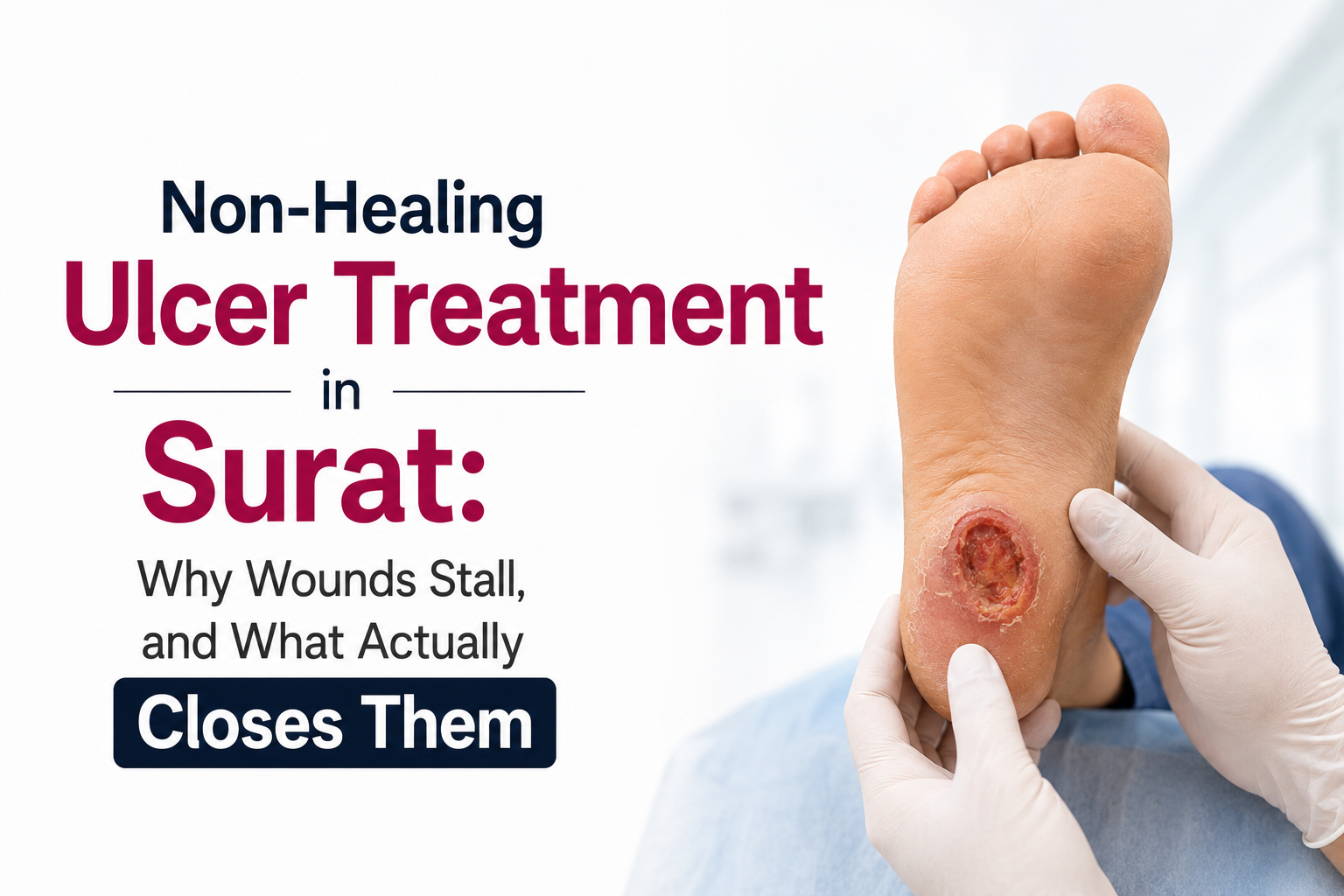
Non-healing ulcer treatment in Surat starts with finding why the wound stopped healing rather than changing the dressing again. Wounds stall for five main reasons: poor blood supply, infection, unrelieved pressure, dead tissue in the wound, and poor general health. Fix the cause and most wounds close.
A wound that has been dressed for six months is not a dressing problem. Healing is a biological process that fails only when something specific is blocking it, and that blockage is nearly always identifiable. This post explains what to look for and what proper treatment involves.
How long is too long for a wound to stay open?
A wound that has not reduced in size after four weeks of appropriate care, or has not healed by twelve weeks, is considered non-healing and needs its cause investigated. Waiting longer rarely helps and allows infection to reach deeper tissue.
The useful early sign is trajectory rather than closure. A healing wound gets visibly smaller week by week. If measurements are the same at four weeks as at the start, something is blocking the process and more of the same treatment will not change it.
What are the five reasons a wound stops healing?
Almost every stalled wound has one or more of five causes: inadequate blood supply, ongoing infection, continued pressure on the wound, dead tissue in the wound bed, or poor general health. Identifying which applies is the whole task.
- Poor blood supply. The commonest missed cause. Without arterial flow, no dressing works. Warning signs include cold feet, absent pulses and calf pain on walking, explained in our post on calf pain when walking with diabetes. Assessed and treated through our vascular services.
- Ongoing infection. Including deep infection or bone involvement that surface treatment never reaches.
- Continued pressure. A wound crushed with every step cannot close, however good the dressing. This may need corrective surgery such as Achilles tendon lengthening where a tight calf is driving forefoot pressure.
- Dead tissue or slough in the wound bed, which blocks new tissue from forming and needs removing. Where tissue has died completely, this becomes gangrene, covered in our post on diabetic gangrene treatment.
- General health factors: uncontrolled blood sugar, low protein, anaemia, kidney disease, smoking and certain medicines.
In practice these overlap. A patient may have moderate arterial disease, a low-grade infection and an uncorrected pressure point at once, and treating only one of the three explains why previous attempts failed.
Is every leg or foot ulcer a diabetic ulcer?
No, and treating the wrong type is a common reason for failure. Diabetic, arterial, venous and pressure ulcers look different, sit in different places and need different treatment. Compression, for instance, helps a venous ulcer but can be dangerous on an arterial one.
| Type | Typical site | Key features |
|---|---|---|
| Diabetic neuropathic | Sole, ball of foot, under a callus | Painless, punched out, surrounded by thick callus |
| Arterial | Toes, heel, outer ankle | Painful, pale or black base, cold foot, weak pulses |
| Venous | Inner ankle, lower leg | Shallow, wet, swollen leg, brown skin staining |
| Pressure | Heel, outer ankle, bony points | In immobile patients, over bone, from unrelieved pressure |
| Mixed | Any of the above | More than one cause together, needs careful assessment |
Many patients seen at our Surat clinic have mixed causes, which is precisely why a proper assessment matters more than a stronger dressing. The full range is listed under foot conditions we treat.
What should a proper assessment include?
A useful wound assessment covers the wound itself, the blood supply, the presence of infection or bone involvement, the mechanical cause, and the patient's general health. If none of these has been formally checked, the wound has not really been assessed.
- Wound measurement and photography, so progress is tracked objectively.
- Circulation testing: pulses, ankle brachial index, toe pressures or Doppler.
- Assessment for deep or bone infection, including probing and imaging where indicated.
- Culture from the right place, since surface swabs often mislead.
- Pressure and gait assessment to find what is loading the wound.
- Blood tests: sugar control, protein, haemoglobin, kidney function.
- Review of medicines that impair healing.
What does treatment look like once the cause is known?
Treatment is targeted at the specific blockage, not applied as a standard package. Blood flow is restored if it is inadequate, infection is treated with culture-guided antibiotics, dead tissue is removed, pressure is taken off, and the wound is closed once the bed is healthy.
- Revascularisation by angioplasty or bypass where arteries are blocked.
- Debridement of dead tissue and callused edges, repeated as needed.
- Culture-guided antibiotics rather than repeated blind courses.
- Offloading with casts, boots or custom footwear, and corrective surgery through diabetic foot surgery where deformity is the cause.
- Advanced dressings and negative pressure therapy under non-surgical wound management.
- Surgical closure with a skin graft or flap where the wound is too large to close on its own.
- Optimising sugar control, nutrition and anaemia throughout.
What should you expect from good wound care?
You should expect the wound to be measured, the blood supply to be checked, a specific cause to be named, and a plan with a timeline. If treatment has been dressings alone for months with no explanation of why it is not closing, it is reasonable to seek another opinion.
- Your wound measured and recorded at each visit, not just described.
- A named reason for why it has not healed.
- Circulation formally assessed, not assumed.
- A clear plan with review points, so you know if it is working.
- An explanation of what you must do, particularly offloading and footwear.
- A discussion of surgery if the wound is not closing with conservative care.
When should you seek care the same day?
Seek care immediately if there is fever, spreading redness, swelling, foul discharge or pus, if the foot becomes suddenly cold, pale or severely painful, or if the wound suddenly enlarges or turns black.
- Fever, chills or feeling generally unwell.
- Redness spreading up the foot or leg.
- Foul smell, pus or a sudden increase in discharge.
- A cold, pale or blue foot.
- Rapid enlargement or blackening of the wound.
Non-healing ulcer treatment at our Surat clinic
Elegance Diabetic Foot & Ulcer Clinic (EDFC) is based in Surat and led by Dr. Ashutosh Shah, a plastic and microvascular surgeon specialising in diabetic foot care, chronic wounds and limb salvage. For non-healing ulcer treatment in Surat, the clinic provides wound assessment, circulation testing, infection management, debridement, advanced dressings, reconstructive surgery and long term foot protection in one place.
You can also send clear photos of the wound, along with any reports, to our team on WhatsApp for initial guidance and book an assessment. If there is fever, spreading redness or foul discharge, please come in or attend hospital the same day. Follow EDFC on Facebook, Instagram and YouTube for wound care guidance and real limb salvage stories.
Change the question, not the dressing
If a wound has been open for months, the question worth asking is not which dressing to try next. It is what is stopping this wound from healing, and has anyone actually checked. In most cases the answer is findable, and once found, the wound closes.
Next step: book a wound and circulation assessment with Dr. Ashutosh Shah at Elegance Diabetic Foot & Ulcer Clinic, Surat, call +91 83205 00350, or send photos and reports on WhatsApp today.
Medical disclaimer: This article is for educational purposes only and is not a substitute for professional medical diagnosis or treatment. The cause of a non-healing wound can only be determined by in-person assessment including circulation testing. Fever, spreading redness or foul discharge needs urgent care. Please consult Dr. Ashutosh Shah or a qualified specialist about your condition. For further guidance, see the NHS guide to leg ulcers and the IWGDF diabetic foot guidelines.
This article is general education, not a diagnosis. If you have a diabetic foot wound, please have it assessed in person. Send a photo on WhatsApp or book a consultation.
About the Author

Dr. Ashutosh Shah, Plastic, Reconstructive & Diabetic Foot Surgeon, Elegance Diabetic Foot & Ulcer Clinic, Surat
Dr. Ashutosh Shah is a board certified plastic and reconstructive surgeon with over 22 years of experience and more than 10,000 limbs and feet saved. He founded Elegance Diabetic Foot & Ulcer Clinic, India's first chain of clinics dedicated to foot care, with centres in Surat and OPD partners across South Gujarat. He is known for a limb first approach, safe wound care and ethical, natural results.