
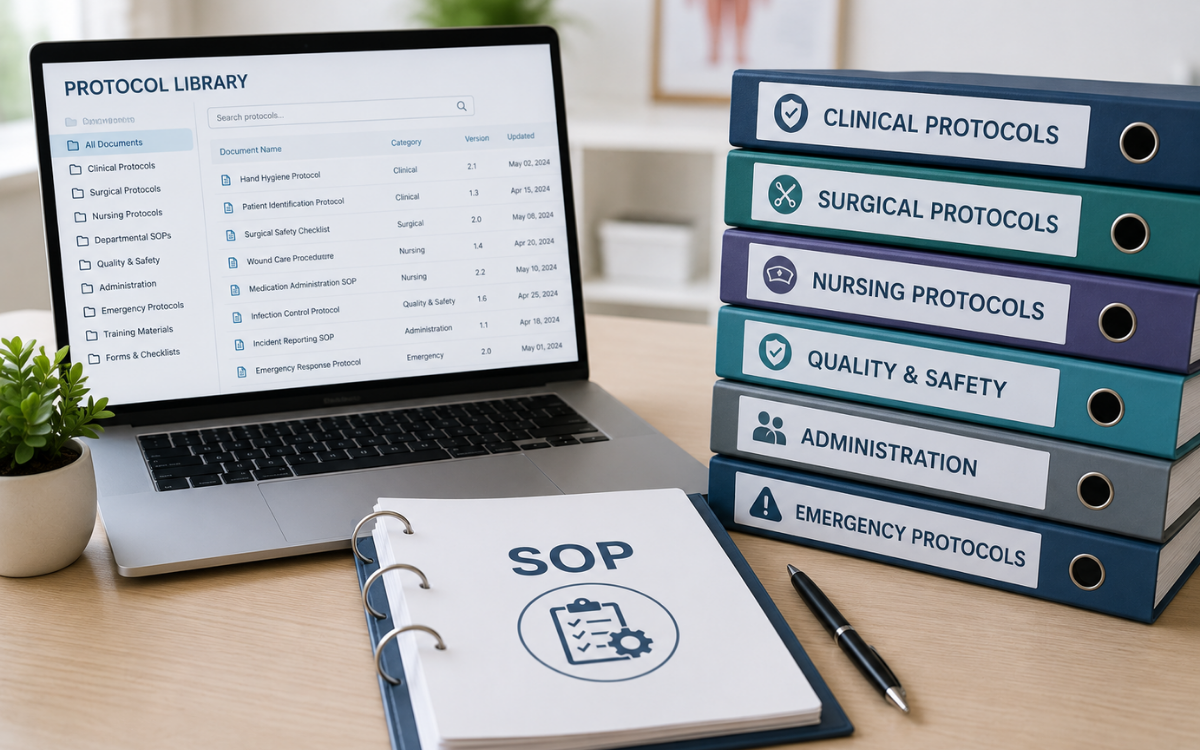
SOP & Protocol Library
A working library of clinical and operational procedures your whole team can follow.
Key Takeaways
- Protocols keep care consistent when the founding doctor is unavailable.
- They shorten training for every staff member who joins later.
- Referral thresholds are the most important protocols in diabetic foot care.
- The library is updated as evidence and practice change.
What Does the Library Contain?
- Assessment protocols covering neuropathy, vascular and pressure testing
- Risk categorisation and review interval rules
- Wound care procedures including debridement and dressing selection
- Offloading decision rules by ulcer site and patient circumstance
- Infection recognition and antibiotic guidance
- Referral thresholds, including the same day list
- Operational procedures for sterilisation, waste, records and appointments
Why Do Small Clinics Need Protocols?
Because consistency must survive the founder's absence. When you are away or the clinic gets busy, a documented standard is what stops care quietly drifting. Without one, each staff member develops their own approach and quality becomes unpredictable.
Additionally, protocols make training tractable. A new nurse can be brought to a working standard in weeks rather than absorbing habits over a year.
Which Protocols Matter Most?
The referral thresholds, without question. Knowing precisely which findings demand same day escalation, spreading infection, exposed bone, absent pulses with a wound, or a hot swollen foot without injury, prevents the delays that cost limbs.
Everything else improves outcomes gradually. Those save them abruptly.
Are Protocols Rigid?
No, and they should not be. They define the standard approach and the escalation points, while clinical judgement handles the cases that do not fit. Their purpose is to prevent avoidable variation, not to replace thinking.
How Are Updates Handled?
The library is revised as evidence and practice change, and partner centres receive updates as part of ongoing support alongside staff training. There is no additional charge for revisions.
How Are Protocols Introduced to a Team?
Gradually, and with the reasoning explained. Handing a team a folder achieves nothing, since staff follow rules they understand and quietly work around ones they do not.
So each protocol is introduced with the failure it prevents. Once a nurse has seen why a wound must be measured at every visit rather than described, the rule stops feeling like paperwork and starts being clinical practice.