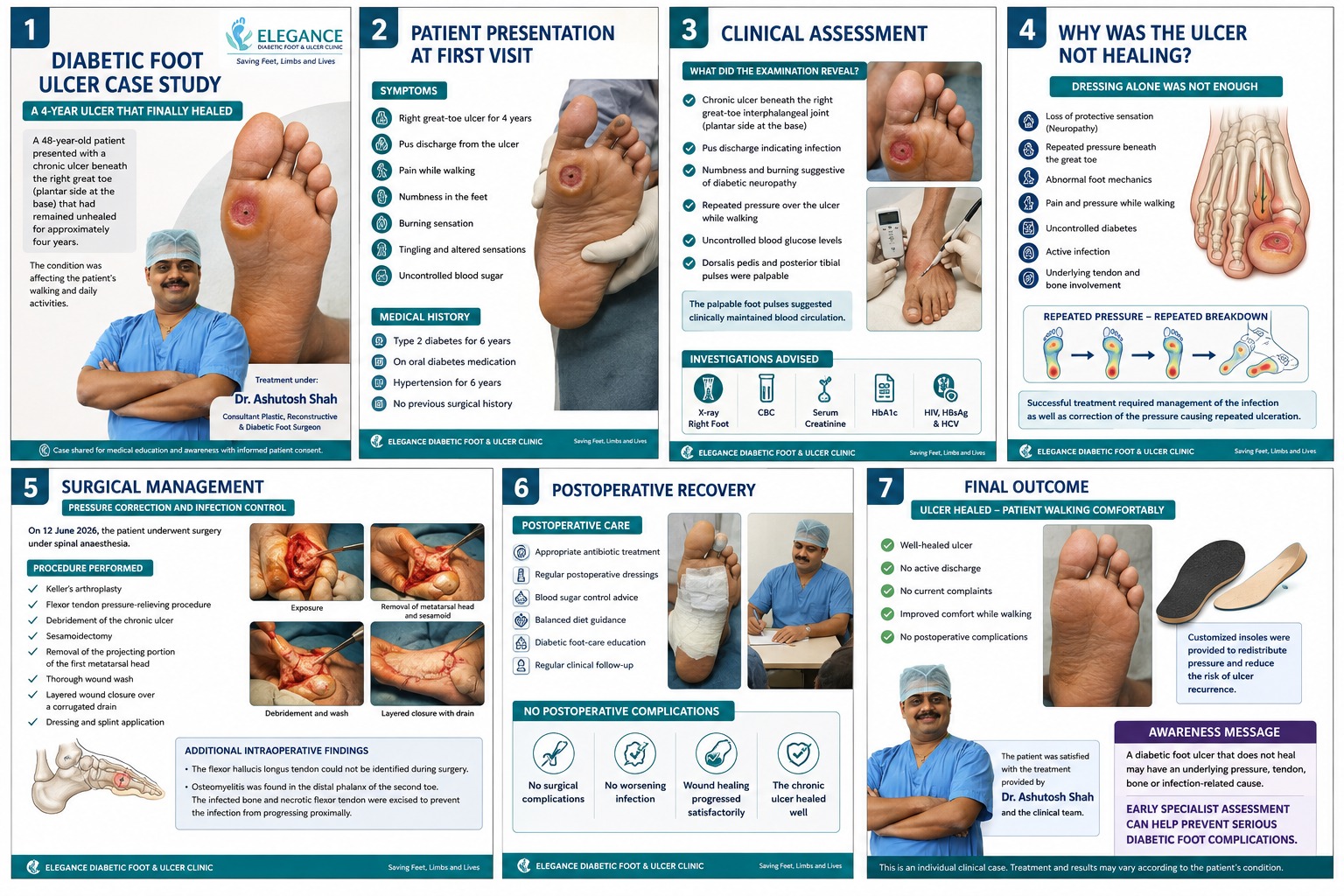

An ulcer that has not reduced by about 50 percent in four weeks will not heal on the current plan. The five usual causes are inadequate offloading, poor circulation, hidden infection or bone involvement, poor sugar and nutrition, and a wrong dressing choice.
At Elegance Diabetic Foot & Ulcer Clinic (EDFC), Dr. Ashutosh Shah and the diabetic foot care team treat a diabetic foot ulcer not healing as a reason for structured reassessment rather than simply continuing the same dressing. Pressure, circulation, infection, bone involvement, glucose control and nutrition all need to be reviewed to identify what is preventing progress.
What Is Normal Healing Progress Week by Week?
A diabetic foot ulcer does not necessarily close within a few days. What matters is whether there is measurable progress from one review to the next.
During the first week, treatment focuses on identifying the cause of the wound, controlling infection if present, removing unhealthy tissue when appropriate and reducing pressure on the ulcer.
Over the following weeks, the wound should show signs of progress. These may include less unhealthy tissue, healthier granulation tissue, controlled drainage and a gradual reduction in wound area.
The wound should therefore be measured consistently rather than judged only by appearance. Length, width and depth should be documented so the treatment team can compare the ulcer with previous visits.
If a diabetic foot ulcer not healing shows little measurable improvement despite several weeks of treatment, simply continuing the same plan may waste valuable time.
Patients who repeatedly develop wounds may also need assessment for the factors discussed under Recurrent ulcers.
What Does the 50 Percent at Four Weeks Rule Mean?
The four-week point provides an important opportunity to judge whether the current treatment strategy is working.
As specified in this treatment framework, an ulcer that has not reduced by approximately 50% after four weeks is unlikely to heal satisfactorily on the existing plan.
This does not mean that every ulcer should be completely healed within four weeks. Instead, the change in wound size acts as a progress marker.
For example, if an ulcer started with an area of 4 cm² and remains close to the same size four weeks later, something may still be preventing healing.
A diabetic foot ulcer not healing at the expected rate should trigger questions such as:
- Is the patient actually offloading the wound?
- Is blood flow adequate?
- Is infection being missed?
- Could infection have reached the bone?
- Is glucose control interfering with healing?
- Is nutrition adequate?
- Is the current wound-care approach appropriate?
The response should be reassessment, not simply another month of the same treatment.
Which Five Causes Explain Most Stalled Ulcers?
When a wound becomes stuck and stops closing, five areas deserve particular attention.
1. Inadequate Offloading
A plantar ulcer may be dressed correctly but still fail to heal if the patient continues putting pressure on it.
This is especially common when neuropathy reduces pain. Because walking does not hurt, the patient may not realise that each step is repeatedly stressing newly healing tissue.
The offloading method and actual patient adherence should therefore be reviewed.
2. Poor Circulation
Healing tissue needs an adequate blood supply.
If circulation is poor, oxygen and nutrients may not reach the wound sufficiently. Peripheral arterial disease can therefore cause an ulcer to remain open despite apparently appropriate wound care.
Vascular status should be reassessed rather than assuming an earlier circulation result remains adequate.
3. Hidden Infection or Bone Involvement
Not every infection produces dramatic redness, swelling or pain, particularly in a neuropathic diabetic foot.
A deep ulcer may contain infection that is not obvious from the surface. Infection can also extend to bone, producing osteomyelitis.
Persistent deep wounds, exposed or palpable bone, recurrent discharge and other suspicious findings may require investigation for Osteomyelitis.
4. Poor Sugar Control or Nutrition
High glucose levels can interfere with several processes involved in wound healing and infection control.
Nutrition matters as well. A patient needs adequate energy, protein and appropriate micronutrients to rebuild damaged tissue. Poor intake, significant weight loss or other nutritional problems should not be overlooked when evaluating a stalled ulcer.
HbA1c and nutritional status should therefore form part of the reassessment.
5. The Current Dressing or Wound-Care Plan Is No Longer Appropriate
The needs of a wound can change as it heals.
A heavily draining wound may require a different approach from a relatively dry wound. Necrotic tissue, excess moisture, surrounding skin damage or other wound-bed problems can also influence the choice of dressing and treatment.
The answer is not necessarily to use a more expensive dressing. The wound first needs to be reassessed so treatment addresses its current condition.
Appropriate Wound care should work alongside pressure relief, infection control and adequate circulation rather than being treated as the only solution.
Which Tests Should Be Repeated at Week Four?
A diabetic foot ulcer not healing after four weeks deserves a structured reassessment.
Week 4 Reassessment Checklist
| What is reassessed? | Failing result | Action it triggers | Urgency |
|---|---|---|---|
| Wound measurement trend | Little reduction or wound becoming larger | Reassess the entire treatment plan | This week |
| Offloading compliance | Continued unprotected weight-bearing | Change or strengthen offloading strategy | This week |
| Vascular status | Evidence of inadequate perfusion | Further vascular assessment/intervention | This week or urgent depending on severity |
| Infection markers | Clinical or laboratory evidence of infection | Investigate and treat infection | Same day if infection is spreading/systemic |
| Probe to bone | Bone can be reached or bone involvement is suspected | Investigate for osteomyelitis | Prompt assessment |
| Nutrition | Poor intake, weight loss or nutritional deficiency concerns | Nutritional assessment and correction | This week |
| HbA1c/glucose control | Persistently poor glucose control | Review diabetes management | This week |
Previous test results should not automatically end the investigation. The patient's circulation, infection and wound characteristics may have changed during those four weeks.
What Changes in the Plan: Offloading, Circulation, Infection or Nutrition?
Once the reason for stalled healing has been identified, treatment should target that problem.
If continued pressure is the main issue, offloading needs to be improved. This may mean reviewing footwear, a walker, casting or another pressure-relieving strategy.
If circulation is inadequate, vascular assessment becomes a priority. A wound cannot be expected to heal normally if the tissue does not receive sufficient blood flow.
If infection is suspected, the clinician needs to determine its extent. A deep infection or possible bone involvement requires a different approach from a superficial wound problem.
Nutrition and glucose management should also be addressed rather than considered separate from wound treatment.
Some wounds may benefit from Advanced wound therapies, but these should not substitute for correcting fundamental problems such as inadequate blood supply, infection or continued pressure.
For a diabetic foot ulcer not healing, the question at week four should therefore be: what is still blocking healing, and what specifically needs to change?
Which Stalled Ulcers Are Actually an Emergency in Disguise?
Not every stalled ulcer can safely wait for a routine follow-up.
A wound that has stopped improving may actually be worsening because of infection, loss of circulation or deeper tissue involvement.
Seek urgent medical assessment if a non-healing ulcer develops:
- rapidly spreading redness or swelling
- foul smell or increasing discharge
- black, blue or suddenly discoloured tissue
- fever, chills or systemic illness
- sudden increase in wound depth
- exposed or suspected infected bone
- rapidly worsening tissue breakdown
- new severe pain or an unexpectedly painful foot
These findings should not be treated as an ordinary four-week healing delay.
A diabetic foot ulcer not healing alongside signs of spreading infection, severe ischaemia or systemic illness may require same-day hospital assessment rather than another dressing appointment.
Conclusion: Four Weeks Without Progress Means the Plan Needs Reassessment
A diabetic foot ulcer not healing after four weeks should not automatically receive another month of unchanged treatment. Failure to make expected progress is a signal to reassess why healing has stalled.
The five major areas to review are offloading, circulation, hidden infection or bone involvement, glucose and nutrition, and the wound-care strategy. Measurements and relevant investigations help identify which of these is preventing progress.
Most importantly, a stalled wound accompanied by spreading redness, swelling, foul smell, fever, tissue discolouration or other signs of deterioration should not wait for a routine follow-up. These changes may indicate an urgent diabetic foot problem requiring prompt assessment.
quiz Frequently Asked Questions
This article is general education, not a diagnosis. If you have a diabetic foot wound, please have it assessed in person. Send a photo on WhatsApp or book a consultation.
About the Author

Dr. Ashutosh Shah, Plastic, Reconstructive & Diabetic Foot Surgeon, Elegance Diabetic Foot & Ulcer Clinic, Surat
Dr. Ashutosh Shah is a board certified plastic and reconstructive surgeon with over 22 years of experience and more than 10,000 limbs and feet saved. He founded Elegance Diabetic Foot & Ulcer Clinic, India's first chain of clinics dedicated to foot care, with centres in Surat and OPD partners across South Gujarat. He is known for a limb first approach, safe wound care and ethical, natural results.