Hyperbaric oxygen therapy (HBOT) is an add-on, not a first treatment, for diabetic foot ulcers. The IWGDF 2023 guideline suggests considering it for ischaemic or neuro-ischaemic ulcers that have not healed despite standard care, including offloading, debridement and revascularisation where possible. It is unsuitable with an untreated pneumothorax and usually needs many daily sessions.
Diabetic foot ulcer hyperbaric oxygen therapy (HBOT) is an add-on treatment, not the first treatment for a diabetic foot ulcer. IWGDF guidance suggests considering systemic HBOT for selected ischaemic or neuro-ischaemic ulcers when appropriate standard care has not been enough. Offloading, wound care, infection control and restoration of blood flow where needed remain fundamental.
Key Takeaways
- HBOT is not required for every diabetic foot ulcer.
- It is considered an adjunct to standard care, rather than a replacement for it.
- Selected people with difficult-to-heal ischaemic or neuro-ischaemic ulcers may be considered for HBOT.
- Blood flow and vascular status should be assessed before deciding whether oxygen therapy is appropriate.
- An untreated pneumothorax is an important contraindication to HBOT.
- A course usually involves repeated treatment sessions rather than one visit.
- Topical oxygen therapy and systemic HBOT are different treatments.
- The underlying causes of a non-healing ulcer still need to be addressed.
What Does Hyperbaric Oxygen Do to a Wound?
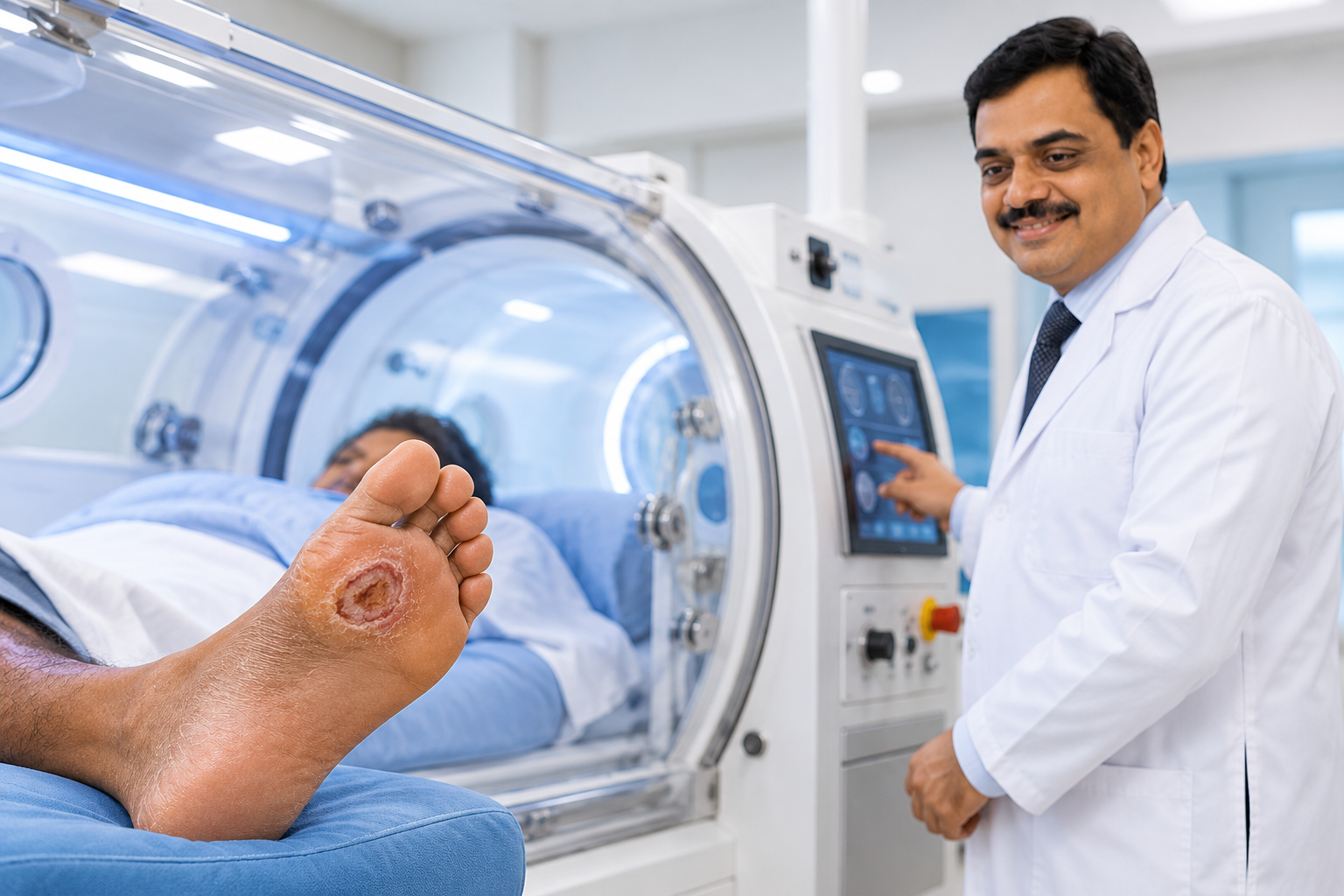
During systemic hyperbaric oxygen therapy, a patient enters a specially designed chamber and breathes oxygen while the chamber is pressurized above normal atmospheric pressure.
Under these conditions, more oxygen can dissolve in the blood plasma.
The purpose is to temporarily increase oxygen delivery to tissues. In a selected difficult-to-heal wound, increased tissue oxygen may support some biological processes involved in healing.
However, this does not mean oxygen alone can heal a diabetic foot ulcer.
If a patient continues walking on an inadequately offloaded plantar ulcer, has untreated infection or has severely impaired arterial supply that requires vascular intervention, placing the patient in a hyperbaric chamber does not correct those underlying problems.
HBOT therefore needs to be considered within a complete diabetic foot treatment plan.
Why Isn't HBOT the First Treatment for Every Diabetic Foot Ulcer?
A diabetic foot ulcer can remain open for many different reasons.
These include:
- Repeated mechanical pressure
- Loss of protective sensation
- Peripheral arterial disease
- Infection
- Necrotic tissue
- Foot deformity
- Poor glucose control
- Inappropriate footwear
- Inadequate wound care
The first priority is to identify which factors are affecting the individual wound.
Appropriate standard wound care can include wound assessment, debridement when indicated, suitable dressings, infection management and regular measurement of healing progress.
For plantar neuropathic ulcers, appropriate offloading is particularly important.
If arterial disease is limiting blood flow, the vascular problem also needs assessment rather than assuming additional oxygen treatment can replace restoration of circulation.
Which Ulcers Qualify Under the IWGDF 2023 Guideline?
The IWGDF 2023 wound-healing guidance does not recommend routine systemic HBOT for every person with a diabetic foot ulcer.
It suggests considering systemic hyperbaric oxygen as an adjunctive treatment for selected neuro-ischaemic or ischaemic diabetes-related foot ulcers when standard care alone has failed and resources are available.
The word “adjunctive” is important.
It means HBOT is added to appropriate diabetic foot ulcer care. It does not replace that care.
A patient being considered for HBOT for diabetic foot therefore needs an assessment of the wound and the reasons it has failed to heal.
People with ischaemic ulcers may require particular attention to arterial circulation and whether vascular treatment is possible.
What Should Be Checked Before Considering HBOT?
The decision should begin with a complete assessment rather than simply asking whether a hyperbaric chamber is available.
Important questions include:
What type of ulcer is present?
A neuropathic ulcer with good perfusion is different from an ischaemic or neuro-ischaemic ulcer.
Has appropriate standard treatment been provided?
The clinician should review wound care, debridement, offloading, infection management and other relevant treatment.
Is blood supply adequate?
Peripheral arterial disease should be assessed and revascularisation considered when clinically indicated.
Is infection being treated?
HBOT should not be used as a substitute for appropriate infection management.
Is the wound actually improving?
Serial measurements help determine whether the ulcer is responding to the existing treatment plan.
Why Is Vascular Assessment Important Before HBOT?
Oxygen cannot reach tissue effectively without adequate circulation.
For this reason, an assessment of perfusion is particularly relevant when considering oxygen-based treatment for an ischaemic or neuro-ischaemic wound.
A vascular assessment may include clinical examination and appropriate non-invasive tests according to the patient's condition.
In selected patients, transcutaneous oxygen pressure, or TcPO2, can provide information about tissue oxygenation and may contribute to treatment planning.
At EDFC, TcPO2 may be assessed before referral for HBOT when clinically appropriate. The overall wound, vascular findings and response to standard care are considered rather than making a decision from one number alone.
HBOT Eligibility Checklist
The following provides a practical framework. It is not a substitute for individual medical assessment.
| Factor | What Needs to Be Considered |
|---|---|
| Ulcer type | Ischaemic or neuro-ischaemic ulcer may be considered in selected circumstances |
| Standard care | Has appropriate wound care already been provided without adequate healing? |
| Offloading | Has damaging mechanical pressure been adequately addressed? |
| Blood flow | Is vascular assessment complete and has revascularisation been considered where appropriate? |
| TcPO2/perfusion | Tissue oxygenation testing may contribute to selection in appropriate patients |
| Infection | Infection requires appropriate treatment; HBOT is not a replacement for infection control |
| Wound progress | Serial wound measurements help determine whether healing has stalled |
| Pneumothorax | Untreated pneumothorax is a contraindication |
| Medicines | Medication history should be reviewed because some drugs require special consideration |
| Seizure history | Uncontrolled seizure disorders require careful specialist assessment |
| Claustrophobia | Severe claustrophobia may make chamber treatment difficult |
| Ability to attend | A course may require numerous sessions, making adherence important |
Eligibility cannot be decided from a photograph of the ulcer alone.
Who Should Not Have HBOT?
An untreated pneumothorax is the major absolute contraindication to hyperbaric oxygen treatment because pressure changes can create a serious risk.
Other conditions require individualized assessment rather than automatically excluding every patient.
These can include certain lung conditions, seizure disorders, problems equalizing ear pressure, severe claustrophobia and the use of particular medicines.
Some chemotherapy agents and other medications may require special consideration depending on timing and the individual clinical situation.
This is why a complete medical and medication history is required before treatment.
The hyperbaric medicine team should determine whether HBOT can be given safely.
Hyperbaric Oxygen Therapy Near Vizianagaram: Who Should Be Referred?
A patient looking for hyperbaric oxygen therapy near Vizianagaram should first have the diabetic foot ulcer properly assessed rather than going directly to a hyperbaric chamber simply because the wound has not healed.
The assessment should establish whether the ulcer is neuropathic, ischaemic or neuro-ischaemic; whether pressure has been controlled; whether infection is present; and whether arterial disease requires treatment.
When standard treatment is appropriate but a selected difficult-to-heal ischaemic or neuro-ischaemic ulcer remains problematic, HBOT can then be discussed as a possible adjunct.
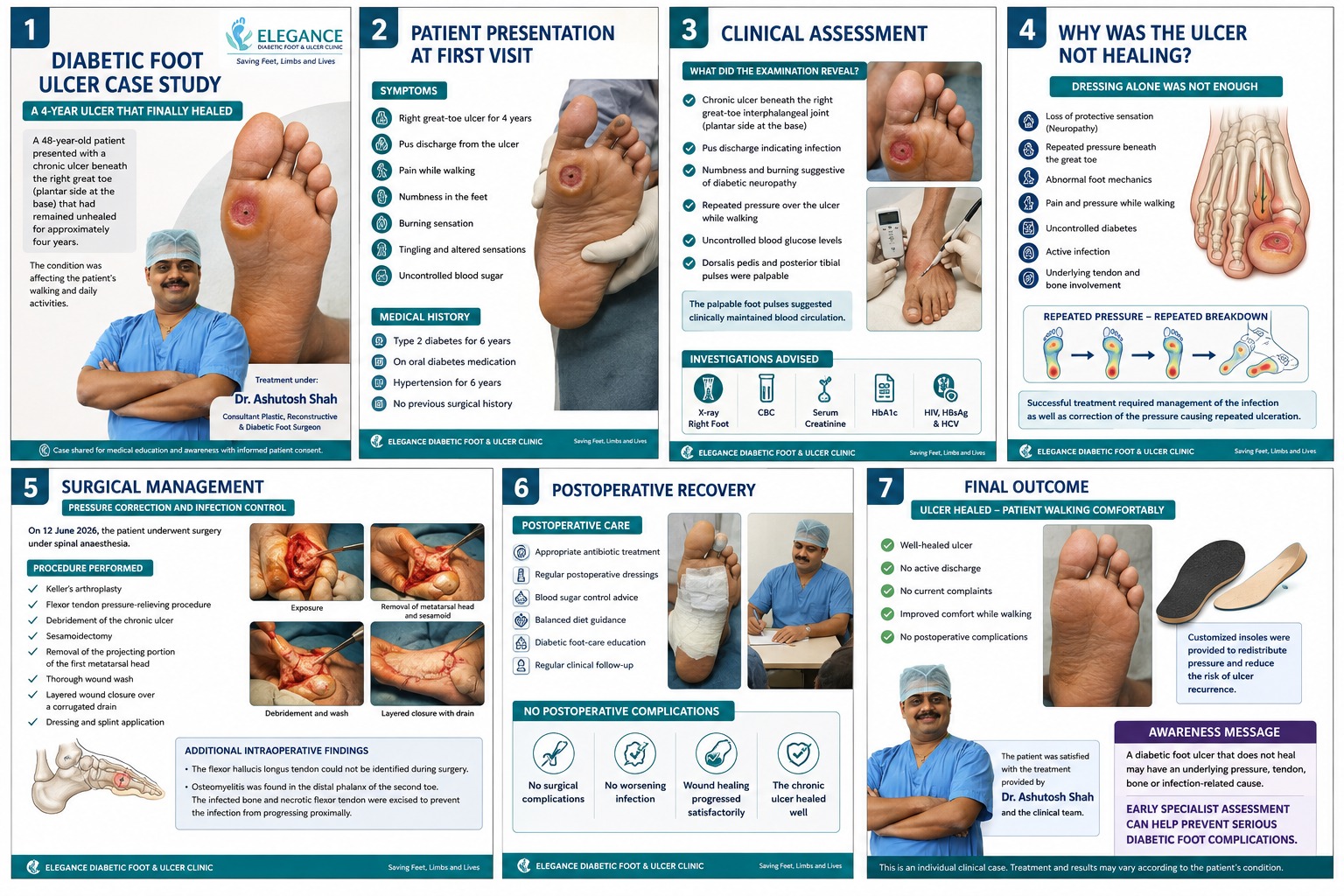
At Elegance Diabetic Foot & Ulcer Clinic (EDFC), the treatment decision is reviewed in the context of the complete wound assessment under Dr. Ashutosh Shah, Consultant Plastic, Reconstructive & Diabetic Foot Surgeon.
How Many HBOT Sessions Are Needed?
HBOT is usually not a one-session treatment.
Treatment protocols vary according to the indication, hyperbaric facility and patient's clinical condition. A diabetic foot treatment course may involve multiple sessions over several weeks.
A typical session involves entering a monoplace or multiplace chamber, increasing the chamber pressure according to the prescribed protocol, breathing oxygen for the treatment period and then gradually returning the chamber to normal pressure.
The exact number and duration of sessions should be prescribed by the treating hyperbaric medicine team.
Patients should be cautious about packages that promise healing after a predetermined number of sessions without considering the wound's response.
What Does a Course of HBOT Involve?
Before treatment begins, the patient undergoes safety screening.
During each session, pressure gradually increases inside the chamber. Patients may notice pressure in their ears similar to the sensation experienced during aircraft take-off or landing.
The treatment team explains techniques for equalizing ear pressure.
Depending on the chamber type, the patient may lie inside a transparent monoplace chamber or receive treatment in a larger multiplace chamber.
After treatment, the chamber is gradually decompressed.
Wound care outside the chamber continues throughout the course.
How Should the Ulcer Be Monitored During HBOT?
HBOT should not become a reason to stop measuring the wound.
The clinical team should continue monitoring ulcer size, depth, infection, surrounding tissue, pressure management and overall progress.
At EDFC, ulcer area can be measured regularly during the treatment course to determine whether the wound is moving in the right direction.
If the ulcer is deteriorating, the treatment plan needs reassessment.
Possible reasons may include ongoing pressure, worsening infection, inadequate perfusion or another unrecognized problem.
A patient should not simply continue chamber sessions indefinitely without reviewing why the wound is failing to respond.
Can HBOT Replace Revascularisation?
No.
If clinically significant peripheral arterial disease is restricting blood supply to the foot, the patient should be assessed to determine whether revascularisation is appropriate.
HBOT increases oxygen availability under pressure, but it does not mechanically open a severely narrowed or blocked artery.
That distinction is essential.
For an ischaemic diabetic foot ulcer, vascular assessment and restoration of blood flow where possible remain important components of limb-preservation care.
Can HBOT Replace Debridement or Offloading?
No.
HBOT does not remove dead tissue from a wound, and it does not remove mechanical pressure from the sole of the foot.
A plantar ulcer can continue breaking down if a patient repeatedly loads the same area while walking.
Similarly, necrotic or infected tissue may require appropriate debridement when clinically indicated.
This is why advanced wound therapies are generally considered after the basic causes of failed healing have been identified and appropriately addressed.
Advanced technology should support good diabetic foot care rather than replace it.
How Does Topical Oxygen Therapy Compare?
Topical oxygen therapy for wounds is not the same as systemic hyperbaric oxygen therapy.
With systemic HBOT, the whole patient is placed inside a pressurized chamber and breathes oxygen.
Topical oxygen delivers oxygen locally to the wound using a specialized device.
| Feature | Systemic HBOT | Topical Oxygen Therapy |
|---|---|---|
| Oxygen delivery | Patient breathes oxygen under increased atmospheric pressure | Oxygen is delivered directly around the wound |
| Whole body in chamber? | Yes | No |
| Pressurized hyperbaric chamber? | Yes | No systemic chamber exposure |
| Main treatment location | Hyperbaric medicine facility | Depends on the topical oxygen system |
| Pressure-related ear problems | Possible | Not the same systemic pressure exposure |
| Role in DFU care | Adjunct for selected difficult-to-heal ulcers | May be considered as an adjunct for selected difficult-to-heal ulcers |
| Replaces standard wound care? | No | No |
The two therapies should therefore not be presented as interchangeable simply because both involve oxygen.
What About Hyperbaric Oxygen Therapy Cost in India?
The hyperbaric oxygen therapy cost in India varies considerably between facilities.
The total cost depends on the number of prescribed sessions, chamber type, hospital or standalone facility, medical supervision, wound-care requirements and whether additional investigations are required.
A per-session price alone can therefore be misleading.
Before starting treatment, patients should ask:
Why is HBOT being recommended for this specific ulcer?
Has appropriate standard care already been optimized?
How will wound improvement be measured?
What happens if the ulcer fails to respond?
Clinical suitability should be established before comparing treatment packages based solely on price.
Can HBOT Prevent Amputation?
This question needs a careful answer.
HBOT should not be promoted as a guaranteed method of preventing amputation.
Diabetic foot amputation risk depends on many factors, including infection severity, tissue death, blood supply, wound depth, bone infection, systemic illness and how quickly appropriate treatment is provided.
In selected patients, HBOT may be considered as part of a broader limb-preservation strategy.
But successful limb salvage may also depend on infection control, revascularisation, debridement, pressure relief, wound management and metabolic control.
No single therapy can replace these components.
The Most Important Point About HBOT
The main question should not be:
“Where is the nearest hyperbaric chamber?”
It should be:
“Why is this diabetic foot ulcer not healing, and is HBOT appropriate for this particular wound?”
For some selected difficult-to-heal ischaemic or neuro-ischaemic ulcers, diabetic foot ulcer hyperbaric oxygen therapy may be considered as an additional treatment.
For many other ulcers, correcting pressure, treating infection, improving wound care or addressing poor blood flow may be more important.
At Elegance Diabetic Foot & Ulcer Clinic (EDFC), assessment under Dr. Ashutosh Shah focuses on identifying the reasons a diabetic foot wound is failing to heal before advanced therapies are considered.
HBOT is therefore best understood as one possible tool within comprehensive diabetic foot care not a replacement for it.
quiz Frequently Asked Questions
This article is general education, not a diagnosis. If you have a diabetic foot wound, please have it assessed in person. Send a photo on WhatsApp or book a consultation.
About the Author

Dr. Ashutosh Shah, Plastic, Reconstructive & Diabetic Foot Surgeon, Elegance Diabetic Foot & Ulcer Clinic, Surat
Dr. Ashutosh Shah is a board certified plastic and reconstructive surgeon with over 22 years of experience and more than 10,000 limbs and feet saved. He founded Elegance Diabetic Foot & Ulcer Clinic, India's first chain of clinics dedicated to foot care, with centres in Surat and OPD partners across South Gujarat. He is known for a limb first approach, safe wound care and ethical, natural results.