
Written by Dr. Ashutosh A Shah, M.B.B.S., M.S., M.Ch., D.N.B., Diabetic Foot and Limb Salvage Surgeon, Elegance Diabetic Foot & Ulcer Clinic, Surat. Reg. no. [REG NO]. 22+ years in reconstructive and diabetic foot surgery.
Medically reviewed by Dr. Ashutosh A Shah · Published 22 September 2026 · Last reviewed 22 September 2026
Most diabetic amputations begin as a small ulcer that was treated too late. The limb is usually saved by acting at four points: daily foot checks, getting any non-healing wound seen within two weeks, offloading pressure off the wound, and restoring blood flow before infection reaches bone.
The word amputation makes people stop reading, which is unfortunate, because almost everything that decides the outcome happens long before anyone says it out loud. By the time amputation is genuinely on the table, four earlier opportunities have usually been missed.
This post is about those four opportunities. Not statistics, not worst cases, just the specific decisions that prevent diabetic foot amputation, and what can still be done when things are already advanced.
How does a small ulcer become an amputation?
Through a predictable sequence, not a sudden event. A minor injury goes unnoticed in a foot that has lost sensation. It becomes an open ulcer. Pressure from continued walking stops it healing. Bacteria enter and the infection deepens. If blood supply is poor, tissue dies. Once infection reaches bone, the options narrow sharply.
The sequence, and where it can be interrupted:
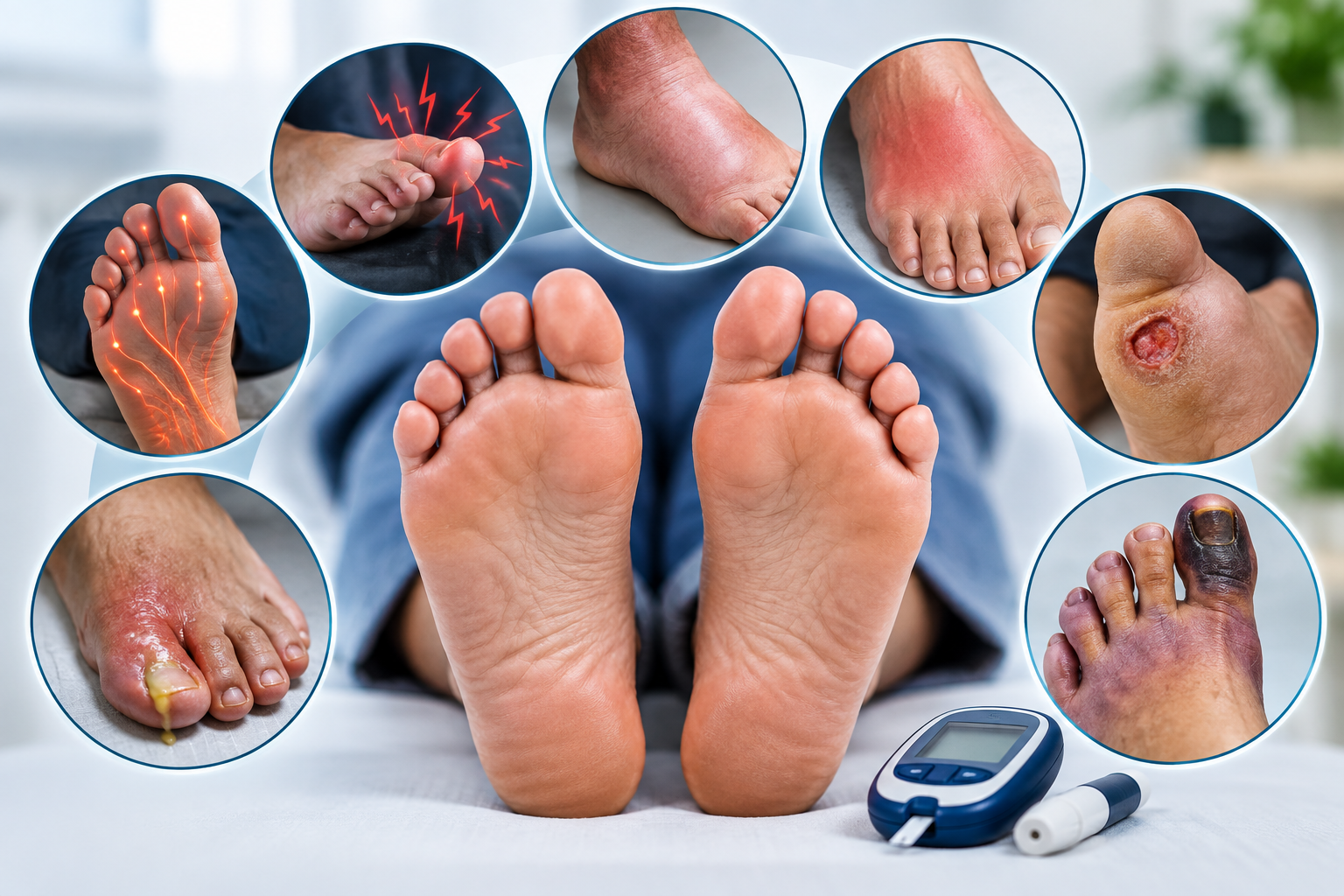
- An injury happens and is not felt. A stone in the shoe, a new sandal, a small burn, a crack in dry skin. Interrupt here with the daily check.
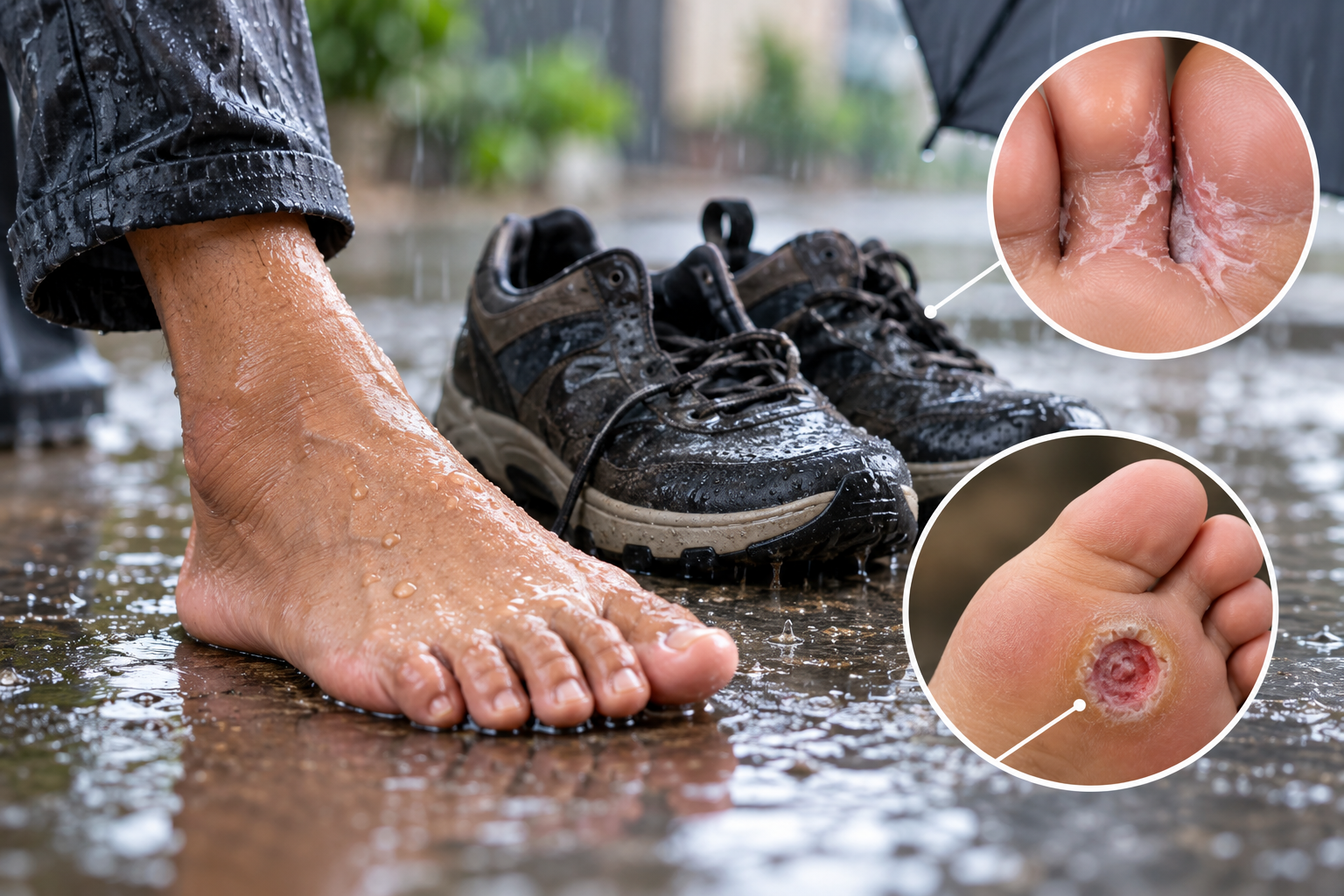
- An ulcer forms. Often under a callus, which is why bleeding or darkening under hard skin matters so much. Interrupt here by getting it seen.
- It fails to heal. Usually because pressure is still being applied to it every time the person walks. Interrupt here with offloading.
- Infection sets in and deepens. Through soft tissue, then toward tendon and bone. Interrupt here with prompt treatment and, where needed, restoring blood supply.
- Tissue dies or bone becomes infected. Options narrow, but limb salvage is still frequently possible.
The important thing about that list is that it is slow at the start and fast at the end. Weeks of opportunity at steps one to three, then days at step four. Most people who lose a limb spent a long time at step two or three thinking it was minor.
What are the four decisions that prevent diabetic foot amputation?
They are catching it, getting it seen, taking the pressure off, and restoring the blood supply. Each one is a decision someone makes, or fails to make, and each one is more powerful than anything that happens after it.
- Catch it. Check both feet every day, because a foot that cannot feel injury has to be inspected instead.
- Get it seen. Any wound that has not clearly improved within two weeks needs specialist assessment, not another dressing.
- Take the pressure off. A wound being walked on will not heal, whatever is put on it. Offloading is treatment, not advice.
- Restore the blood supply. If arterial flow is inadequate, nothing heals. Circulation must be tested properly and improved where possible, before infection deepens.
Everything else, dressings, antibiotics, supplements, is support around those four. Get all four right and the odds change completely. Miss point three or four and the best wound care in the world will not compensate.
Point 1: how do you catch a problem you cannot feel?
By looking, every single day. In a foot with nerve damage, the pain alarm that would normally warn you is switched off, so visual inspection has to replace sensation. It takes under a minute and it is the highest-value minute in diabetic foot care.
The daily check:
- Look at the tops of both feet and all the toes
- Look at the soles, using a mirror on the floor or your phone camera, which most people find easier
- Check between every toe for cracks, softness, moisture or smell
- Check the heels for cracks and splits
- Compare the two feet for temperature with the back of your hand
- Check your socks for any stain, often the first evidence of a wound you could not feel
- Check inside your shoes by hand before putting them on, every time
Alongside that, professional examination on a schedule. How often depends on your risk level, which a clinician assesses from sensation, circulation, foot shape and any history of previous ulcers. Someone with no neuropathy and good circulation may need a check once a year. Someone with neuropathy, poor circulation or a previous ulcer needs one every one to three months. Those are very different schedules, and being on the wrong one is itself a risk.
The full symptom list, and what each sign means, is covered in our post on the 7 diabetic foot warning signs you must never ignore.
Point 2: why is there a two-week rule?
Because two weeks without clear improvement means something is actively blocking healing, and that something has to be identified rather than covered with a new dressing. A healthy wound on a well-perfused foot shows visible progress in that time. One that does not is telling you the problem is not the wound surface.
What the assessment is looking for:
- Is pressure still being applied? The commonest single reason, and the most fixable.
- Is the blood supply adequate? Tested properly, not guessed from a pulse.
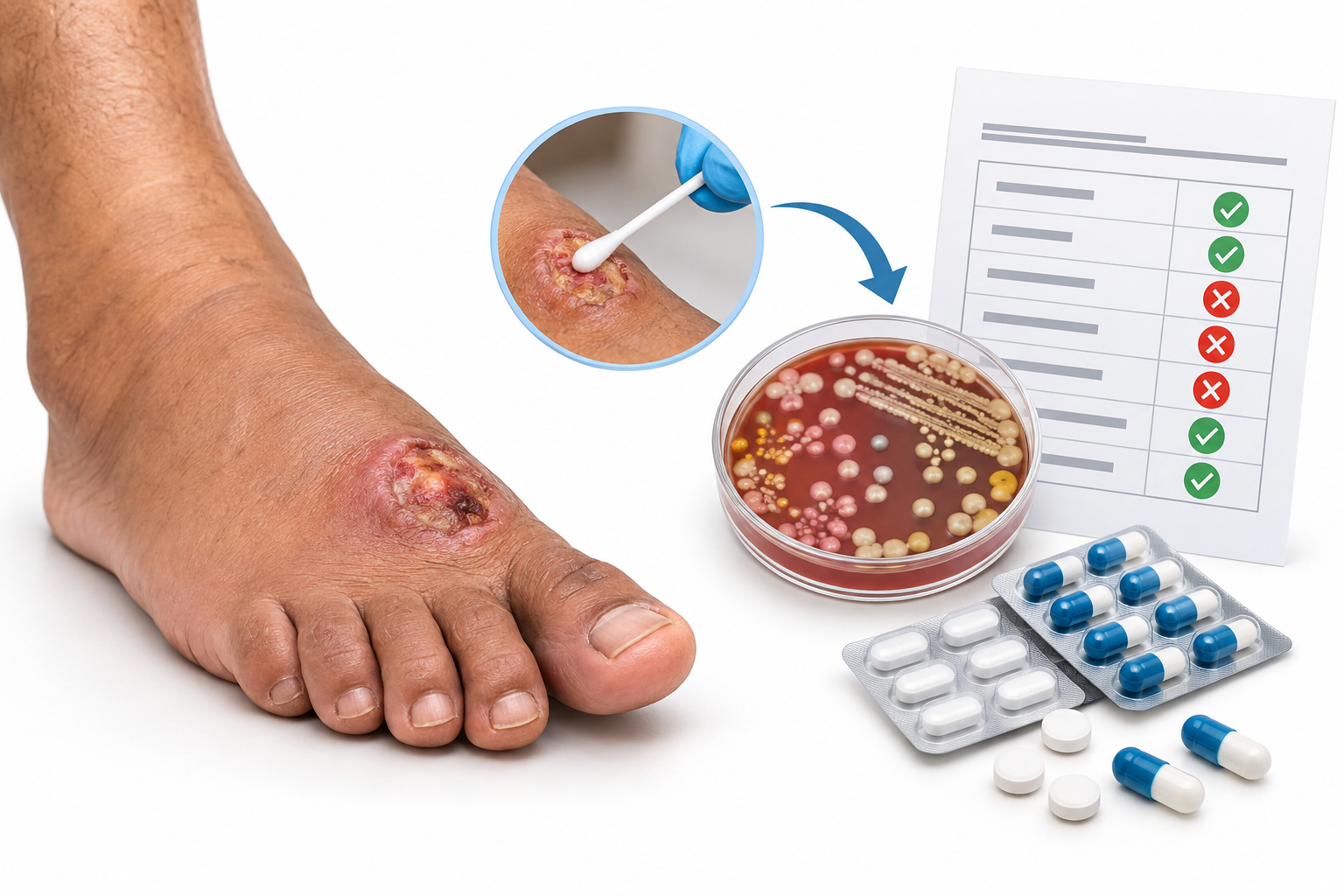
- Is there infection, and how deep does it go? Including whether a probe reaches bone.
- Is there dead tissue in the wound bed? Slough and necrotic tissue must be removed for healing to begin.
- Is glucose control good enough? Persistently high sugars slow every stage of repair.
- Is the foot shape driving it? A deformity that concentrates pressure on one point will keep reopening the same ulcer.
A wound forming under a callus deserves particular attention, since the callus hides it. Bleeding or dark discolouration beneath hard skin usually means an ulcer is already developing underneath, as covered in our post on callus on the foot with diabetes. Ongoing dressing support at home is described under home wound care.
Point 3: what is offloading, and why does walking on a wound stop it healing?
Offloading means removing mechanical pressure from the wound so the tissue can repair. Every step on an ulcer crushes the fragile new tissue trying to form. This is why the single most important intervention for a plantar ulcer is not the dressing, it is taking the weight off it.
The options, in rough order of effectiveness:
- A total contact cast. A non-removable cast that redistributes pressure across the whole foot. Treated as the reference standard for a neuropathic plantar ulcer, and its advantage is partly that the patient cannot take it off.
- A non-removable walker, where a removable boot is rendered non-removable. Similar principle, similar reasoning.
- A removable walker or cast boot. Effective in theory. In practice results depend entirely on whether it is actually worn, and adherence is the weak link.
- Felted foam, half shoes and custom insoles, useful in selected wound positions.
- Crutches or a wheelchair, where the wound position or the patient's situation demands it.
- Surgical offloading, such as tendon lengthening or removing a bony prominence, when a deformity keeps reproducing the same ulcer.
The IWGDF 2023 offloading guideline sets out this hierarchy in detail, and the reason it exists is worth stating plainly: offloading is the intervention patients are most likely to abandon, and abandoning it is the most common reason a wound that should have healed did not.
If you take one thing from this post, take this: if someone gives you a dressing but no plan for keeping weight off the wound, you have been given half a treatment.
Point 4: why is feeling a pulse not enough to check blood supply?
Because diabetes calcifies the walls of the leg arteries, which can make standard pressure readings falsely reassuring and can leave a pulse palpable in a limb that is nonetheless poorly perfused. Circulation in a diabetic foot has to be assessed with tests that work around that, not by feel alone.
What proper assessment involves:
- Toe pressures and the toe-brachial index. The small toe vessels are usually spared the calcification that distorts ankle readings, so these are more reliable in diabetes.
- Ankle-brachial index, interpreted with caution. Useful, but an unexpectedly high value can indicate stiff calcified arteries rather than healthy flow.
- Duplex ultrasound, to see where narrowing or blockage actually is.
- Angiography where revascularisation is being planned.
Where flow is inadequate, it can often be improved. Angioplasty opens narrowed vessels through a small puncture. Bypass surgery reroutes around a blocked segment. The decision between them depends on the pattern of disease and the patient's overall condition, and it is a decision that should be made quickly, because a wound cannot heal on a blood supply that cannot deliver.
Timing matters here more than anywhere else in this post. Revascularisation before infection has spread deeply preserves options. After tissue has died, the conversation is about damage limitation instead.
What can limb salvage surgery do when it is already severe?
A great deal, more often than people expect. Even with deep infection, bone involvement or dead tissue, the goal remains saving a functional foot. That may involve clearing infection surgically, restoring blood flow, removing only the tissue that cannot be saved, and reconstructing what remains.
What limb salvage actually includes:
- Debridement. Surgical removal of dead and infected tissue, sometimes in stages, to convert a spreading problem into a controlled wound.
- Revascularisation, angioplasty or bypass, so the remaining tissue has the blood supply to heal.
- Minor amputation. Removing a toe or a ray to save the foot. This is limb salvage, not failure, and the distinction matters enormously to how people feel about it.
- Bone surgery for infected bone, removing the affected segment rather than the limb.
- Reconstruction. Skin grafts, local flaps or free tissue transfer to close a defect that will not close on its own. This is where a reconstructive surgical background changes what is possible.
- Negative pressure wound therapy, to prepare a wound bed for closure.
- Offloading surgery, correcting the deformity that caused the ulcer so it does not simply recur.
On bone infection specifically: it does not automatically mean losing the limb. Depending on extent, location and blood supply, it may be treated by removing the infected bone with antibiotic cover, and in selected cases by antibiotics alone. The IWGDF and IDSA 2023 guideline on diabetes-related foot infection sets out how those decisions are made. Our structured pathways are described under diabetic foot programs and limb salvage.
Routine, urgent or go to hospital today?
Use this to decide what to do right now. When two columns could apply, choose the more urgent. On a diabetic foot, over-reacting costs you an appointment, and under-reacting costs time you cannot get back.
| Go today, to a hospital | Get seen this week | Routine review |
|---|---|---|
| Pus, discharge or a foul smell | Any new wound, blister or crack in the skin | Scheduled foot screening for your risk level |
| Black tissue anywhere on the foot or toes | A wound that has not improved in two weeks | Dry or cracked skin with no break in it |
| Redness spreading, or a red streak up the leg | Bleeding or darkening under a callus | Callus with no redness, bleeding or darkening |
| Fever or chills alongside any foot problem | New or worsening numbness or tingling | Advice on footwear, insoles or nail care |
| A suddenly hot, red, swollen foot | Pale or dusky colour change, no black tissue | Questions about daily foot care routine |
| New pain in a foot that was previously numb | A change in foot shape or how your shoes fit | Review of glucose control and general prevention |
| Severe pain in the foot at rest or at night | Cramping calf pain when walking that is new | Annual circulation and sensation testing |
What does the EDFC limb salvage pathway look like?
Dr. Ashutosh A Shah is a reconstructive surgeon with over 22 years of practice in Surat, Gujarat, working in diabetic foot care and limb salvage at Elegance Diabetic Foot & Ulcer Clinic. Every foot assessed here is evaluated on the three things that actually determine the outcome, and which are frequently checked separately or not at all: sensation, blood supply and pressure loading.
Two things shape how cases are managed here. The first is that offloading is treated as a prescription rather than a suggestion, because a wound that is still being walked on is not being treated. The second is that a reconstructive surgical background widens what counts as salvageable: grafts, flaps and staged closure make some wounds closable that would otherwise be written off.
Patients are also told plainly when a toe or ray needs to go to save the foot. That conversation is easier when it is framed correctly, because removing a small part to keep a functional, walking limb is a success, not a defeat. The symptom side of this, and what each individual sign means, is covered in our companion post on the 7 diabetic foot warning signs.
Next step
If you have a wound on your foot that has not improved in two weeks, the four decisions above are all still available to you, and the first one is simply getting it looked at. Book an assessment with Dr. Ashutosh Shah at EDFC, Surat, or call +91 83205 00350.
Medical disclaimer: This article is for education only and is not a substitute for professional diagnosis or treatment. Diabetic foot problems can deteriorate quickly and without pain. If you have pus, black tissue, spreading redness, fever or a suddenly hot swollen foot, seek medical care the same day rather than reading further.
quiz Frequently Asked Questions
This article is general education, not a diagnosis. If you have a diabetic foot wound, please have it assessed in person. Send a photo on WhatsApp or book a consultation.
About the Author

Dr. Ashutosh Shah, Plastic, Reconstructive & Diabetic Foot Surgeon, Elegance Diabetic Foot & Ulcer Clinic, Surat
Dr. Ashutosh Shah is a board certified plastic and reconstructive surgeon with over 22 years of experience and more than 10,000 limbs and feet saved. He founded Elegance Diabetic Foot & Ulcer Clinic, India's first chain of clinics dedicated to foot care, with centres in Surat and OPD partners across South Gujarat. He is known for a limb first approach, safe wound care and ethical, natural results.