
Written by Dr. Ashutosh A Shah, M.B.B.S., M.S., M.Ch., D.N.B., Diabetic Foot and Limb Salvage Surgeon, Elegance Diabetic Foot & Ulcer Clinic, Surat. Reg. no. [REG NO]. 22+ years in reconstructive and diabetic foot surgery.
Medically reviewed by Dr. Ashutosh A Shah · Published 21 September 2026 · Last reviewed 21 September 2026
The seven diabetic foot warning signs are numbness, tingling, swelling, redness, a wound that will not heal, a change in skin colour, and signs of infection such as pus, odour or fever. Any one of them needs same-week assessment, because diabetic foot problems worsen silently when sensation is reduced.
Go to a hospital today, not next week, if you have spreading redness, pus, a foul smell, black tissue, fever, or a suddenly hot and swollen foot. Those are not warning signs any more. Those are emergencies.
Almost every diabetic foot that ends in amputation started as something small that did not hurt. That is the whole problem with this condition. In a foot that has lost sensation, the usual alarm system is switched off, so the signs you have to rely on are the ones you can see rather than the ones you can feel.
This post takes the seven signs in order and tells you, for each one, what it actually means, how urgent it is, and what happens next. It is the written version of the points covered in our Short, "Diabetes patients ko ye symptoms ignore nahi karne chahiye".
What are the 7 diabetic foot warning signs?
The seven signs, in the order they usually matter, are numbness, tingling, swelling, redness, a wound that will not heal, a change in skin colour, and signs of infection. None of them require pain to be serious, and in a neuropathic foot most of them will not hurt at all.
- Numbness. Reduced or absent feeling in the toes, sole or whole foot.
- Tingling. Pins and needles, burning, or an electric sensation, often worse at night.
- Swelling. Especially swelling of one foot only, or a foot that is warmer than the other.
- Redness. A red area, a red streak spreading upward, or redness around a callus or wound.
- A wound that will not heal. Any break in the skin that has not clearly improved within two weeks.
- A change in skin colour. Pale, blue, purple, dusky or black skin anywhere on the foot or toes.
- Signs of infection. Pus, discharge, a foul smell, fever, or an unexplained rise in your blood sugar.
Two of those deserve highlighting immediately. Black tissue is never watch-and-wait. And an unexplained rise in blood sugar in someone whose control was previously stable is very often the earliest sign of a foot infection, appearing before any fever and sometimes before the foot itself looks dramatic.
Why do diabetic foot problems get missed until they are severe?
Because the foot stops warning you. Diabetes damages the small nerves that carry pain and temperature, so a blister, a stone in the shoe, or a burn from hot water produces no signal at all. The injury continues, the tissue breaks down, and the first thing the person notices is a stain on the sock.
Three failures stack on top of each other:
- The pain alarm is off. Loss of protective sensation means damage accumulates without being felt.
- The blood supply may be reduced. Narrowed arteries mean less oxygen, fewer white cells and fewer nutrients reach the injury, so healing is slow and infection spreads more easily.
- The immune response is blunted. High glucose impairs white cell function, so infection can be advanced before the body mounts an obvious reaction.
Put together, that is a foot that can be seriously damaged while feeling completely normal. This is why the international standard, set out in the IWGDF 2023 guidelines on diabetes-related foot disease, is built around regular screening and early escalation rather than waiting for symptoms to become uncomfortable.
Signs 1 and 2: what do numbness and tingling in the feet mean?
Numbness and tingling are peripheral neuropathy, meaning nerve damage from long-term high blood sugar. It typically starts in the toes and moves upward in a stocking pattern, affecting both feet. Once protective sensation is lost, every future foot problem becomes silent, which is why this is sign number one.
What to watch for:
- Reduced feeling when you touch your toes, or an inability to feel a pebble in your shoe
- Burning, tingling or electric pain, often worse at night and better on walking
- Feeling as though you are walking on cotton wool or a thick sock
- Not noticing water temperature accurately with your feet
- Unsteadiness or changed balance in the dark
Clinically this is confirmed with simple bedside tests, usually a 10 g monofilament to check protective sensation and a tuning fork for vibration sense. Our post on the foot vibration test for diabetics explains what that test shows and what a missed reading means.
Be clear-eyed about the prognosis. Established nerve damage does not usually reverse. What good glucose control, blood pressure control and stopping smoking do is slow its progression and protect what sensation remains. That is a genuine benefit, and it is worth doing, but the more important response to a numb foot is to change how you protect it.
Signs 3 and 4: what do swelling and redness mean, and what is Charcot foot?
Swelling and redness in a diabetic foot mean one of two things, and both are urgent: infection, or Charcot neuroarthropathy. A hot, red, swollen foot in someone with neuropathy, especially with no wound and no obvious cause, must be assumed to be Charcot foot until proven otherwise.
Charcot neuroarthropathy is the one most often missed. The bones of a numb foot soften and fragment while the person keeps walking on it, because it does not hurt enough to stop them. Within weeks the arch can collapse into a rocker-bottom shape that is very difficult to fit a shoe to and very prone to ulceration. Caught early and immobilised, the foot is usually saved. Caught late, the deformity is permanent.
What points toward Charcot rather than infection:
- One foot swollen, red and noticeably warmer than the other
- Known neuropathy
- Often no wound and no fever
- Sometimes a minor twist or extra walking in the days before
A practical home check: compare the two feet with the back of your hand. A clear temperature difference between one foot and the other, particularly with swelling, is a same-day call, not a same-week one. Sudden one-sided swelling is covered in more detail in our post on sudden foot swelling in diabetes.
One distinction worth knowing: swelling of both feet together is more often a heart, kidney or medication issue and is usually less urgent, though it still needs review. Swelling of one foot is the red flag.
Sign 5: what does it mean if a wound has not healed in 2 weeks?
Any break in the skin on a diabetic foot that has not clearly improved within two weeks needs specialist assessment. Not a new dressing, not another course of the same ointment, an assessment. Two weeks without progress means something is blocking healing, and that something has to be identified.
The usual blockers are:
- Pressure. You are still walking on it. A wound under a weight-bearing area cannot heal while it is being loaded, no matter how good the dressing is. This is why offloading matters more than the dressing choice.
- Poor blood supply. If arterial flow is inadequate, the wound will not heal until the circulation is assessed and, where possible, improved.
- Infection, including in the bone. If a probe reaches bone through the wound, underlying bone infection is likely and needs imaging and treatment.
- Dead tissue in the wound bed. Slough and necrotic tissue must be removed for healing to start.
- Glucose control. Persistently high sugars slow every stage of repair.
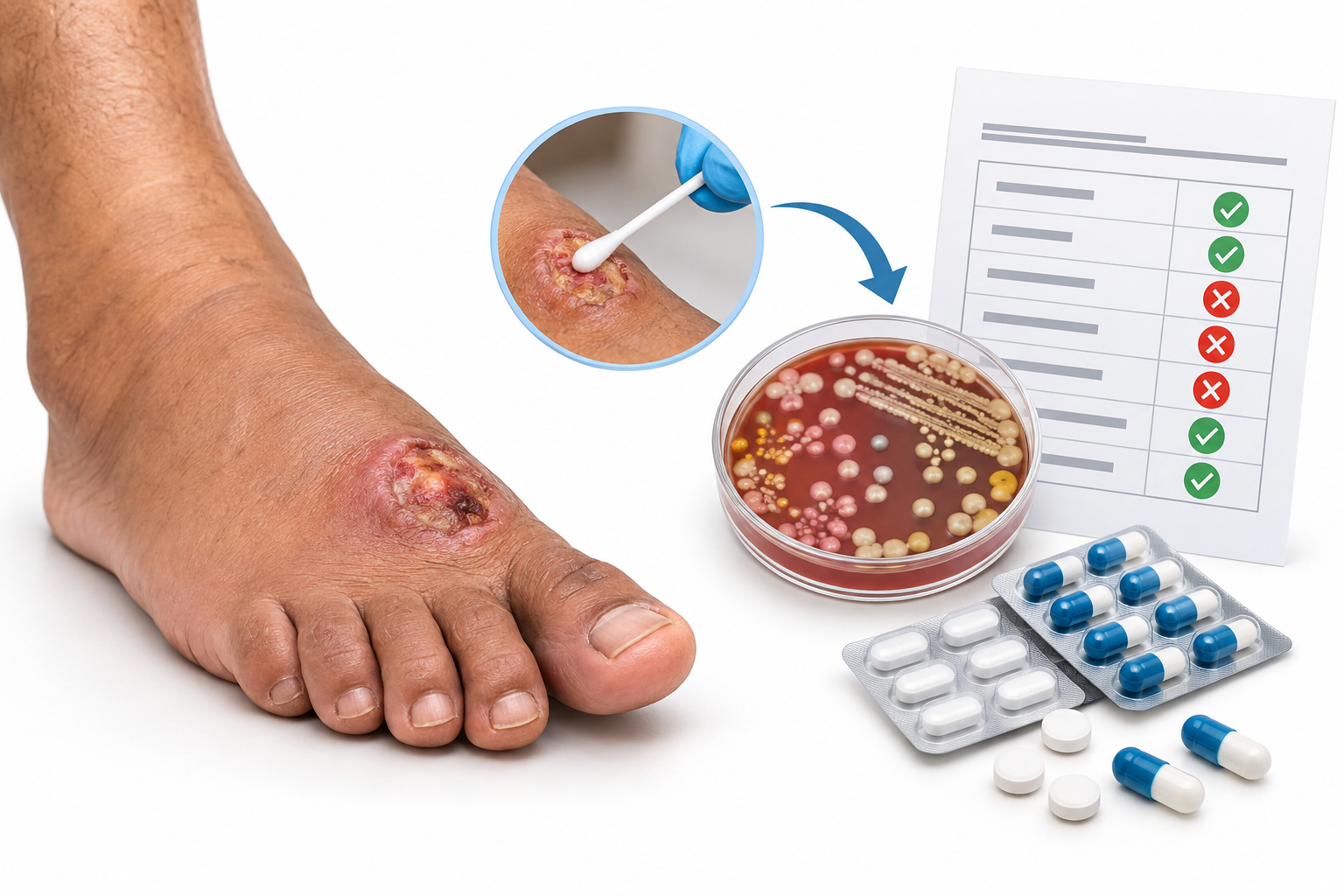
A blister, a small crack between the toes, a rubbed heel, a wound under a callus: none of these are minor on a diabetic foot. Bleeding or dark discolouration underneath a callus is a particularly important sign, because it usually means an ulcer is already forming beneath the hard skin.
Sign 6: what do pale, blue or black skin colour changes mean?
Colour tells you about blood supply. Pale or white skin suggests reduced arterial flow. Blue, purple or dusky skin suggests significantly poor oxygen delivery. Black skin means tissue has died. Each step along that sequence is more urgent than the last, and black is an emergency.
| Colour | What it usually means | How urgent |
|---|---|---|
| Pale or white, especially when the leg is raised | Reduced arterial blood supply | Assess this week |
| Dark red or purple when the foot hangs down | Dependent rubor, a sign of poor circulation | Assess this week |
| Blue or dusky toes | Seriously inadequate oxygen delivery | Within 24 to 48 hours |
| Bright red and spreading, with warmth | Infection or inflammation | Today |
| Black, dry and shrivelled | Dry gangrene, tissue has died | Today |
| Black with swelling, wetness or smell | Wet gangrene, a limb-threatening emergency | Immediately, go to hospital |
A black toe is not something to bandage and monitor. Whether it is dry gangrene, which may be stable for a while, or wet gangrene, which spreads fast, is a clinical judgement that has to be made by someone who can see it. Our post on a foot turning black with diabetes covers what happens next in each case.
Sign 7: which signs of infection mean you should go today?
Infection in a diabetic foot escalates faster and more quietly than in a healthy foot. The signs are pus or discharge, a foul smell, redness spreading outward or upward as a streak, warmth, swelling, fever or chills, and an unexplained rise in blood sugar. Any of these means today, not an appointment next week.
The specific things to act on:
- Pus or discharge from a wound or from between the toes
- A foul or sweet rotting smell, which is a strong indicator of deep or anaerobic infection
- A red streak spreading up the foot or leg, which suggests infection tracking along the tissues
- Fever, chills or feeling generally unwell alongside any foot problem
- An unexplained rise in blood sugar in someone previously stable, which is frequently the first sign of infection and often precedes the fever
- New pain in a foot that was previously numb, which is a serious sign and should never be dismissed as improvement
- Crackling under the skin when pressed, which suggests gas-forming infection and is a surgical emergency
The IWGDF and IDSA have published dedicated guidance on diabetes-related foot infection alongside their 2023 practical guidelines, and the consistent message across all of it is that delay, rather than severity at presentation, is what costs limbs.
Emergency, same-week or routine: how urgent is what you are seeing?
Use this to decide what to do right now. When two categories could apply, choose the more urgent one. On a diabetic foot, over-reacting costs you an appointment; under-reacting can cost a limb.
| Go today, to a hospital | Get seen this week | Routine review |
|---|---|---|
| Pus, discharge or a foul smell | Any new wound, blister or crack in the skin | Routine foot screening as advised |
| Black tissue anywhere on the foot or toes | A wound that has not improved in two weeks | Callus or corn with no redness or bleeding |
| Spreading redness or a red streak up the leg | New or worsening numbness or tingling | Dry, cracked skin on the heels |
| Fever or chills with any foot problem | Pale or dusky colour change without black tissue | Nail thickening or fungal nails |
| A suddenly hot, red, swollen foot (possible Charcot) | Swelling of one foot without heat or redness | Advice on footwear and insoles |
| New pain in a previously numb foot | Bleeding or dark colour under a callus | Nail and skin care questions |
| An unexplained sharp rise in blood sugar with foot symptoms | A change in the shape of the foot or the fit of your shoes | General prevention review |
How do you do a 60-second daily foot check?
Check both feet once a day, every day, in good light. It takes under a minute and it is the single most effective thing a person with diabetes can do for their own feet, because in a numb foot looking replaces feeling.
- Look at the tops of both feet and all the toes.
- Look at the soles. Use a mirror on the floor, or take a photo with your phone camera, which is easier for most people.
- Check between every toe for cracks, softness, moisture or smell.
- Check the heels for cracks and dry splits.
- Feel for temperature differences with the back of your hand, comparing the two feet.
- Check your socks for any stain, which is often the first evidence of a wound you could not feel.
- Check inside your shoes with your hand before putting them on, every single time, for stones, torn lining or anything sharp.
And the things never to do with a numb foot: never use a hot water bottle, heating pad or hot water to warm your feet, because you cannot judge the temperature and burns are common; never walk barefoot, indoors or out; never cut corns or calluses yourself, and never use medicated corn caps or acid plasters; never ignore a new callus, because callus is pressure made visible and an ulcer often forms underneath it.
Care at EDFC, Surat
Dr. Ashutosh A Shah is a reconstructive surgeon with over 22 years of practice in Surat, Gujarat, working in diabetic foot care and limb salvage at Elegance Diabetic Foot & Ulcer Clinic. Assessment here covers the three things that actually determine outcome and are frequently assessed separately elsewhere: sensation, blood supply and pressure loading.
Patients who come in early with one of these seven signs are usually managed with offloading, wound care and infection control. The ones who arrive late are the ones facing reconstruction or amputation, and the difference between those two groups is very often just a matter of weeks. The structured limb salvage pathways are described under our diabetic foot programs.
Next step
If you recognise any of these seven signs on your own foot, the useful question is not whether it will settle on its own, but which column of the triage table it sits in. Book an assessment with Dr. Ashutosh Shah at EDFC, Surat, or call +91 83205 00350.
Medical disclaimer: This article is for education only and is not a substitute for professional diagnosis or treatment. Diabetic foot problems can become limb-threatening quickly and silently. If you have pus, black tissue, spreading redness, fever or a suddenly hot swollen foot, seek medical care the same day rather than reading further.
quiz Frequently Asked Questions
This article is general education, not a diagnosis. If you have a diabetic foot wound, please have it assessed in person. Send a photo on WhatsApp or book a consultation.
About the Author

Dr. Ashutosh Shah, Plastic, Reconstructive & Diabetic Foot Surgeon, Elegance Diabetic Foot & Ulcer Clinic, Surat
Dr. Ashutosh Shah is a board certified plastic and reconstructive surgeon with over 22 years of experience and more than 10,000 limbs and feet saved. He founded Elegance Diabetic Foot & Ulcer Clinic, India's first chain of clinics dedicated to foot care, with centres in Surat and OPD partners across South Gujarat. He is known for a limb first approach, safe wound care and ethical, natural results.