
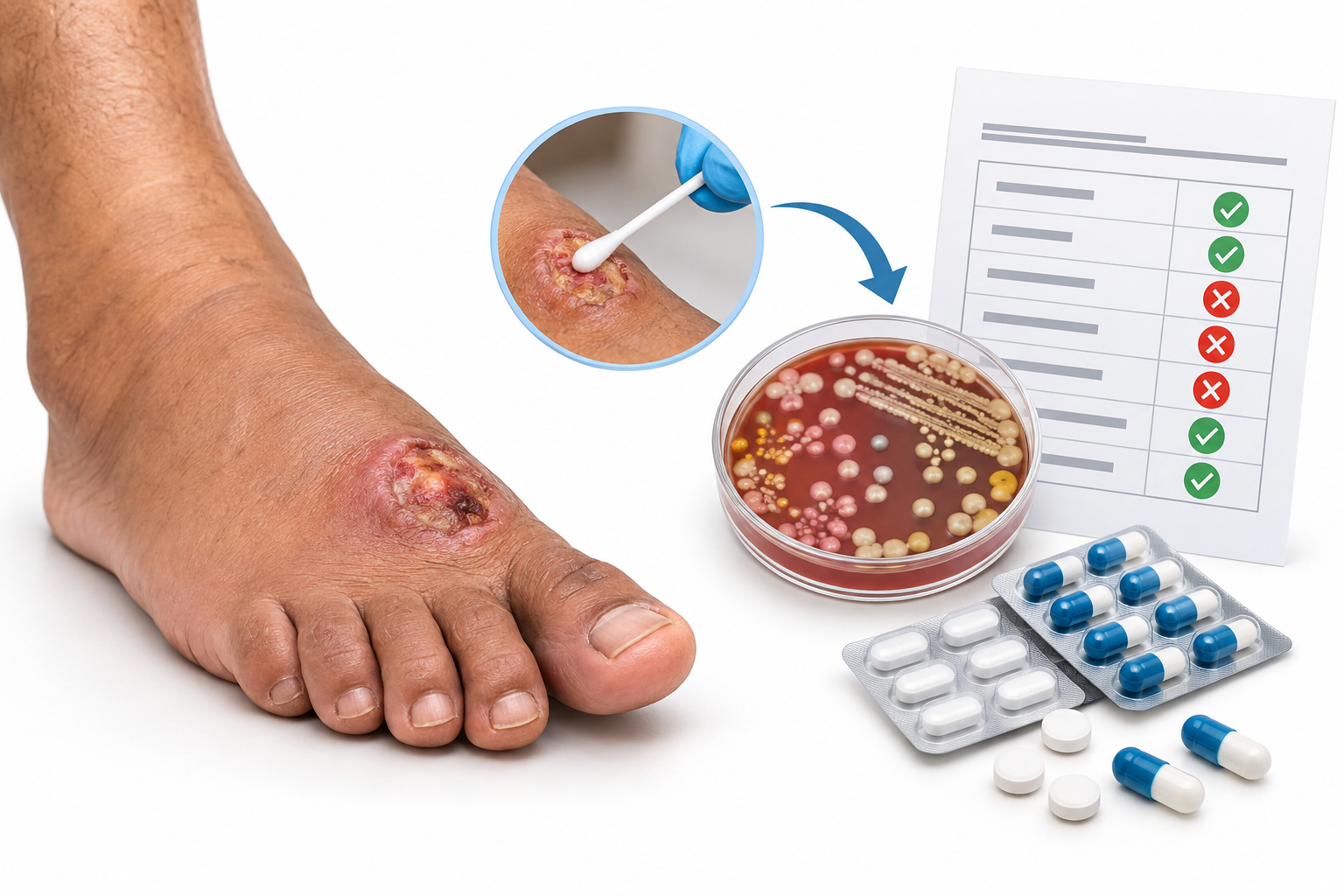
A surface swab mostly grows skin contaminants, so treatment based on it often fails. A deep tissue or bone sample taken after cleaning identifies the real organism. Soft tissue infection usually needs one to two weeks of antibiotics, bone infection six weeks or more.
A deep tissue or bone sample taken after appropriate wound cleaning provides more useful information. Antibiotics for diabetic foot infection are then selected according to infection severity, culture findings and whether deeper tissue or bone is involved.
Antibiotics are important, but choosing the correct drug is only one part of treating an infected diabetic foot. The wound must also be assessed for dead tissue, abscess, poor circulation, pressure and possible bone infection.
Why Does a Surface Swab Often Give the Wrong Answer?
A diabetic foot ulcer is exposed to the outside environment. Its surface may therefore contain several organisms that are colonising the wound without necessarily being responsible for the deeper infection.
A superficial swab can collect these organisms.
That creates a problem: the laboratory report may identify bacteria, but those bacteria may not accurately represent what is happening deeper inside the wound.
This is why wound culture and sensitivity should be interpreted together with the clinical examination.
Where clinically appropriate, a properly obtained deeper specimen can provide more useful information than simply rubbing a swab across the ulcer surface.
Before sampling, the wound may need cleaning and removal of contaminated or dead surface material.
More information about managing infection is available under Infection management.
How Is a Deep Tissue or Bone Sample Taken?
A deep tissue sample vs swab differs mainly in where the specimen comes from.
Instead of collecting material only from the wound surface, the clinician obtains tissue from an appropriately prepared deeper part of the wound.
The exact technique depends on the wound and suspected depth of infection.
The process may involve:
- examining the ulcer;
- cleaning the wound;
- removing dead or contaminated tissue where indicated;
- obtaining an appropriate deep specimen; and
- sending it to the laboratory for culture and sensitivity testing.
If bone infection is suspected, further investigation may be required. In selected cases, a bone specimen can help identify the organism responsible for osteomyelitis.
Laboratory testing can then show which organisms have grown and provide information that helps clinicians choose or adjust antimicrobial treatment.
See Laboratory tests for more information about diagnostic testing in diabetic foot care.
Sample Comparison: Swab, Tissue, Bone and Blood
| Sample | What It Detects | Reliability / Limitation | What It May Change |
|---|---|---|---|
| Surface swab | Organisms on the wound surface | May include colonising organisms and may not represent deeper infection | Limited value when deeper infection is suspected |
| Deep tissue sample | Organisms within infected tissue | More representative when collected appropriately | Helps guide targeted antibiotic selection |
| Bone biopsy/sample | Organisms associated with suspected bone infection | Useful when osteomyelitis requires microbiological confirmation | Can guide treatment of bone infection |
| Blood culture | Organisms circulating in the bloodstream | Most relevant when systemic infection is suspected | May influence treatment in severe/systemic infection |
A culture result should not be interpreted in isolation. The patient's clinical condition and infection severity remain central to treatment decisions.
How Long Should Antibiotics Run for Skin, Deep Tissue and Bone Infection?
There is no single answer to how long antibiotics for foot infection should continue.
Duration depends on the depth and severity of infection, response to treatment, surgical findings, circulation and whether bone is involved.
A mild soft-tissue infection may need a relatively short course, while deeper or more extensive infection may require longer treatment.
Bone infection can require a substantially different plan.
This is why patients should not continue, stop or restart antibiotics based only on whether the wound looks better on the surface.
The treating team considers the whole clinical picture.
Typical Treatment Planning by Infection Type
| Infection Type | Usual Route | Typical Planning | Red Flags Requiring Urgent Review |
|---|---|---|---|
| Mild soft-tissue infection | Often oral when clinically appropriate | Commonly a shorter treatment course with review | Increasing redness, swelling, discharge or systemic symptoms |
| Moderate soft-tissue infection | Oral or IV depending on severity | Duration adjusted according to response and source control | Spreading infection or deterioration |
| Severe infection / sepsis | Usually requires hospital-based treatment | Urgent treatment plus assessment for surgical source control | Fever, confusion, vomiting, low blood pressure or rapidly spreading infection |
| Bone infection | Route depends on clinical situation and organism | Often requires a longer treatment plan and assessment for surgery | Progressive tissue destruction, systemic illness or uncontrolled infection |
The exact antibiotic and duration must be determined by the treating medical team.
Why Do Repeated Short Antibiotic Courses Make Things Worse?
A common problem is repeatedly treating a diabetic foot wound with short courses of antibiotics without identifying why the infection keeps returning.
The problem may not simply be the antibiotic.
Persistent or recurrent infection can occur when there is:
- an undrained abscess;
- dead or infected tissue;
- infected bone;
- inadequate blood supply;
- continuing pressure on the ulcer;
- an inappropriate antibiotic choice; or
- insufficient source control.
Repeatedly changing tablets without reassessing the foot can delay definitive treatment.
It may also make subsequent antibiotic selection more complicated.
If an infection returns after treatment, the foot needs reassessment rather than automatically repeating the previous prescription.
The Diabetic foot infection resource explains the wider approach to these infections.
When Will Antibiotics Never Be Enough Without Surgery?
Antibiotics reach living tissue through the bloodstream. They cannot by themselves drain an abscess or remove extensive dead tissue.
Surgical treatment may therefore be required when infection is associated with problems such as:
- an abscess or collection of pus;
- significant dead tissue;
- rapidly progressive infection;
- wet gangrene;
- deep infection requiring drainage;
- selected cases of infected bone; or
- infection that is not improving despite appropriate treatment.
Poor circulation can make the situation even more difficult because reduced blood supply affects both tissue healing and delivery of treatment to the affected area.
This is why a diabetic foot infection should not be viewed as simply a question of “which antibiotic?”
The clinician must determine whether there is something inside the foot that medication alone cannot correct.
When bone involvement is suspected, see Osteomyelitis for further information.
Why Did My Infection Come Back After Antibiotics?
An infection that returns after antibiotics does not automatically mean the medicine was weak.
The original infection may have involved deeper tissue, an abscess or bone. There may also be inadequate circulation or continuing pressure on the wound.
The culture may not have represented the true organism if only a superficial specimen was obtained.
For this reason, recurrent infection requires a fresh assessment.
The team may need to reassess:
- wound depth;
- surrounding redness and swelling;
- discharge;
- circulation;
- pressure points;
- possible bone involvement;
- previous culture reports; and
- previous antibiotic exposure.
Treatment should address the cause of persistence, not simply repeat the same prescription.
Which Signs During Treatment Mean Going Back to Hospital Today?
Do not assume that being on antibiotics makes a worsening foot safe.
Seek urgent medical assessment if there is:
- rapidly spreading redness;
- increasing swelling;
- new black or dusky tissue;
- foul smell or increasing pus;
- fever or chills;
- vomiting or confusion;
- rapidly worsening weakness;
- increasing tissue destruction; or
- sudden deterioration of the whole foot.
A person with diabetic neuropathy may have a serious infection without severe pain.
For that reason, appearance, smell, swelling and systemic symptoms may be more important warning signs than pain alone.
Conclusion
Choosing antibiotics for diabetic foot infection requires more than taking a surface swab and prescribing whichever drug appears next to the laboratory result.
The quality of the sample matters. A properly obtained deep tissue or bone specimen can provide more useful information when deeper infection is suspected, while the clinical examination determines how urgently treatment is needed.
Just as importantly, antibiotics cannot correct every cause of infection. Abscesses, dead tissue, poor circulation and some cases of bone infection may require additional procedures or surgery.
If the foot develops spreading redness, increasing swelling, foul smell, black tissue, fever or other signs of deterioration while treatment is underway, seek urgent medical assessment rather than waiting for the antibiotic course to finish.
quiz Frequently Asked Questions
This article is general education, not a diagnosis. If you have a diabetic foot wound, please have it assessed in person. Send a photo on WhatsApp or book a consultation.
About the Author

Dr. Ashutosh Shah, Plastic, Reconstructive & Diabetic Foot Surgeon, Elegance Diabetic Foot & Ulcer Clinic, Surat
Dr. Ashutosh Shah is a board certified plastic and reconstructive surgeon with over 22 years of experience and more than 10,000 limbs and feet saved. He founded Elegance Diabetic Foot & Ulcer Clinic, India's first chain of clinics dedicated to foot care, with centres in Surat and OPD partners across South Gujarat. He is known for a limb first approach, safe wound care and ethical, natural results.