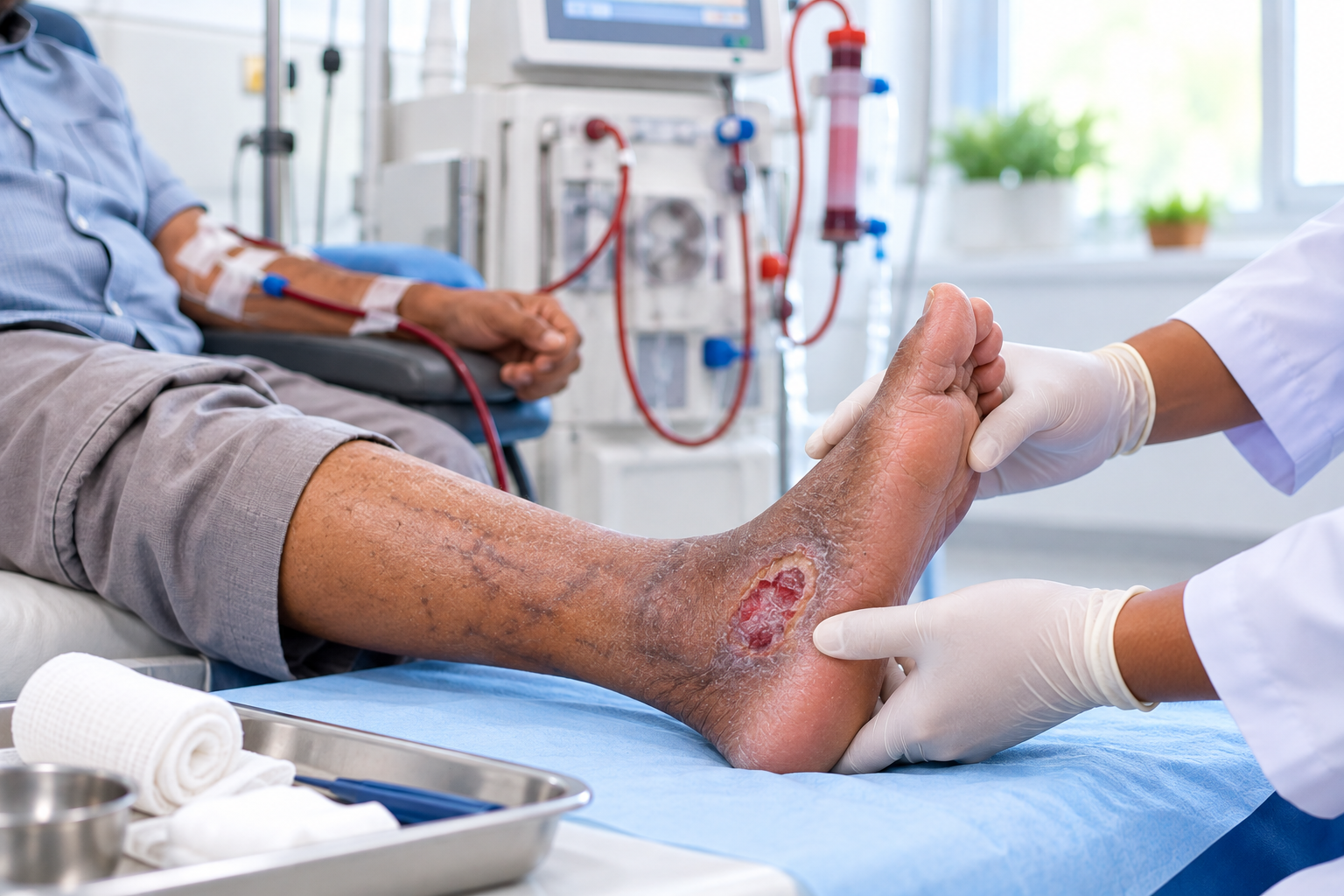
Kidney disease roughly doubles the risk of a foot ulcer failing to heal. Contrast for angiography must be minimised or replaced with CO2 angiography, antibiotic doses need renal adjustment, and pressure sores on the heel are common during long dialysis sessions.
A diabetic foot ulcer on dialysis needs coordinated care because kidney disease changes several parts of wound treatment at the same time. At Elegance Diabetic Foot & Ulcer Clinic, Dr. Ashutosh A Shah considers circulation, infection, pressure, dialysis scheduling, medication adjustment and nutrition when planning diabetic foot care for a patient with kidney disease.
Why Do Wounds Heal So Slowly in Kidney Disease?
Kidney disease makes diabetic foot treatment more complicated.
According to the supplied 29 September plan, kidney disease roughly doubles the risk of a foot ulcer failing to heal.
This does not mean that a foot ulcer cannot heal in someone receiving dialysis. It means the patient needs closer assessment because several factors can interfere with healing simultaneously.
A patient with chronic kidney disease may also have:
-
Diabetes
-
Peripheral arterial disease
-
Anaemia
-
Infection
-
Swelling
-
Poor nutritional reserve
-
Reduced mobility
-
Neuropathy
-
Pressure-related skin damage
The wound therefore cannot be assessed in isolation.
When managing a diabetic foot ulcer on dialysis, the treatment team needs to understand why the wound developed and which factors are currently preventing it from closing.
Can a Foot Ulcer Heal in Someone on Dialysis?
Yes, healing is possible.
Dialysis does not automatically mean that a diabetic foot ulcer will remain open permanently.
However, the treatment pathway may need more coordination than it would for a patient without significant kidney disease.
The wound still requires assessment of:
-
Blood supply
-
Infection
-
Pressure and offloading
-
Wound depth
-
Tissue viability
-
Glucose control
-
Nutrition
Kidney disease then adds additional considerations, particularly medication dosing, angiography planning and the timing of dressings or procedures around dialysis.
The important question is therefore not simply whether the patient is on dialysis.
It is whether all of the barriers to healing have been identified and managed.
How Does Poor Circulation Affect a Dialysis Patient With a Foot Ulcer?
A diabetic foot ulcer may fail to heal if the foot is not receiving adequate blood flow.
This is particularly important when the patient has diabetes and kidney disease, because circulation problems can coexist with the wound.
Signs that may lead to vascular assessment include a non-healing ulcer, tissue colour changes or other clinical evidence suggesting inadequate circulation.
If poor arterial supply is contributing to the wound, the team may need to assess whether blood flow can be improved.
Patients can read more about Ischaemic ulcer.
How Is Angiography Done Safely When Kidneys Are Already Failing?
Angiography may be needed when a diabetic foot ulcer is associated with poor arterial circulation.
Standard angiography can use iodinated contrast.
In a patient with impaired kidney function, contrast exposure requires additional planning.
The supplied plan specifically states that contrast should be minimised or replaced with CO2 angiography.
The objective is to obtain the vascular information required for treatment while reducing avoidable renal risk.
CO2 angiography can reduce the amount of iodinated contrast required in selected peripheral vascular procedures. Research has found a lower risk of contrast-associated acute kidney injury with CO2-based approaches compared with conventional iodinated contrast, although kidney injury risk is not eliminated completely.
The imaging strategy therefore needs to be individualised rather than assuming that every patient with kidney disease should receive exactly the same angiogram.
Is an Angiogram Safe With Kidney Disease?
It may still be performed when clinically necessary, but kidney disease changes how the procedure is planned.
The treating team considers:
-
Current renal function
-
Whether the patient is already receiving dialysis
-
The reason angiography is required
-
The amount of iodinated contrast required
-
Whether a lower-contrast strategy is possible
-
Whether CO2 angiography is appropriate
CO2 is not simply a universal replacement for iodinated contrast. It has its own limitations and needs appropriate equipment and expertise.
The aim is to balance the kidney risk against the danger of leaving severe limb ischaemia untreated.
For more information about vascular procedures used for diabetic foot disease, see Endovascular treatment.
What Does CO2 Angiography Change?
CO2 can be used as an alternative contrast medium for selected peripheral vascular imaging.
Its main relevance in kidney disease is that it can reduce exposure to iodinated contrast.
Evidence from peripheral vascular procedures suggests that CO2-based angiography can reduce contrast-associated kidney injury compared with iodinated contrast strategies, although a residual risk of acute kidney injury remains.
The decision to use CO2, iodinated contrast or a combination depends on the anatomy being examined and the clinical situation.
For a patient with a threatened diabetic foot, avoiding all vascular imaging simply because kidney disease exists may also carry risk if poor circulation is preventing the wound from healing.
How Are Antibiotic Doses Adjusted on Dialysis?
A diabetic foot ulcer on dialysis may become infected and require antibiotics.
Kidney function matters because many medicines are cleared partly or substantially through the kidneys.
The supplied plan therefore requires renal adjustment of antibiotic doses.
The exact adjustment is not the same for every antibiotic.
It can depend on:
-
Which antibiotic is prescribed
-
Type of infection
-
Organism and culture result
-
Residual kidney function
-
Dialysis method
-
Dialysis schedule
-
Patient weight
-
Drug pharmacokinetics
Published antimicrobial dosing guidance likewise uses drug-specific regimens for intermittent haemodialysis and continuous renal replacement therapy rather than one universal dialysis dose.
Patients should not independently reduce or skip an antibiotic because they are on dialysis.
The dose and timing should be determined by the treating medical team.
Do Antibiotic Doses Change on Dialysis?
Yes, some antibiotic doses or dosing intervals need adjustment, while others may require different timing around dialysis.
There is no single rule that applies to every antibiotic.
The foot team treating the infection may therefore need to coordinate with the physician or nephrology team managing dialysis.
This becomes particularly important when prolonged antibiotic treatment is required for a deeper diabetic foot infection.
Why Do Heel Ulcers Appear During Dialysis Sessions?
The supplied plan highlights heel pressure sores as a particular concern during long dialysis sessions.
The heel can remain against the bed, recliner or supporting surface for an extended period.
For a patient with neuropathy, that pressure may not hurt.
The patient therefore may not receive the normal pain signal that would make someone else move the foot.
Repeated or prolonged pressure can damage vulnerable tissue.
A patient who already has poor circulation may have even less tolerance for sustained heel pressure.
That is why heel protection should be considered as part of CKD diabetic foot care, not only after a heel wound appears.
How Can the Heel Be Protected During Dialysis?
The principle is to avoid prolonged uncontrolled pressure on the heel.
The dialysis and wound-care teams may need to consider positioning and appropriate heel protection according to the patient's individual risk.
Patients and caregivers should also inspect the heels regularly.
Look for:
-
Persistent redness
-
Darkening
-
Blistering
-
New skin breakdown
-
Swelling
-
A new black area
A person with diabetic neuropathy should not rely on pain as the warning sign.
The heel can be injured without significant discomfort.
Care Adjustments for a Diabetic Foot Ulcer on Dialysis
| Area of Care | What Changes in Kidney Disease | Why | Who Coordinates It |
|---|---|---|---|
| Imaging and contrast | Iodinated contrast exposure may need minimisation; CO2 angiography may be considered where appropriate | Kidney disease changes contrast-related risk | Vascular/interventional team with the renal team as needed |
| Antibiotic dosing | Some doses, intervals or timing need renal/dialysis adjustment | Drug clearance changes with severe kidney disease and dialysis | Treating physician, infection team and renal team |
| Anaesthesia planning | Kidney disease and dialysis status are considered before a procedure | Overall medical condition affects perioperative planning | Surgical and anaesthesia teams with relevant physicians |
| Dressing schedule | Reviews and dressing changes may need coordination around dialysis sessions | Reduces treatment disruption and allows both care plans to continue | Wound team and dialysis team |
| Heel protection | Greater attention to prolonged heel pressure during dialysis | Long sessions can expose an insensate heel to sustained pressure | Dialysis staff, patient and foot-care team |
| Nutrition and protein | Nutrition needs individual assessment rather than a generic high-protein wound diet | Wound-healing requirements must be balanced with renal dietary needs | Renal and nutrition teams |
| Red flag | Fever, sudden foot swelling or a new black area | May indicate serious infection, tissue damage or worsening limb threat | Go to hospital the same day |
How Are Dressings Scheduled Around Dialysis Days?
A dialysis patient may already spend substantial time travelling to and attending dialysis sessions.
Foot treatment therefore needs practical coordination.
The supplied plan specifically requires dressing schedules to be considered around dialysis days.
There is no single schedule given in the plan for every patient.
The timing depends on:
-
Wound condition
-
Dressing type
-
Amount of wound drainage
-
Infection
-
Dialysis schedule
-
Planned procedures
-
Availability of the treating team
The aim is to prevent either treatment from being neglected.
A patient should not repeatedly miss wound reviews because of dialysis, nor should essential dialysis be disrupted simply for a routine dressing when care can be coordinated appropriately.
Should Surgery Be Done on a Dialysis Day?
The supplied plan asks this question but does not state a universal rule that surgery must or must not occur on a dialysis day.
The timing needs to be coordinated individually.
Factors can include:
-
Urgency of the foot problem
-
Dialysis schedule
-
Fluid status
-
Electrolytes
-
Anaesthesia requirements
-
Infection severity
-
Overall medical fitness
An emergency foot problem should not be delayed simply to fit a routine schedule.
For planned procedures, the surgical, anaesthesia and renal teams can coordinate timing around dialysis.
How Does Kidney Disease Change Anaesthesia Planning?
Kidney disease is relevant before diabetic foot surgery because the patient may have additional medical and metabolic considerations.
The anaesthesia team needs to know the patient's kidney status and dialysis schedule.
The exact anaesthetic plan depends on the proposed operation and the patient's overall condition.
A minor procedure and a major limb-salvage operation do not necessarily require the same preparation.
The 29 September plan does not specify a particular anaesthesia technique, so the choice should remain individualised rather than presenting one approach as appropriate for all dialysis patients.
What About Nutrition and Protein for Wound Healing on Dialysis?
Nutrition is important during wound healing, but renal disease makes generic dietary advice inappropriate.
A patient with an active wound has nutritional requirements related to healing.
At the same time, kidney disease and dialysis may affect the dietary plan.
The supplied plan therefore places nutrition and protein within the coordinated-care table rather than giving one fixed protein target.
The safest approach is an individual nutrition plan that takes both wound healing and renal requirements into account.
A patient should not dramatically increase or restrict protein solely because of general online wound-healing advice without discussing it with the renal and nutrition teams.
Why Does a Dialysis Patient Need More Urgent Review?
A diabetic foot ulcer on dialysis sits within a more complicated clinical picture.
Kidney disease may coexist with:
-
Diabetes
-
Neuropathy
-
Poor circulation
-
Infection
-
Pressure injury
-
Reduced healing capacity
This means a change in the foot deserves attention rather than being left until the next routine appointment.
The supplied plan specifically identifies fever, sudden foot swelling or a new black area as signs requiring hospital assessment the same day.
Which Signs in a Dialysis Patient Mean Hospital the Same Day?
Go to hospital the same day if a dialysis patient with a diabetic foot problem develops:
-
Fever
-
Sudden foot swelling
-
A new black area on the foot
These signs should not be left until the next dialysis session, dressing appointment or routine clinic review.
A new black area can indicate significant tissue compromise.
Sudden swelling or fever may indicate a serious infection or another acute problem that needs prompt assessment.
Why a Painless Foot Can Still Be Serious
Diabetic neuropathy can reduce the ability to feel pain.
This means a pressure injury, heel wound or infected ulcer may progress without causing the level of discomfort expected from the appearance of the wound.
For dialysis patients, this is particularly important during prolonged periods of sitting or lying in one position.
Regular inspection remains important even when the patient says:
“It doesn't hurt.”
Lack of pain does not prove that the tissue is healthy.
Laboratory Monitoring During Diabetic Foot Treatment
Kidney disease also means that laboratory results may play an important role in treatment planning.
The exact tests depend on the patient's condition and the proposed treatment.
They may help the team assess medical status before medication changes, imaging or surgery.
For more information, see Laboratory tests.
Laboratory results should be interpreted in the context of the patient's kidney disease and dialysis treatment rather than viewed as isolated numbers.
Preventing Another Foot Wound While on Dialysis
Prevention should continue even when the current wound improves.
Important measures include:
-
Inspecting both feet daily
-
Paying particular attention to the heels
-
Avoiding prolonged uncontrolled heel pressure
-
Using prescribed footwear and offloading
-
Checking for blisters or skin colour changes
-
Reporting a new black area promptly
-
Continuing circulation assessment where indicated
-
Coordinating wound reviews with dialysis appointments
-
Following the individual renal nutrition plan
Patients with previous ulceration, neuropathy or other major risk factors may also require ongoing surveillance through a High risk foot programme.
Conclusion
A diabetic foot ulcer on dialysis can heal, but kidney disease changes how the entire treatment pathway is planned. Circulation imaging may require a kidney-conscious contrast strategy, antibiotics may need renal adjustment, heel pressure needs active prevention, and wound care or surgery must be coordinated with dialysis.
At Elegance Diabetic Foot & Ulcer Clinic, Dr. Ashutosh A Shah assesses the foot problem alongside circulation, infection, pressure and the patient's kidney-related treatment needs. For a dialysis patient, fever, sudden foot swelling or a new black area should prompt same-day hospital assessment rather than waiting for the next routine wound or dialysis appointment.
quiz Frequently Asked Questions
This article is general education, not a diagnosis. If you have a diabetic foot wound, please have it assessed in person. Send a photo on WhatsApp or book a consultation.
About the Author

Dr. Ashutosh Shah, Plastic, Reconstructive & Diabetic Foot Surgeon, Elegance Diabetic Foot & Ulcer Clinic, Surat
Dr. Ashutosh Shah is a board certified plastic and reconstructive surgeon with over 22 years of experience and more than 10,000 limbs and feet saved. He founded Elegance Diabetic Foot & Ulcer Clinic, India's first chain of clinics dedicated to foot care, with centres in Surat and OPD partners across South Gujarat. He is known for a limb first approach, safe wound care and ethical, natural results.