Written by Dr. Ashutosh Shah, Plastic & Microvascular Surgeon - Diabetic Foot & Limb Salvage Specialist, Elegance Diabetic Foot & Ulcer Clinic (EDFC). Practising since 2004 (22+ years). Read full bio.
Medically reviewed by Dr. Ashutosh Shah
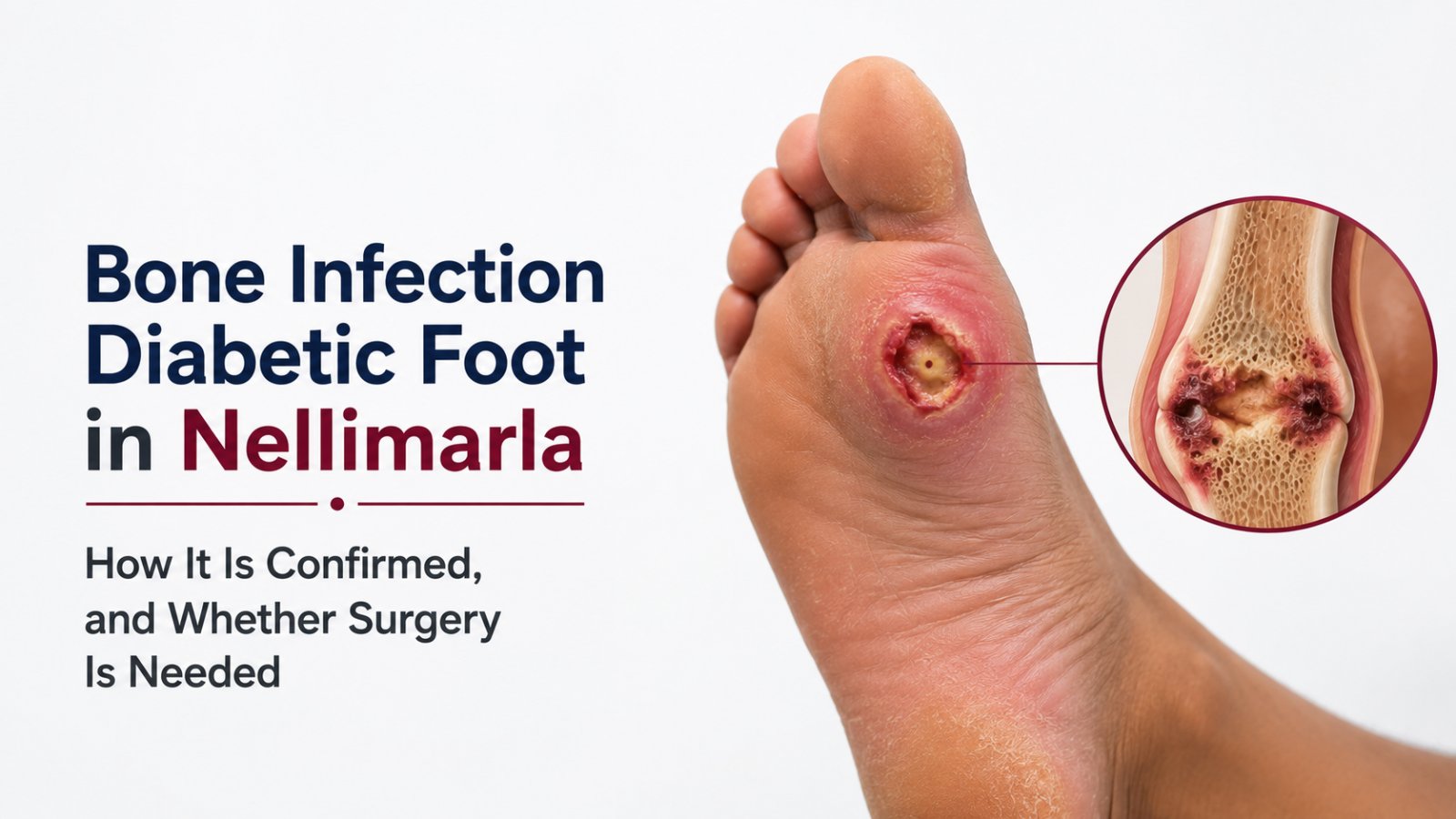
A bone infection diabetic foot in Nellimarla, called osteomyelitis, happens when bacteria from a foot ulcer spread into the bone underneath. It is the usual reason a wound refuses to heal for months. It is treated with prolonged antibiotics, surgical removal of the infected bone, or both.
This is the diagnosis that changes everything about a foot ulcer, and it is also the one most often missed. Bone infection rarely announces itself with dramatic symptoms. It usually shows up as a wound that simply will not close, in someone who has been told to keep doing dressings.
How do you know if the bone is infected?
You often cannot know by looking, which is the central difficulty. Bone infection is suspected when an ulcer has failed to heal despite good care, when it is deep or large, when bone is visible or can be touched with a probe, or when a whole toe is red and swollen.
Suspicion rises with any of these:
- An ulcer that has not healed after about six weeks of proper treatment.
- Visible bone, or bone felt when the wound is gently probed.
- A "sausage toe", a whole toe that is red, swollen and sausage-shaped.
- A deep or wide ulcer, especially over a bony point.
- Recurring infection in the same site despite repeated antibiotic courses.
- Raised inflammatory markers on blood tests without another explanation.
- Foul discharge or a wound that keeps producing pus.
Why is it so hard to diagnose?
Because the classic signs of infection are muted in a diabetic foot. Neuropathy removes the pain that would normally signal deep infection, poor circulation blunts redness and swelling, and many patients have no fever at all even with established bone infection.
There is a second trap. Charcot foot, a non-infective collapse of the bones, can look almost identical, with a hot swollen foot and abnormal X-rays. Distinguishing the two matters enormously, because one needs antibiotics and possibly surgery, while the other needs immobilisation and protection.
Which tests actually confirm it?
No single test is perfect. X-ray is the starting point but is often normal early, MRI is the most useful imaging, and a bone sample sent for culture is the reference standard. The combination, read alongside the clinical picture, is what gives the answer.
| Test | What it shows | Important limitation |
|---|---|---|
| Plain X-ray | Bone destruction, erosion, sequestrum | Often normal for the first two to three weeks. A normal X-ray does not exclude infection |
| Probe-to-bone test | Whether bone can be touched through the wound | Simple and useful, but must be interpreted with other findings |
| MRI | Bone marrow changes, abscesses, extent of infection | Can be difficult to distinguish from Charcot changes |
| Blood tests | Inflammatory markers, sugar control, kidney function | Can be normal, and are not specific to bone |
| Bone biopsy and culture | Confirms infection and identifies the exact organism | Requires a procedure, but guides antibiotic choice most accurately |
Two points are worth emphasising because they change decisions. First, an early normal X-ray reassures many patients wrongly; bone changes lag behind the infection by weeks. Second, a swab taken from the surface of the ulcer often grows surface bacteria rather than the organism actually living in the bone, which is why bone samples matter.
What is the probe-to-bone test?
It is a simple bedside examination in which a sterile blunt probe is passed gently into the ulcer to feel whether hard, gritty bone can be touched. If bone is reached in a deep, chronically infected ulcer, bone infection becomes considerably more likely.
It costs nothing, takes seconds, and is done by a clinician, never at home. Probing a wound yourself risks introducing new bacteria into a foot that is already struggling.
Antibiotics or surgery: how is that decided?
Both are legitimate. Antibiotics alone can work when the infection is limited, blood supply is good and no dead bone remains. Surgery is chosen when bone is dead or exposed, when infection is extensive, when abscess is present, or when antibiotics have already failed.
Antibiotic-led treatment tends to suit:
- Infection limited to a small area of forefoot bone.
- Adequate circulation to deliver the antibiotic.
- No dead bone fragment or abscess needing drainage.
- A patient able to complete a long course reliably.
Surgery tends to be needed when:
- Bone is dead, exposed or crumbling.
- There is an abscess or spreading soft tissue infection.
- Blood supply is too poor for antibiotics to reach the bone.
- Prolonged antibiotics have already failed.
- The infected bone is also the pressure point causing the ulcer.
Circulation is assessed before either route, through our vascular services, because an antibiotic cannot reach bone that has no blood supply. Surgical options sit within diabetic foot surgery, and wound care alongside them under non-surgical wound management.
How long does treatment take?
Treatment is measured in weeks, not days. When infected bone is left in place and treated medically, antibiotic courses generally run around six weeks. When all infected bone is surgically removed, a much shorter course is usually sufficient, often one to two weeks.
That difference is the practical argument for surgery in suitable cases: removing the infected bone shortens antibiotic exposure considerably. Against it sits the fact that removing bone alters foot mechanics and can create a new pressure point elsewhere, so the decision is balanced case by case rather than by rule.
Why does bone infection come back?
Recurrence usually means something was left behind or left uncorrected: residual infected bone, inadequate blood supply, an uncorrected pressure point, or antibiotics stopped early. It rarely means the bacteria were unusually resistant.
- Residual infected or dead bone not fully removed.
- Poor circulation that was never assessed or treated.
- The original pressure point still crushing the same spot with every step.
- Antibiotics stopped early once the wound looked better.
- Poor blood sugar control, low protein or anaemia.
Where infection has reached bone, amputation is often raised as the next step. It is not always necessary, and the alternatives are set out in our post on limb preservation surgery.
How do you stop it happening in the first place?
Bone infection almost always begins as a skin wound. Preventing it means treating small foot wounds within days rather than months, checking feet daily, never walking barefoot, and having ulcers assessed properly rather than dressed indefinitely.
- Get any ulcer assessed if it has not healed in two to four weeks.
- Treat blisters early, as covered in our post on blisters on the foot with diabetes.
- Protect the heels of anyone bed-bound, since heel wounds reach bone quickly. See pressure ulcers of the foot.
- Treat infected or ingrowing nails properly, not at home. See pincer nail correction.
- Never walk barefoot, and inspect both feet daily.
- Attend regular reviews under preventive foot care.
Related problems across the spectrum are listed under foot conditions we treat.
Bone infection and diabetic foot care for Nellimarla
Elegance Diabetic Foot & Ulcer Clinic (EDFC), led by Dr. Ashutosh Shah, provides diabetic foot infection treatment, bone-preserving surgery, reconstruction and limb salvage from its centre in Surat, with care expanding into the Vizianagaram district including Nellimarla. If you suspect a bone infection diabetic foot in Nellimarla, the questions that matter are whether the diagnosis has actually been confirmed and whether circulation has been assessed.
You can send clear photos of the wound, along with any X-ray or MRI reports, to our team on WhatsApp for initial guidance and book a foot assessment. If there is fever, spreading redness, swelling or foul discharge, go to hospital the same day instead. Follow EDFC on Facebook, Instagram and YouTube for foot care guidance and real limb salvage stories.
A wound that will not heal deserves a proper answer
If an ulcer has been dressed for months without closing, the useful next step is not another dressing. It is finding out whether the bone underneath is infected, and whether the foot has the blood supply to heal at all.
Next step: book a foot and circulation assessment with Dr. Ashutosh Shah at Elegance Diabetic Foot & Ulcer Clinic, or send photos and your reports on WhatsApp today for initial guidance.
Medical disclaimer: This article is for educational purposes only and is not a substitute for professional medical diagnosis or treatment. Bone infection can only be confirmed by clinical assessment with appropriate imaging and, where indicated, bone culture. Fever, spreading redness or foul discharge needs urgent care. Please consult Dr. Ashutosh Shah or a qualified specialist about your condition. For further guidance, see the NHS guide to osteomyelitis and the IWGDF diabetic foot guidelines.
quiz Frequently Asked Questions
This article is general education, not a diagnosis. If you have a diabetic foot wound, please have it assessed in person. Send a photo on WhatsApp or book a consultation.
About the Author

Dr. Ashutosh Shah, Plastic, Reconstructive & Diabetic Foot Surgeon, Elegance Diabetic Foot & Ulcer Clinic, Surat
Dr. Ashutosh Shah is a board certified plastic and reconstructive surgeon with over 22 years of experience and more than 10,000 limbs and feet saved. He founded Elegance Diabetic Foot & Ulcer Clinic, India's first chain of clinics dedicated to foot care, with centres in Surat and OPD partners across South Gujarat. He is known for a limb first approach, safe wound care and ethical, natural results.