Written by Dr. Ashutosh A Shah, M.B.B.S., M.S., M.Ch., D.N.B., Consultant Plastic and Reconstructive Surgeon, Elegance Diabetic Foot and Ulcer Clinic, Surat. Reg. no. [REG NO]. 22+ years in reconstructive surgery and limb salvage.
Medically reviewed by Dr. Ashutosh A Shah · Published 26 September 2026 · Last reviewed 26 September 2026
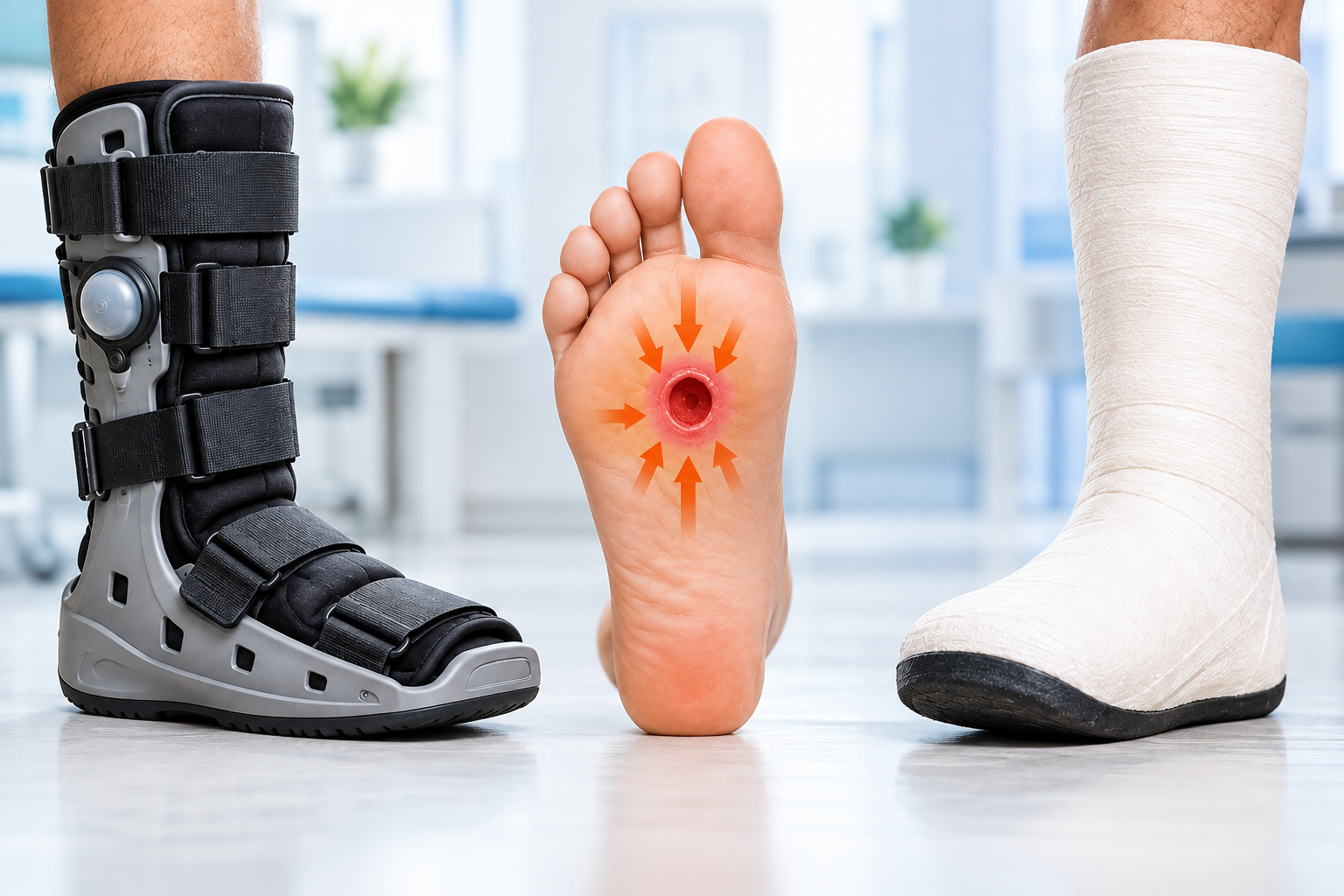
Offloading a diabetic foot means taking pressure off a healing wound so tissue can repair. An aircast boot is removable and uses inflatable air cells to spread load. A total contact cast is non-removable and offloads more reliably. Guidelines put the non-removable device first, because a device that can come off usually does.
Most people are handed a boot and told to wear it. Very few are told why the removable one is second choice, how long they will be in it, or what to do about the fact that it makes one leg longer than the other.
This page covers the devices themselves: what each one is, how they differ, what the guidelines actually say, and what living in one is like for the weeks it takes a wound to close.
What does offloading mean, and why does pressure stop a wound healing?
Offloading means removing mechanical pressure from an area of the foot so the tissue underneath can repair. A wound on the sole is being re-injured with every step, and a wound that is re-injured daily cannot close.
That is the whole principle. Dressings manage the surface of a wound. They do nothing about the force that created it. If pressure has not been addressed, the wound has not yet been treated, only covered.
Two things make this worse in a diabetic foot specifically. Sensation is often reduced, so the foot gives no warning that it is being loaded. And the walking pattern itself is usually the cause, which means normal walking in normal shoes is what keeps the wound open.
How do the offloading options compare?
They differ mainly in one respect: whether you can take the device off. Everything else follows from that. The IWGDF 2023 offloading guideline sets out a clear order of preference.
| Device | Can it be removed? | Where it sits in the guideline | Main limitation |
|---|---|---|---|
| Total contact cast | No. Moulded to the leg | First choice, as a non-removable knee-high device | Needs skilled application. Wound cannot be seen between visits |
| Knee-high walker rendered irremovable | No, once wrapped or sealed | First choice, same category as the cast | Same visibility issue. Depends on it staying sealed |
| Removable knee-high walker, including air-cell boots | Yes | Second choice, when non-removable is not suitable or not tolerated | Only works while it is on the leg |
| Ankle-high removable boot | Yes | Second choice, alongside the removable knee-high | Offloads less than a knee-high device |
| Felted foam with well fitting footwear | Yes | Third choice, when offloading devices are not available | A fallback, not an equivalent |
One instruction from the same guideline is worth repeating on its own, because it is the most commonly broken rule in this whole subject. Do not wear ordinary shoes, or standard therapeutic footwear, over an offloading device. The guideline says so explicitly.
What is an aircast boot, and how do the air cells work?
An aircast boot is a removable walking boot with inflatable cells inside a rigid outer shell. The cells are inflated after the boot is on, so the lining moulds around the shape of your leg rather than pressing on a few fixed points.
Two things are happening at once. The rigid shell and the rocker sole stop the foot bending and rolling through the step, which is what drives pressure into the forefoot. The air cells then spread whatever load remains across a wide area instead of concentrating it.
The inflation is not a comfort feature and it is not set once. Legs swell and settle over a day and over weeks, so the fit changes. If the boot has become loose enough to move on the leg, it is no longer offloading the way it was fitted to.
Air cells do not make a removable boot equivalent to a cast. They make it a better removable boot.
Why does a non-removable device usually heal a wound faster?
Because it is worn. That is the entire mechanism, and the guideline says so in plain terms: the principal advantage of non-removable devices over removable ones is enforced adherence.
This is not a judgement about willpower. A removable boot comes off to shower, to sleep, to answer the door, to walk to the bathroom at two in the morning. Each of those is a handful of unprotected steps on a wound, and a handful of steps is enough to undo a day of protection.
NICE guideline NG19 takes the same position for a defined group of ulcers, recommending non-removable casting to offload plantar neuropathic, non-ischaemic, uninfected forefoot and midfoot ulcers, and an alternative offloading device in the meantime until casting can be provided.
There are real reasons a non-removable device is not always the right call. The IWGDF guideline is specific that where there is severe infection or poor blood supply, those are addressed first and the offloading decision follows. A wound that must be seen daily cannot be sealed inside a cast. Those are clinical decisions, not preferences.
How long is each device worn, and what happens at the reviews?
Until the wound closes, not for a set number of weeks. This is the question every patient asks and the honest answer is that guidelines do not set a standard duration, because it depends on the wound rather than the device.
What is specified is review. The IWGDF guideline is explicit that when an ulcer is infected or the blood supply is poor, it should be monitored at least weekly by a healthcare professional so the device can be removed and the wound checked.
What a review is actually for:
- Taking the device off and looking at the wound, which is the only way to know whether the plan is working.
- Checking the rest of the foot and the leg for damage caused by the device itself.
- Re-fitting. Swelling reduces over the first weeks and a device fitted to a swollen leg becomes loose.
- Deciding whether to continue, change device, or escalate.
If you are several weeks in and nobody has taken the device off and looked, that is worth raising. A device is a treatment under review, not a thing you are left in.
How does a boot on one foot affect the other leg and the back?
A knee-high boot is taller than your shoe, so the leg wearing it is effectively longer. Every step becomes uneven, and the hip, knee and lower back on the opposite side absorb the difference.
People notice this in week two, usually as one-sided lower back pain or knee pain on the good leg, and they rarely connect it to the boot. It is the boot.
The fix is straightforward and is often simply not offered: a levelling shoe, sometimes called an even-up, worn on the opposite foot to match the boot's height. Ask for one at fitting rather than waiting until your back hurts.
There is a second reason this matters more than comfort. An uneven gait changes where pressure lands on the other foot, and in a person with neuropathy the other foot is also at risk. Protecting the good foot is part of treating the bad one.
What should you check on your skin every day in a boot?
Everything the device touches, every day, using a mirror for the sole. Devices cause pressure damage of their own, and in a numb foot the first warning you get is what you see, not what you feel.
| What to look for | Where | What it usually means |
|---|---|---|
| Redness that does not fade within about 20 minutes of the device coming off | Heel, ankle bones, top of the foot, shin | Sustained pressure at that point. Needs refitting |
| A new blister or broken skin | Strap edges, the rim at the top of the boot | Rubbing. Stop using it and be seen |
| Wetness, staining or a smell inside the device | Anywhere | Drainage from the wound. Be seen promptly |
| The boot moving or rotating on the leg | The whole device | It has become loose and is no longer offloading correctly |
| New swelling, or the device suddenly feeling tight | Foot and lower leg | Needs assessment before you keep wearing it |
In a non-removable cast you cannot do this, which is exactly why the review schedule exists and why anything unusual means contacting the clinic rather than waiting.
What is daily life in a boot actually like?
Manageable, but it changes more than people expect. This is the part nobody explains at fitting, and it is where most of the practical problems of week two come from.
- Bathing. A cast or boot must stay dry. Use a proper waterproof cover rather than a plastic bag and tape, and sit down to wash rather than standing on one leg on a wet floor.
- Sleeping. Ask specifically whether yours comes off at night. Some do, many do not, and guessing is how wounds get walked on at 3am.
- Stairs. The rocker sole is designed to roll forward, which is unhelpful on a step. Lead with the unaffected leg going up and with the boot going down, and use a handrail.
- Driving. Not in the boot. It changes how fast you can move to the brake. Ask your treating team, and check your motor insurance, because cover can be affected.
- Work. A job that involves standing or walking is the main reason wounds do not close. Say so at your appointment. A note for your employer is easier to arrange than a wound that reopens.
- Getting around the house. Loose rugs, thresholds and slippers on the other foot are the common trip hazards while wearing a rigid boot.
In our clinic in Surat the practical problems that bring people back early are almost never the wound. They are a boot that got wet, a boot nobody said could come off at night, and back pain from walking unevenly for a fortnight. All three are avoidable at fitting.
Why does footwear not stop when the wound closes?
Because the pressure that caused the ulcer has not gone anywhere. Closing the skin does not change the shape of the foot, the callus pattern or the loss of sensation, and new skin over an old wound is the most vulnerable skin on the foot.
The device comes off and everyday footwear takes over the job. What that footwear needs to do, how to check a fit you cannot feel and when custom insoles are needed is its own subject and is covered separately. The point here is only that this is a handover, not an ending. Callus returning at the same spot is the early warning, and there is more on that in our post on callus on a diabetic foot.
Which warning signs mean stop and be seen?
New pain, wetness, smell or visible rubbing. Any of those means the device comes off and you are seen, not that you wait for the next appointment.
- New or increasing pain, particularly in a foot that is usually numb. Pain appearing in a numb foot is significant.
- Wetness, staining or discharge from inside the device.
- A smell that was not there before.
- Fever, chills, or feeling generally unwell.
- A new area of broken skin anywhere the device touches.
- Redness spreading up the foot or leg, or the leg becoming hot.
NICE NG19 sets the expectation for urgency in this situation: a person with a new diabetic foot problem should be referred to the multidisciplinary foot care service within 24 hours of the initial examination. If you are worried, that is the timescale the guideline works to, and it is a reasonable thing to expect.
The full picture of why a wound stops making progress, and what is done about it, is in our separate post on a foot ulcer that will not heal.
Are these boots only used for diabetes?
No, and it is worth saying because the same boot turns up in very different situations. Walking boots and casts are routinely used after ankle and foot fractures and after surgery, for the same reason: they hold the area still and take load off it.
The NHS notes that for a broken ankle you may be given a boot or a plaster cast, and that the injury "usually takes 6 to 8 weeks to heal, but it can take longer". That timescale is for a fracture, not for an ulcer, and the two should not be read across. A fracture heals on a reasonably predictable schedule. A wound heals when the conditions allow it.
The difference that matters clinically is sensation. Someone in a boot after a fracture feels a rub and adjusts it. Someone with neuropathy does not, which is why the daily skin check in a diabetic foot is not optional advice.
How is offloading fitted at EDFC, Surat?
By deciding first what the wound needs, then which device can actually deliver it for you specifically. The guideline order is the starting point, not the answer, because a device that does not suit your circumstances will not be worn.
What that assessment covers:
- Where the wound sits, how deep it is, and whether the forefoot, midfoot or heel is loaded.
- Whether anything needs attention before a device is sealed on.
- The shape of the foot, any deformity, and where callus is forming.
- How far you actually need to walk in a normal day, and on what surfaces.
- Whether you can manage stairs, bathing and getting to the bathroom at night.
- Who is at home to help, and whether anyone can check the skin for you.
In practice the most common reason a first device is changed is not the wound at all. It is that the person cannot live in it, so they stop wearing it, and nobody asked the question at fitting. That is a fixable failure and it is worth being honest about at the first appointment rather than the third.
Offloading sits inside the wider limb preservation work described on our diabetic foot programs page, and for people who cannot travel easily there is a home wound care service.
Next step
If you are in a boot and something about it is not working, that is a reason to be seen rather than to persevere. Book an assessment through the EDFC contact page in Surat, and bring the device with you.
This article is for education and is not a substitute for professional diagnosis or treatment. Which offloading device suits you depends on your wound, your circulation and your circumstances, and can only be decided after an examination. Please consult Dr. Ashutosh A Shah or another qualified specialist about your own foot.
quiz Frequently Asked Questions
This article is general education, not a diagnosis. If you have a diabetic foot wound, please have it assessed in person. Send a photo on WhatsApp or book a consultation.
About the Author

Dr. Ashutosh Shah, Plastic, Reconstructive & Diabetic Foot Surgeon, Elegance Diabetic Foot & Ulcer Clinic, Surat
Dr. Ashutosh Shah is a board certified plastic and reconstructive surgeon with over 22 years of experience and more than 10,000 limbs and feet saved. He founded Elegance Diabetic Foot & Ulcer Clinic, India's first chain of clinics dedicated to foot care, with centres in Surat and OPD partners across South Gujarat. He is known for a limb first approach, safe wound care and ethical, natural results.