Written by Dr. Ashutosh A Shah, M.B.B.S., M.S., M.Ch., D.N.B., Consultant Plastic and Reconstructive Surgeon, Elegance Diabetic Foot and Ulcer Clinic, Surat. Reg. no. [REG NO]. 22+ years in reconstructive surgery and limb salvage.
Medically reviewed by Dr. Ashutosh A Shah · Published 29 September 2026 · Last reviewed 29 September 2026
Bunion pain diabetes assessment differs from bunion pain alone, because a bunion creates a fixed pressure point and reduced sensation can hide the damage it causes. The concern is not only comfort. It is that pressure points are where diabetic foot ulcers commonly begin, and NICE treats deformity as a risk factor in its own right.
Most advice about bunions is written for people who can feel their feet. It is about pain, about which shoes hurt less, and about when the discomfort justifies surgery. All of that assumes pain is a reliable signal.
With diabetes it often is not, and that changes the whole question. This page is about what a bunion does to the loading of your foot, why that matters far more when sensation is reduced, and what to do about it.
What is a bunion, in terms that matter here?
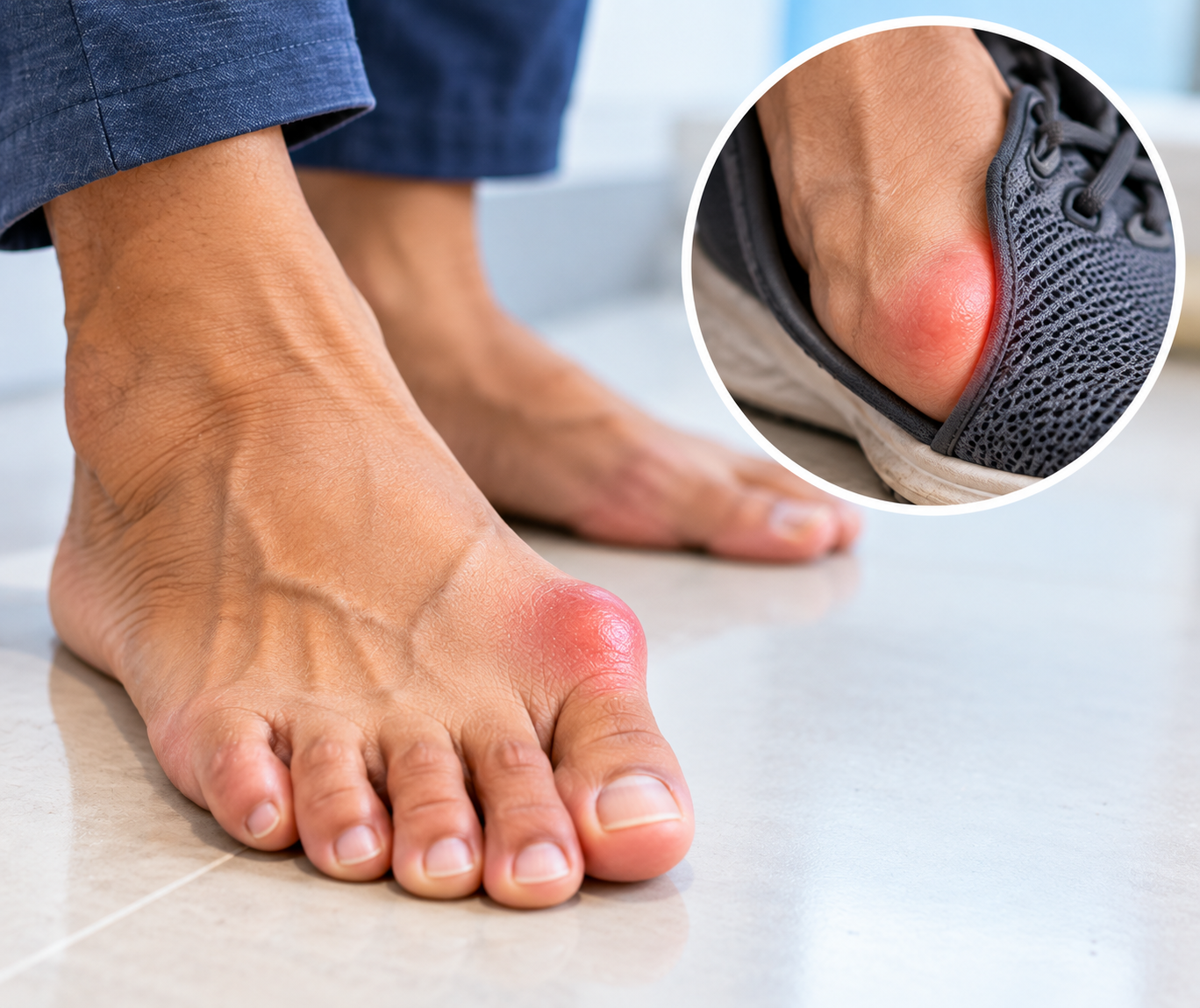
A change in the shape of the joint at the base of the big toe, where the joint drifts outward and the toe angles inward. The medical name is hallux valgus. What matters for this page is the result: a bony prominence on the inner edge of the foot that sticks out further than the rest.
That prominence is the whole subject. It is a fixed point that now contacts the inside of every shoe you own, and it now carries load the foot was not designed to put there.
On a foot with normal sensation, that prominence announces itself. It rubs, it aches at the end of the day, and the person changes shoes. That feedback loop is what protects most people who have bunions.
Why does a bunion change where the foot takes load?
Because the forefoot is a load-sharing structure, and moving one joint out of line moves the load onto whatever is left. The big toe joint normally takes a large share of the push-off in every step, and when it drifts, that share is redistributed.
Two things happen at once. The prominence itself becomes a contact point against footwear, taking friction it never used to take. And the load that the big toe joint used to carry shifts sideways onto the lesser toe joints, which are not built for it.
You can often see the evidence before anyone measures it. Hard skin builds where the pressure now is, and hard skin on a foot is a map of where load has moved. On any foot that map is interesting. On a diabetic foot it is a warning.
Why does that matter more when you have diabetes?
Because the national guidance does not treat a foot deformity as a comfort problem. It uses it to decide how closely your feet need watching. NICE guideline NG19 sets its risk categories out plainly.
NG19 places in the moderate risk group anyone with "deformity or neuropathy or peripheral arterial disease". It places in the high risk group, among others, anyone with "neuropathy in combination with callus and/or deformity or peripheral arterial disease in combination with callus and/or deformity".
Read that against your own foot. A bunion by itself moves you into moderate risk. A bunion together with reduced sensation, or with poor circulation, moves you into high risk. The IWGDF guidance reaches the same place from the other direction, putting "LOPS + foot deformity or PAD + foot deformity" in its moderate risk category.
That is the practical meaning of this page's title. The bunion is not the disease. It is the place where the disease is most likely to show itself.
What part does reduced sensation play?
It removes the alarm. Everything protective about having a bunion on a normal foot depends on it hurting enough to make you change what you are doing, and reduced sensation switches that off.
This is why a painless bunion can be more dangerous than a painful one, and it is the single most counter-intuitive thing on this page. A person whose bunion aches will stop wearing the shoe that causes it. A person who feels nothing will wear that shoe all day, every day, for months, while the skin over the prominence breaks down quietly.
Loss of protective sensation is tested, not guessed. IWGDF names the methods: "Pressure perception: Semmes-Weinstein 10 gram monofilament; Vibration perception: 128 Hz tuning fork". If nobody has done either on your feet, you do not know which category you are in.
Three things over a bunion mean be seen, not wait: any break in the skin however small, any hard or discoloured skin over the prominence, and any warmth, swelling or redness around the joint. The full set of diabetic foot warning signs, and how urgent each one is, is covered in our guide to the seven warning signs.
What should you check on your own foot, and how often?
Daily, by looking rather than by feeling, with the bunion prominence as a named checkpoint. IWGDF advises that people at risk "should be encouraged to wash and examine their feet daily and to learn how to recognize (pre-) ulcerative lesions".
A general daily foot check is covered in the warning signs guide. What is specific to you is that the bunion gives you a known address to inspect, which makes the check faster and more reliable.
- Look at the prominence itself, on the inner edge, in good light. Use a mirror or your phone camera if you cannot see it comfortably.
- Look for colour. Redness that does not fade within an hour of taking your shoes off is pressure that is still happening.
- Look for hard or thickened skin, and for any dark spot within it, which can be bleeding underneath.
- Look between the first and second toes, where the drifting toe now crowds its neighbour.
- Look at the lesser toe joints, under the ball of the foot, because that is where the transferred load landed.
How often a clinician should be checking is set by your risk category. NICE recommends assessment "Frequently (for example, every 3 to 6 months) for people who are at moderate risk" and "More frequently (for example, every 1 to 2 months) for people who are at high risk, if there is no immediate concern". Having a bunion puts you in at least the first of those.
What actually needs to change about your footwear?
The shoe has to accommodate the prominence rather than compress it, and it has to be judged by hand rather than by comfort. IWGDF is direct about what happens when off-the-shelf shoes cannot do this: "If there is no off-the-shelf footwear that can accommodate the foot (e.g., if the fit is poor due to foot deformity)...prescribe therapeutic footwear."
| What to look for | Why it matters on a diabetic foot with a bunion |
|---|---|
| Width and depth at the toe box | The prominence needs room, not stretch. A shoe that "gives" is still pressing |
| No seam over the prominence | Seams sit exactly where the bunion is and become the friction point |
| Adjustable fastening, laces or straps | Feet swell through the day. A slip-on either presses in the evening or slides in the morning |
| A firm sole that does not twist | Reduces the bending force driven through the forefoot at every step |
| Depth to take an insole | An insole added to a shallow shoe tightens it, which undoes the point of the insole |
| Fitted late in the day | The foot is at its largest then, so a shoe fitted in the morning may be too small by evening |
| Checked by hand, not by feel | With reduced sensation, comfort is not evidence. Press along the inside with your thumb |
The last row is the one most people skip. If you cannot feel pressure reliably, "it feels fine" tells you nothing about whether the shoe fits. Feel the inside of the shoe with your hand, and look at your foot after wearing it.
What can padding and offloading do, and what are their limits?
They redistribute pressure. They do not change the shape of the joint, and nothing worn on the outside will. That is the honest boundary and it is worth being clear about before anyone spends money.
Properly made insoles and prescribed footwear can genuinely take load off the prominence and off the transferred pressure points. What they cannot do is correct the deformity, and a device that promises to is describing something it does not do.
Hard skin over a bunion is not a home job. Thickened callus over a pressure point is a pre-ulcerative lesion, and IWGDF's instruction is to "Provide appropriate treatment of excess callus on the foot", meaning by a clinician.
- No blades, no razors, no scrapers. A cut you cannot feel on a foot with reduced circulation is how an ulcer starts.
- No files or pumice on thickened skin over a bony prominence.
- No medicated corn caps, corn plasters or chemical agents. They work by damaging skin, which is the last thing this foot needs.
- Do not burst or drain anything, including a blister over the prominence.
- Do not pad the prominence with whatever is to hand. Improvised padding can concentrate pressure at its edges instead of spreading it.
What to do at home between reviews, including washing, drying and moisturising, is set out in the EDFC home care guidance. Hard skin itself, and why it matters, is covered in our guide to callus on a diabetic foot.
When does bunion pain diabetes care need more than footwear?
When the skin over the prominence has already changed, when the deformity cannot be accommodated by any shoe, or when the transferred pressure is causing problems elsewhere on the foot. At that point footwear is managing a situation rather than solving it.
Signs that the conversation has moved beyond shoes:
- Callus that keeps returning over the prominence despite proper footwear, because it is telling you the pressure was never removed.
- Any break in the skin, at any time, however small. This is not a footwear problem any more.
- New pain in a foot that was numb. A change in sensation in either direction is worth assessing.
- Pressure problems under the lesser toes, showing the load transfer is now causing its own trouble.
- No shoe fits. When off-the-shelf footwear cannot accommodate the foot, IWGDF's answer is therapeutic footwear, not a bigger size.
Why a small ulcer at a pressure point is taken so seriously, and what the decision points are afterwards, is set out in our guide to preventing a diabetic foot amputation.
Why is bunion surgery a different decision when you have diabetes?
Because the calculation changes on both sides. The benefit is different, and so is the risk, and neither is the same as it would be for someone without diabetes.
For a person with normal sensation and circulation, bunion surgery is largely an elective decision about pain and function. For a person with diabetes it becomes a question about a pressure point on a foot that may heal slowly and may not signal a problem, which makes both the reason for operating and the risk of operating different.
What has to be established before that decision can even be discussed:
- Circulation, assessed properly rather than by feeling for a pulse. Surgery on a foot that cannot deliver blood to a wound is a different operation.
- Sensation, tested, because it changes both the indication and the aftercare.
- Whether there is any active infection or skin breakdown, which is addressed first.
- Glycaemic control, because it affects healing.
- Whether offloading and footwear have genuinely been tried, as opposed to attempted with the wrong shoes.
- What the recovery actually requires of you, including a period of restricted weight bearing, and whether that is realistic in your circumstances.
This page does not describe how the operation is done, because that is not the useful part for someone deciding. The useful part is knowing that a surgeon who offers it without assessing circulation and sensation first has not assessed you, they have assessed your bunion.
How is a bunion assessed at EDFC, Surat?
As a pressure problem first and a shape problem second. The examination asks where load has moved, what the skin is doing about it, and how much protective sensation remains.
In our practice in Surat the commonest pattern on a foot like this is not the bunion itself but what has grown over it. Thickened skin on the prominence, and often a second area under the ball of the foot where the load transferred to, in someone who has felt nothing and assumed the foot was fine because it did not hurt. The second commonest is a person who has been changing shoes for years and has never had sensation tested, so nobody, including them, knows which risk category they are in.
An assessment covers sensation testing, arterial assessment, where the pressure points actually are, the state of the skin over each one, your footwear examined by hand, and a plan with a review interval matched to your risk category rather than a generic one. The clinic's treatment programs set out how that fits into ongoing care.
Next step
If you have diabetes and a bunion, the useful next step is having sensation and circulation tested and the pressure points mapped, rather than buying another pair of shoes. Book an assessment through the EDFC contact page in Surat, and bring the shoes you wear most with you.
This article is for education and is not a substitute for professional diagnosis or treatment. Do not attempt to treat hard skin, a blister or any break in the skin on a diabetic foot yourself. Please consult Dr. Ashutosh A Shah or another qualified specialist about your own foot.
quiz Frequently Asked Questions
This article is general education, not a diagnosis. If you have a diabetic foot wound, please have it assessed in person. Send a photo on WhatsApp or book a consultation.
About the Author

Dr. Ashutosh Shah, Plastic, Reconstructive & Diabetic Foot Surgeon, Elegance Diabetic Foot & Ulcer Clinic, Surat
Dr. Ashutosh Shah is a board certified plastic and reconstructive surgeon with over 22 years of experience and more than 10,000 limbs and feet saved. He founded Elegance Diabetic Foot & Ulcer Clinic, India's first chain of clinics dedicated to foot care, with centres in Surat and OPD partners across South Gujarat. He is known for a limb first approach, safe wound care and ethical, natural results.