
Surgical Offloading
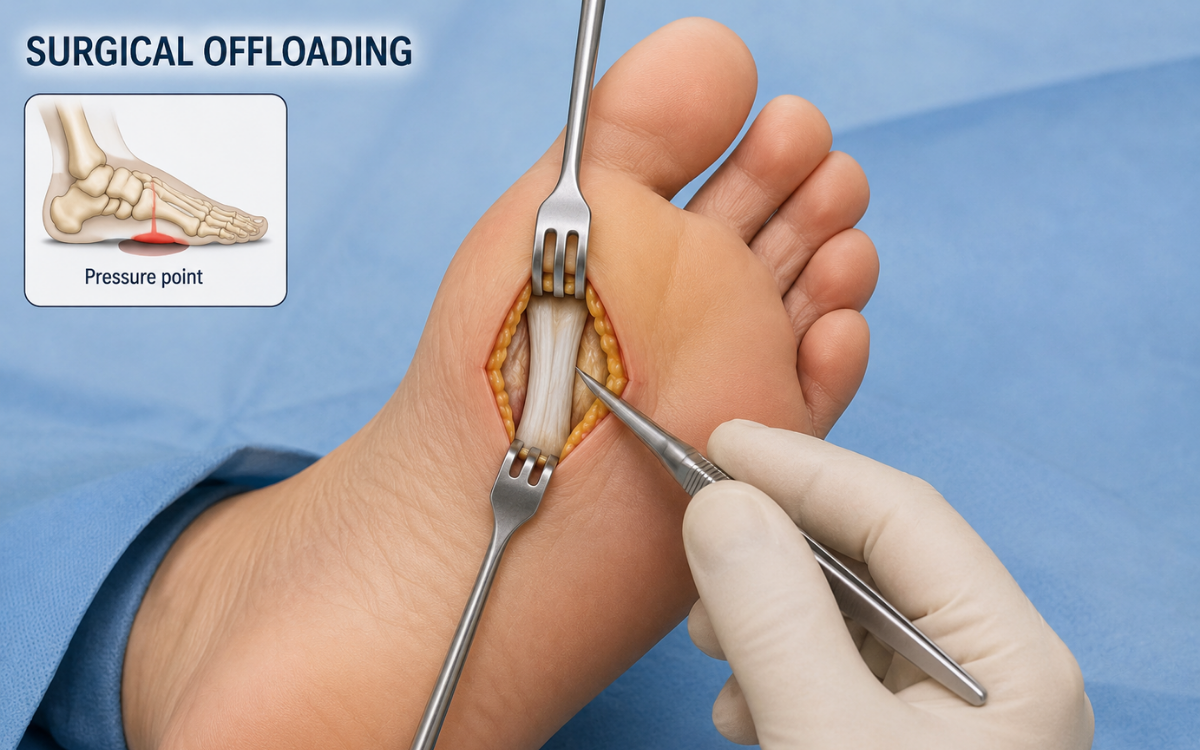
Operations that permanently remove the pressure point causing an ulcer, rather than padding around it.
Key Takeaways
- External offloading works only while the patient wears the device correctly.
- Surgical offloading changes the foot permanently, so protection never comes off.
- Procedures are usually small, often through incisions of a centimetre or less.
- It is considered when an ulcer keeps recurring despite proper footwear.
What Is Surgical Offloading?
It means correcting the mechanical cause of an ulcer through surgery rather than compensating for it with devices. A prominent metatarsal head is elevated or shortened, a curled toe is straightened, or a bony bump is removed. The pressure point disappears with it.
When Is Surgery Preferred Over Footwear?
- The ulcer has recurred despite correct insoles and prescribed shoes
- The patient cannot reliably wear offloading devices
- The deformity is fixed rather than flexible
- The ulcer sits over a sharp bony prominence with thin skin cover
- Repeated wound treatment is disrupting work and daily life
Which Procedures Are Commonly Used?
Flexor tenotomy releases the tendon curling a toe, straightening it in a procedure taking minutes. Metatarsal osteotomy raises a prominent bone so it stops digging into the sole. Exostectomy removes a bony bump, particularly under a collapsed midfoot. Each is chosen to match where the pressure actually falls, which is why pressure mapping comes first.
What Results Should You Expect?
Ulcers that resisted months of dressings frequently close within weeks once the pressure is gone. Recurrence at that site drops substantially. Honestly though, surgery on one area can shift load elsewhere, so follow up pressure checks and footwear review remain part of the plan.
What Does It Cost and Is It Safe?
These are small day procedures, priced well below major reconstructive surgery, with the quote given after assessment. Safety depends mainly on circulation, so blood supply is always tested beforehand, and revascularisation comes first where flow is inadequate.
What Should You Do Before and After the Procedure?
Beforehand, sugar control is optimised and circulation confirmed, because both determine how well the small wound heals. Bring your current footwear so the team can see what you actually walk in every day.
Afterwards, the operated area is protected for a few weeks in a post surgical shoe. Once healing completes, fresh pressure mapping guides a new insole design, since the foot now loads differently from before.