
Nerve Entrapment Release
Surgery to free a nerve trapped at a narrow point, which can restore sensation that neuropathy alone would not.
Key Takeaways
- Diabetic nerves swell, making them vulnerable at natural narrow points in the leg and foot.
- Compression adds to neuropathy and is potentially reversible, unlike the neuropathy itself.
- The tarsal tunnel at the inner ankle is the commonest site.
- Careful selection matters, since the procedure helps compression rather than pure neuropathy.
Why Do Diabetic Nerves Get Trapped?
High sugar causes nerves to take up water and swell. Where a swollen nerve passes through a fixed tunnel of bone and ligament, it becomes compressed. That compression restricts blood supply to the nerve, which worsens function further, creating a cycle.
Importantly, this compression component is mechanical, and mechanical problems can be corrected.
Which Signs Suggest Entrapment Rather Than Neuropathy Alone?
- Symptoms noticeably worse on one side than the other
- Tingling triggered by tapping over the inner ankle
- Night pain that eases when the foot is moved or hung down
- Symptoms following a particular nerve territory rather than a glove and stocking pattern
- Rapid worsening over months rather than years
What Does the Surgery Involve?
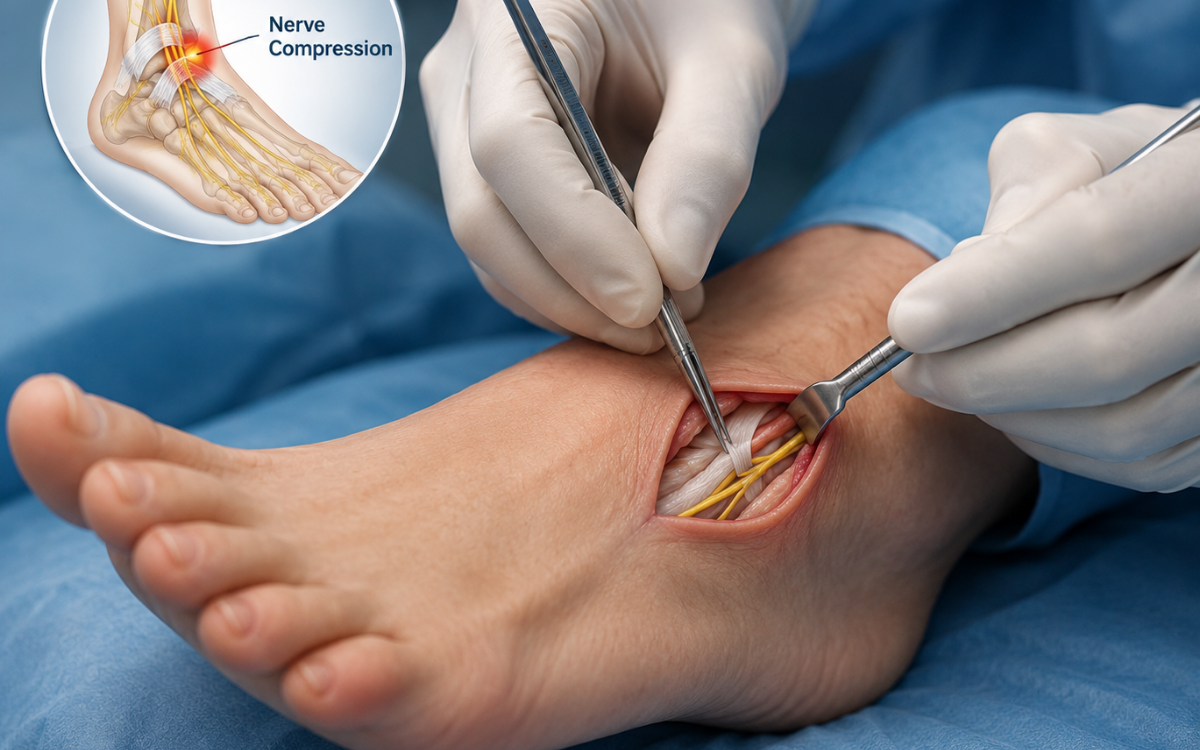
The tight ligament roof over the tunnel is divided, giving the swollen nerve room. It is usually a day procedure through a small incision. The tarsal tunnel at the inner ankle is most commonly released, though the common peroneal nerve near the knee is also treated.
What Results Are Realistic?
Selected patients report meaningful improvement in burning pain and, in some cases, partial return of protective sensation. However, we are careful with expectations, because outcomes depend heavily on selection. Where nerve damage is purely metabolic with no compression, release will not help, and we say so rather than operating.
Assessment through our neuropathy service determines which pattern you have.
What Does It Cost and What Is Recovery Like?
It is a day procedure, quoted after assessment. Expect a dressing for around two weeks, limited walking initially, and gradual improvement in symptoms over the following months rather than immediately.