Written by Dr. Ashutosh A Shah, M.B.B.S., M.S., M.Ch., D.N.B., Board Certified Plastic Surgeon, Elegance Diabetic Foot & Ulcer Clinic, Surat. Reg. no. [REG NO]. 22+ years in plastic and reconstructive surgery.
Medically reviewed by Dr. Ashutosh A Shah · Published 30 September 2026 · Last reviewed 30 September 2026
Varicose veins form when valves in the leg veins stop working and blood pools instead of returning to the heart. Over time this causes heaviness, swelling, visible veins and skin changes, and in some people a venous leg ulcer. A venous ulcer is treated differently from a diabetic foot ulcer.
That last sentence is the reason this page exists. Two leg ulcers can look similar and need almost opposite management.
If you have diabetes and leg swelling, you may have both problems at once, and that combination changes what is safe to do.
What are varicose veins and why do they form?
They are veins that have swollen and twisted because the valves inside them have stopped working properly. The NHS describes them as "swollen, twisted veins under the skin, usually on the legs".
The mechanism, in the NHS's words: "Varicose veins happen when the valves that control the flow of blood in your vein do not work properly". And what follows from that: "This causes blood to build up and put pressure on the vein, which makes it swell and twist".
Two things worth taking from that:
- The visible vein is a consequence, not the problem. The problem is the valve, and the bulge is what pressure does to a vein behind a failed valve.
- Pressure is the operative word. It explains the swelling, the skin changes, and eventually the ulcer, all of which follow from sustained pressure rather than from the appearance of the vein.
This is why treating veins for appearance alone and treating them because of skin damage are different conversations with different urgency.
What is happening inside the vein when valves fail?
Blood that should travel up towards the heart falls back and collects, so pressure in the vein stays high instead of varying normally. The valves are one-way gates, and a gate that does not close lets blood return the wrong way.
What follows from sustained high pressure:
- Fluid is pushed out into the surrounding tissue, which is the swelling people notice at the ankle.
- The skin of the lower leg is affected over time, producing the changes described in the next sections.
- The skin becomes less able to withstand minor injury, which is the step that leads to an ulcer.
The NHS puts that last point precisely when describing how venous ulcers begin: "Venous leg ulcers can develop after a minor injury, if persistently high pressure in the veins of the legs has weakened the skin."
Read that carefully, because it explains something people find baffling. The injury that starts a venous ulcer is often trivial, a knock against furniture or a scratch. What makes it fail to heal is not the injury. It is the state of the skin it happened to.
Which symptoms suggest the veins are affecting the skin?
Heaviness and swelling that worsen through the day, and any change in the skin of the lower leg. The skin changes are the ones that matter, because they mark the point where this stops being a comfort problem.
| What you notice | What it suggests | How soon to act |
|---|---|---|
| Aching, heaviness, legs worse by evening | Venous pressure, often without skin involvement yet | Worth raising at a routine appointment |
| Swollen ankles or legs | Fluid pushed into the tissue | Worth assessing, particularly if new or one-sided |
| Itching, or dry scaly skin over the veins | NHS lists this as varicose eczema | Assessment, because skin is now involved |
| Colour change in the skin near the ankle | Longer standing venous pressure | Assessment, and do not wait for a sore |
| Skin that feels hard or tight near the ankle | Established change in the tissue | Assessment, this precedes ulceration |
| Any sore not healed after two weeks | NHS treats this as the threshold | See a doctor, this is an ulcer by definition |
| Hard, painful veins | NHS lists clots under the skin as a complication | Prompt assessment |
The NHS symptom list for varicose veins covers the first rows directly: "pain, aching or a feeling of heaviness", "skin changes, such as itching, colour changes or dry, scaly skin", and "swollen ankles or legs".
Its advice on when to act is specific about the two week mark: see a GP if "you get a sore on your leg that has not healed after 2 weeks".
What are the skin changes that come before an ulcer?
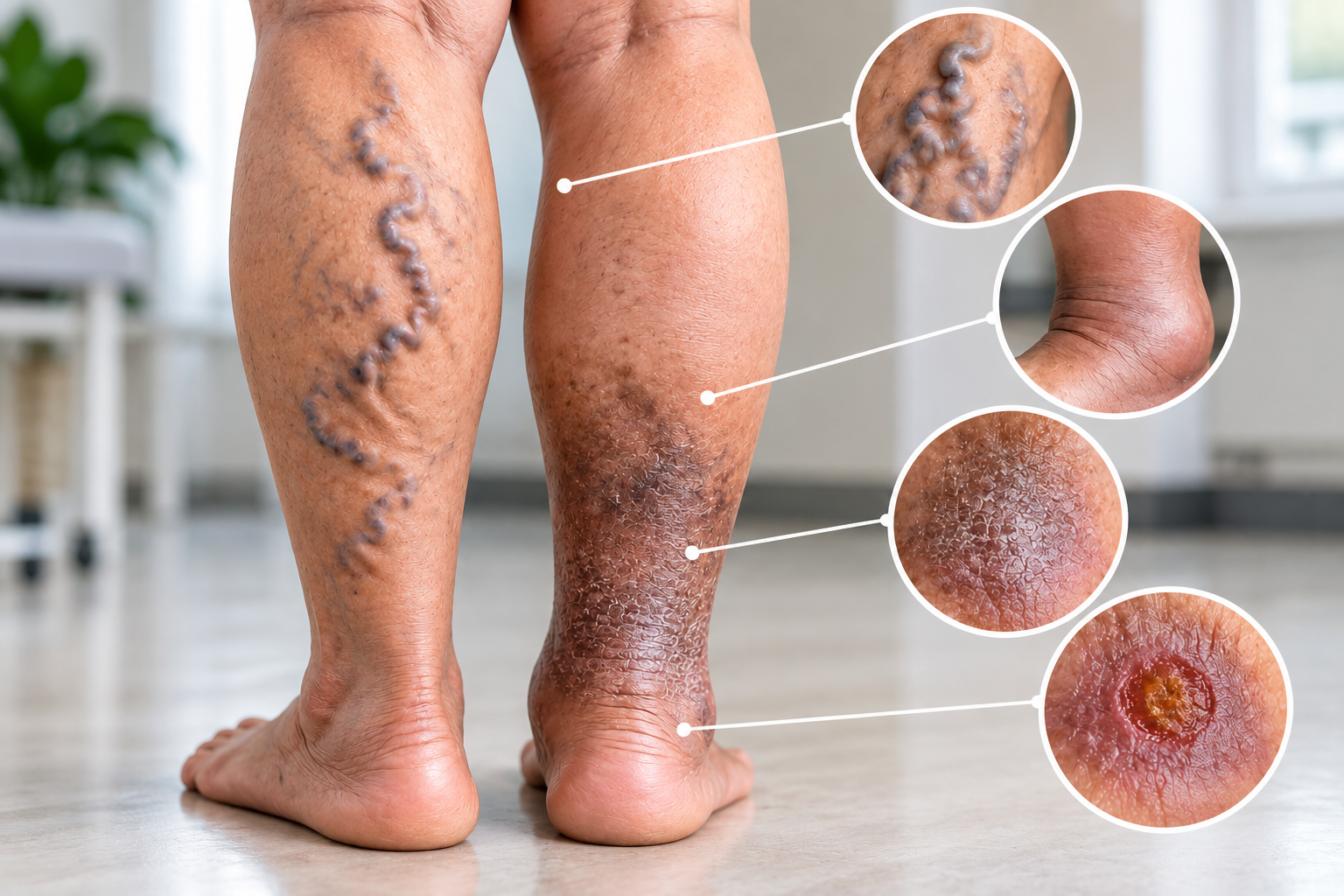
Itching and dryness first, then colour change, then hardening of the skin around the ankle. These are not cosmetic and they are the window in which this is easiest to manage.
The sequence people describe, with the NHS terms where it names them:
- Itching and dry, scaly skin over the veins, which the NHS lists as a complication and calls varicose eczema: "itchy, flaky, dry skin over your veins (varicose eczema)".
- Colour change, which the NHS includes in its symptom list as skin changes.
- Hardening, where the skin and tissue near the ankle feel firm or tight rather than soft.
- Then, in some people, an ulcer. The NHS lists "sores that take a long time to heal (venous leg ulcers)" among the complications of varicose veins.
The useful thing to know is that this sequence takes years, not weeks. Which means someone who notices colour change or hardening has time to have it assessed, and that is a far better position than arriving with an open wound. Most people who reach the ulcer stage passed through the earlier stages without anyone telling them what they were looking at.
So if the skin on your lower leg has changed and nobody has examined it, that is worth an appointment on its own, with no sore required.
What is a venous leg ulcer and where does it usually appear?
A sore on the lower leg that does not heal, typically on the inner leg between knee and ankle. Location is the first thing that distinguishes it from other leg wounds.
The NHS defines the threshold by time: "A leg ulcer is a long-lasting (chronic) sore that takes more than 2 weeks to heal."
On location, it is specific: "It usually develops on the inside of the leg, between the knee and the ankle."
On what accompanies it: "The symptoms of a venous leg ulcer include pain, itching and swelling in the affected leg." And: "There may also be discoloured or hardened skin around the ulcer, and the sore may produce a foul-smelling discharge."
Note that the discoloured or hardened skin appears in that description too. The ulcer arrives in skin that was already changed, which is why the previous section matters.
The NHS is direct about what to do: "See your GP if you think you have a leg ulcer, as it'll need specialist treatment to help it heal."
How is a venous ulcer different from a diabetic foot ulcer?
Different location, different cause and different treatment. The two are confused often enough that it is worth setting out plainly, because the management differs in ways that matter.
The distinctions that do the work:
- Where it is. A venous ulcer is usually on the lower leg, on the inner side between knee and ankle. A diabetic foot ulcer is on the foot, typically where pressure concentrates.
- What drove it. A venous ulcer follows sustained vein pressure that weakened the skin. A diabetic foot ulcer typically follows pressure and reduced sensation, so the damage is not felt as it happens.
- What the leg looks like around it. A venous ulcer sits in skin that is often swollen, discoloured or hardened. That surrounding picture is itself diagnostic information.
- What the mainstay of treatment is. For venous ulcers the NHS names compression as the main treatment. Diabetic foot ulcers are managed differently, and our page on non-healing foot ulcer treatment covers that.
And the situation this clinic sees that most pages ignore: a person can have both. Someone with diabetes and long standing venous disease can have vein problems in the leg and neuropathy in the foot simultaneously. In that case neither description fits neatly, and assuming one explanation is how the wrong treatment gets started.
General warning signs in the diabetic foot are covered separately in our page on diabetic foot warning signs.
Why does the difference change the treatment completely?
Because compression helps a venous ulcer and is the wrong answer where the problem is arterial supply. The treatment that heals one situation can harm another, which is why the distinction is not academic.
For venous ulcers, the NHS describes treatment as "cleaning and dressing the wound" and "using compression, such as bandages or stockings, to improve the flow of blood in the legs".
It also gives an outcome figure, and the condition attached to it is important: "Most venous leg ulcers heal within 6 months if they're treated by a healthcare professional trained in compression therapy for leg ulcers."
Read the whole sentence rather than the number. The six months is conditional on treatment by someone trained in compression therapy for leg ulcers. It is not a timeframe that applies to an untreated ulcer, or to one being managed as though it were something else.
That conditional is the practical argument for getting the diagnosis right. A venous ulcer treated as a diabetic foot ulcer, or the reverse, is not receiving the treatment that figure describes.
Why must circulation be assessed before compression is used?
Do not apply compression bandages or stockings to a swollen leg or a leg ulcer on your own initiative, and do not let anyone apply them before your circulation has been checked. This is the most important sentence on this page.
The reason, in the NHS's own words: "It's not safe to apply compression if the ankle artery pressures are low."
The full context from the NHS guidance on diagnosis: "It's important to carry out this test, as the main treatment for venous ulcers is compression bandages or stockings to improve the vein circulation in your legs."
The test it refers to is a Doppler test. The NHS describes it simply: "This involves measuring the blood pressure in the arteries at your ankles and comparing it to the pressure in your arms." And what it finds: "If you have peripheral arterial disease, the blood pressure in your ankles will be lower than your arms."
Why this is the critical point on a diabetic foot clinic's website. Reduced arterial circulation in the legs is common in people with diabetes. So the population most at risk of leg ulceration overlaps heavily with the population in whom compression, the standard venous ulcer treatment, may be unsafe. Both can be present in the same leg.
This page does not describe how compression is applied, what strength is used, or what to buy, and that is deliberate. There is nothing here you can act on yourself, because the decision depends on a test result you do not have yet. What you can act on is getting the test.
If you have been given compression stockings without any circulation assessment, that is worth asking about before you continue wearing them.
What can be done about the veins themselves?
Treatment is directed at the failing veins, and the NHS names several approaches. Which, if any, is appropriate depends on assessment rather than on symptoms alone.
The approaches the NHS names for varicose veins are "procedures to block blood flow in the veins, such as endothermal ablation and foam sclerotherapy", "surgery to remove varicose veins", and "compression stockings".
Three things worth understanding about that list:
- These are vascular procedures, and this page names them because the NHS names them, not as a statement of what any particular clinic provides.
- Compression appears here too, and the warning in the previous section applies in full. Its appearance on a treatment list does not make it safe before assessment.
- Treating the veins and treating an ulcer are related but separate questions, and an open ulcer usually changes the order in which things are done.
The honest summary for someone deciding whether to seek help: the earlier in the sequence you are, the more options exist and the simpler they are. That is an argument for going when the skin changes appear rather than when a sore does.
How are leg ulcers assessed at Elegance Diabetic Foot and Ulcer Clinic, Surat?
By establishing which kind of ulcer it is, and by checking circulation before any compression is considered. In our practice in Surat, the mixed picture is common enough to be the default assumption rather than the exception.
What that means in practice. A person with diabetes and a leg wound may have venous disease, reduced arterial supply, reduced sensation, or any combination. Deciding which before examining is how the wrong plan starts, so the assessment comes first: where the wound is, what the surrounding skin looks like, whether there is swelling, whether sensation is intact, and what the circulation is doing.
The NHS's own description of the pathway puts a clinic like this one inside it: where an ulcer is thought to be caused by diabetes, it notes that "they may refer you to a diabetes ulcer clinic or a rheumatologist".
Circulation is assessed before compression is applied, not after. That is not a local policy, it is what the guidance requires, and it is the single thing most likely to be skipped when a leg ulcer is treated as a dressing problem.
Where the picture is venous and circulation is adequate, treatment follows the venous pathway. Where arterial supply is reduced, that changes the plan and compression is not simply applied anyway. Where the foot rather than the leg is the problem, our pages on diabetic foot callus and preventing diabetic foot amputation cover that ground.
Next step
If the skin on your lower leg has changed colour or feels hard, that is worth examining before any sore appears. If you already have a leg sore that has not healed in two weeks, it needs assessment, and if anyone has offered you compression without checking your circulation, ask about that first. Book an assessment at Elegance Diabetic Foot and Ulcer Clinic, Surat.
This page is for education and is not a substitute for examination. Compression bandages or stockings should not be applied to a swollen leg or a leg ulcer before circulation has been assessed, because NHS guidance states it is not safe to apply compression if the ankle artery pressures are low. This page deliberately describes no compression method, strength or product. A leg sore that has not healed in two weeks needs medical assessment. Please consult Dr. Ashutosh A Shah or your own doctor about your situation.
quiz Frequently Asked Questions
This article is general education, not a diagnosis. If you have a diabetic foot wound, please have it assessed in person. Send a photo on WhatsApp or book a consultation.
About the Author

Dr. Ashutosh Shah, Plastic, Reconstructive & Diabetic Foot Surgeon, Elegance Diabetic Foot & Ulcer Clinic, Surat
Dr. Ashutosh Shah is a board certified plastic and reconstructive surgeon with over 22 years of experience and more than 10,000 limbs and feet saved. He founded Elegance Diabetic Foot & Ulcer Clinic, India's first chain of clinics dedicated to foot care, with centres in Surat and OPD partners across South Gujarat. He is known for a limb first approach, safe wound care and ethical, natural results.