A venous ulcer heals with graded compression and wound care, but it returns unless the failing vein is treated. Compression closes most ulcers in twelve to sixteen weeks, and vein ablation or surgery afterwards cuts the chance of recurrence sharply. Effective varicose vein ulcer treatment in Surat therefore addresses both the open wound and the underlying vein problem.
At Elegance Diabetic Foot & Ulcer Clinic, Dr. Ashutosh A Shah assesses chronic leg ulcers to determine whether they are venous, arterial, diabetic or caused by a combination of problems. This distinction matters because treatment that is appropriate for one ulcer type may be unsuitable for another.
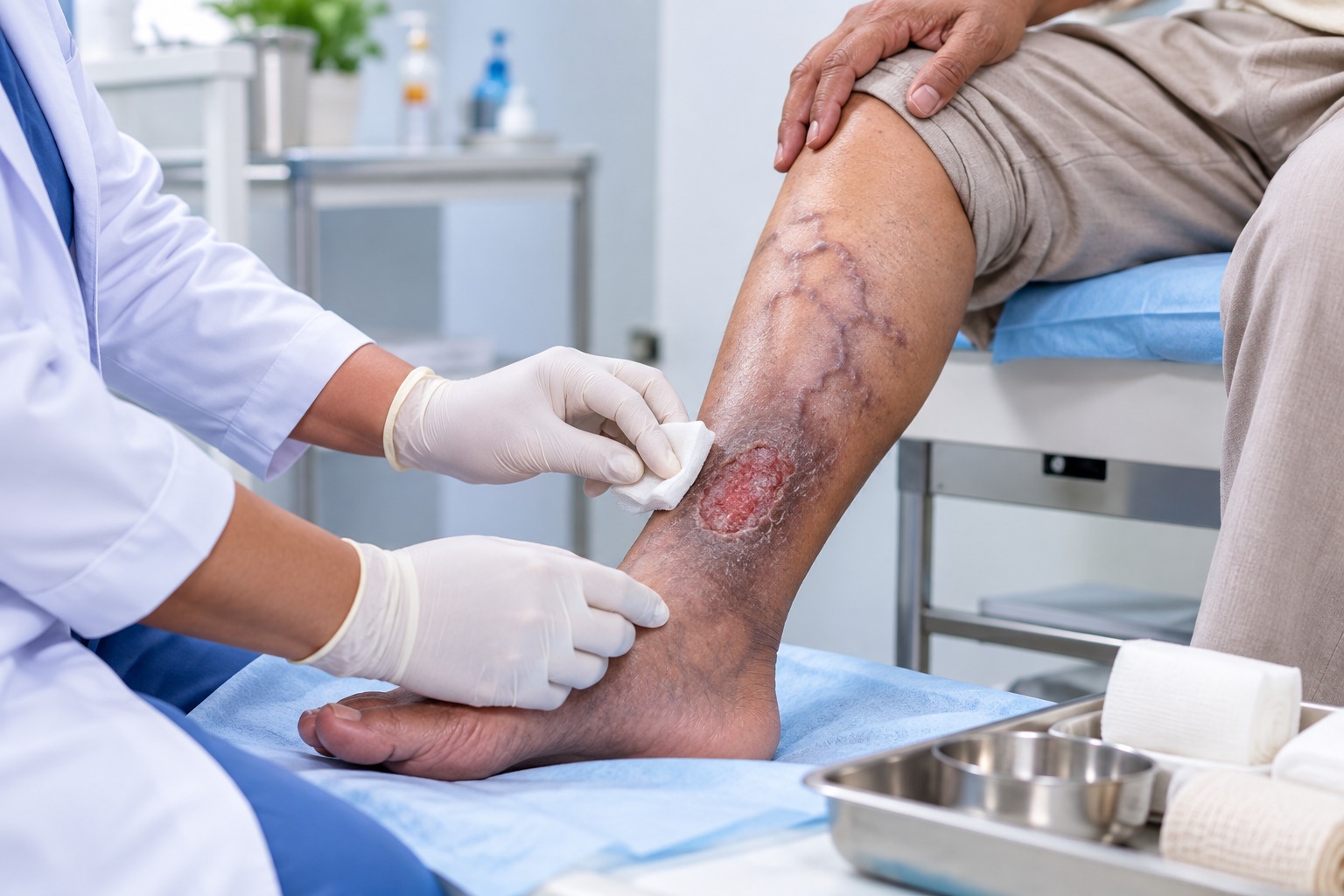
What Causes a Varicose Vein Ulcer and Why Does It Sit Above the Ankle?
A varicose vein ulcer is a chronic wound caused by poor venous circulation in the leg.
Healthy leg veins contain valves that help blood travel upward toward the heart. When these valves fail, blood can flow backward and pool in the lower leg.
This persistent venous pressure affects the surrounding skin and tissues.
Over time, patients may notice:
-
Ankle or lower-leg swelling
-
Visible varicose veins
-
Skin darkening
-
Itching or eczema-like changes
-
Hardening of the skin
-
Repeated skin breakdown
-
A wound that does not close normally
Venous ulcers commonly develop in the lower leg, particularly around or just above the ankle, because venous pressure is greatest in this dependent area.
This is why varicose vein ulcer treatment in Surat needs to look beyond the wound itself.
Repeated dressings may manage the surface wound, but they do not correct the abnormal pressure created by failing veins.
For more information about this wound type, see Venous ulcer.
Why Do Varicose Vein Ulcers Keep Coming Back?
A dressing can help create an appropriate wound environment, but the dressing cannot repair a faulty vein valve.
This explains why leg ulcers keep coming back in some patients.
The ulcer may close temporarily while the abnormal venous pressure remains.
If the underlying vein problem continues, swelling and pressure can again damage the skin and eventually cause another wound.
A complete treatment strategy therefore has two objectives:
-
Heal the existing ulcer.
-
Treat the venous problem contributing to recurrence.
The second part is particularly important once the wound and circulation have been properly assessed.
Patients who also have visible or symptomatic veins can read Varicose veins.
How Is a Varicose Vein Ulcer Told Apart From a Diabetic or Arterial Ulcer?
Not every lower-leg wound in a person with diabetes is a diabetic ulcer.
A patient can have diabetes and still develop a venous ulcer.
Similarly, a wound near the ankle should not automatically be treated as venous without checking arterial circulation.
The location, pain pattern, pulses and wound appearance all contribute to the assessment.
Venous vs Arterial vs Neuropathic Diabetic Ulcer
| Feature | Venous Ulcer | Arterial Ulcer | Neuropathic Diabetic Ulcer |
|---|---|---|---|
| Usual site | Lower leg, often around or above the ankle | Distal foot, toes or pressure-poor circulation areas | Commonly pressure-bearing areas of the foot |
| Pain | Variable | May be significant, particularly with poor circulation | May be painless because of neuropathy |
| Edge and base | Assessment generally fits chronic venous congestion | Features suggest reduced arterial supply | Often associated with repeated pressure and callus |
| Pulses | Need to be checked before compression | May be reduced or absent | May be present unless arterial disease also exists |
| First treatment priority | Wound care plus appropriate compression after circulation assessment | Restore or assess arterial circulation | Offloading, wound care and assessment of infection/circulation |
The purpose of this table is not to diagnose an ulcer at home.
A wound can have mixed causes. For example, someone may have venous disease and arterial disease at the same time.
That possibility is particularly important before compression treatment.
Why Does Compression Heal a Venous Ulcer?
Compression is a central part of venous ulcer treatment because it addresses the high venous pressure contributing to the wound.
Graded compression helps control swelling and supports blood movement out of the lower leg.
As swelling and venous congestion improve, the wound has a better environment in which to heal.
According to the supplied treatment plan, compression closes most venous ulcers in approximately 12–16 weeks.
The exact healing period for an individual wound can still vary according to:
-
Ulcer size and duration
-
Degree of swelling
-
Underlying vein disease
-
Arterial circulation
-
Infection
-
Diabetes control
-
Mobility
-
Adherence to compression
-
General health
Compression is therefore part of a treatment pathway rather than simply a bandage placed over the wound.
When Is Compression Unsafe?
Compression should not automatically be applied to every leg ulcer.
This is particularly important when arterial disease may also be present.
If the arteries supplying the leg are significantly narrowed, strong compression may be inappropriate because arterial blood flow is already compromised.
For this reason, the supplied 26 September plan specifically requires a compression safety caveat for patients who also have arterial disease.
Before starting or increasing compression, the treating team should assess the circulation and decide whether standard compression, modified compression or another approach is appropriate.
Having diabetes does not by itself answer this question.
What matters is the actual blood supply to the leg.
Is Compression Safe If I Also Have Diabetes?
Diabetes alone does not automatically mean compression cannot be used.
However, people with diabetes may also have peripheral arterial disease or other circulation problems.
The circulation therefore needs assessment before deciding on compression strength.
This is one reason varicose vein ulcer treatment in Surat should start with identifying the ulcer type rather than assuming every chronic lower-leg wound needs the same bandaging.
Why Is Wound Care Still Necessary?
Correcting the vein problem does not eliminate the need to manage the ulcer itself.
Wound care remains necessary while healing occurs.
The exact dressing and wound-care plan depends on what the clinician finds during assessment.
Important considerations include:
-
Wound size and depth
-
Amount of wound fluid
-
Condition of surrounding skin
-
Infection
-
Swelling
-
Tissue quality
-
Circulation
-
Progress between reviews
The wound should be monitored over time rather than simply receiving the same dressing indefinitely without reassessment.
For an overview of other ulcer types treated by the clinic, see Non-diabetic ulcers.
Which Vein Procedure Stops the Ulcer Returning?
Healing the ulcer is only one part of the problem.
If an underlying failing vein continues producing abnormal venous pressure, recurrence remains a concern.
The supplied plan therefore requires varicose vein ulcer treatment in Surat to include treatment of the underlying vein after wound management.
Depending on the patient's vein anatomy and assessment, this may involve vein ablation or surgery.
The purpose is not to operate on the ulcer itself simply because a wound exists.
The aim is to address the venous problem contributing to persistent pressure and recurrence.
For more information about these options, see Varicose vein treatment.
What Is Vein Ablation?
Vein ablation is intended to treat an abnormal vein that is contributing to venous reflux.
The exact technique and suitability depend on the patient's venous anatomy and clinical assessment.
Rather than repeatedly managing the consequences of high venous pressure alone, treating the responsible vein aims to address the underlying cause.
A patient should therefore not assume that every visible varicose vein needs treatment or that every venous ulcer requires the same procedure.
The treatment plan follows the findings of the vascular assessment.
When Is Varicose Vein Surgery Considered?
Some patients may require a surgical approach rather than, or in addition to, another vein treatment.
The decision depends on the pattern of venous disease and the patient's overall condition.
This is why the varicose vein surgery for ulcer section of the treatment pathway comes after proper assessment rather than before it.
The goal remains the same: reduce the venous problem responsible for ongoing pressure and lower the risk of another ulcer developing.
Can a Venous Ulcer Be Treated Without Surgery?
The ulcer itself may heal with appropriate wound care and compression.
According to the supplied plan, however, the underlying failing vein is important because leaving it untreated can contribute to recurrence.
This means there is a difference between:
Getting the wound closed
and
Reducing the chance of the wound returning.
A patient who has achieved wound closure may therefore still require assessment of the underlying venous disease.
Treatment Pathway for a Varicose Vein Ulcer
| Stage | Main Purpose | What Happens | Important Point |
|---|---|---|---|
| Compression | Reduce venous pressure and swelling | Graded compression is planned after circulation assessment | Significant arterial disease may change whether or how compression is used |
| Wound care | Support ulcer healing | Wound and surrounding skin are reviewed and dressed appropriately | Progress should be reassessed rather than repeating ineffective care indefinitely |
| Vein ablation | Treat the underlying failing vein where appropriate | Venous reflux is treated according to vein anatomy | Intended to address the cause contributing to recurrence |
| Surgery | Treat venous disease when a surgical approach is appropriate | Procedure depends on individual venous anatomy and assessment | Not every patient requires the same procedure |
| Follow-up | Reduce recurrence | Skin, swelling, veins and healed ulcer area are monitored | Wound closure is not necessarily the end of treatment |
| Same-day red flag | Identify urgent deterioration | Hot swollen calf, fever or rapidly spreading redness | Seek same-day medical assessment |
How Long Does a Varicose Vein Ulcer Take to Heal?
The supplied content plan states that compression closes most venous ulcers in approximately 12–16 weeks.
That figure should be understood as a general treatment window rather than a guarantee for every wound.
A longstanding, large or complicated ulcer may follow a different course.
Healing can also be slower when another problem exists alongside venous disease, such as:
-
Poor arterial circulation
-
Diabetes
-
Infection
-
Persistent swelling
-
Reduced mobility
-
Repeated trauma
-
Difficulty maintaining compression
Regular measurement and reassessment help determine whether the wound is actually progressing.
What Does Recovery Look Like?
Recovery has two separate components.
The first is ulcer healing.
During this phase, the wound, swelling and surrounding skin need ongoing management.
The second is management of the underlying venous disease.
Even once the ulcer has closed, the leg should not automatically be considered permanently cured if the venous problem remains.
Follow-up therefore focuses not only on whether the skin has closed but also on reducing the factors that caused the ulcer.
Will the Ulcer Come Back After Vein Surgery?
Treating the failing vein is intended to reduce recurrence, but no treatment should be presented as guaranteeing that an ulcer will never return.
The supplied plan states that vein ablation or surgery after ulcer healing cuts the chance of recurrence sharply.
Long-term care may still involve monitoring swelling, skin changes and the previously ulcerated area.
New skin breakdown should be assessed early rather than waiting for it to become another established ulcer.
Which Changes in the Leg Mean Being Seen the Same Day?
A chronic ulcer can sometimes deteriorate quickly.
The supplied plan specifically identifies the following as same-day red flags:
-
A hot, swollen calf
-
Fever
-
Rapidly spreading redness
These changes should not be managed by simply waiting for the next routine dressing appointment.
They require prompt medical assessment.
A sudden change in a chronic wound may indicate a new problem that needs evaluation rather than continuation of the existing routine.
Why Treating Only the Wound Is Not Enough
One of the most important ideas in varicose vein ulcer treatment in Surat is that a wound and its cause are not the same thing.
The visible ulcer is the consequence.
The underlying venous pressure is part of the cause.
Dressings are therefore valuable, but dressings alone cannot correct failing vein valves.
Similarly, closing the ulcer does not automatically mean the underlying venous disease has disappeared.
A complete plan asks three questions:
-
What type of ulcer is this?
-
What will close the current wound safely?
-
What needs to change to reduce recurrence?
That approach is more useful than repeatedly treating only the visible wound.
Why a Circulation Check Comes Before Compression
A leg can have more than one circulation problem at the same time.
Someone with varicose veins may also have arterial narrowing.
Someone with diabetes may have venous disease, arterial disease, neuropathy or a combination of all three.
This is why the ulcer differentiation step is important.
Compression is intended to help venous disease, but significant arterial disease changes the safety calculation.
A proper assessment therefore determines whether the wound is venous, arterial, neuropathic or mixed before the treatment plan is finalised.
Conclusion
Effective varicose vein ulcer treatment in Surat is not simply a matter of repeatedly dressing an open wound. The ulcer needs appropriate wound care and compression, while the failing venous system contributing to the problem also needs assessment and, where appropriate, vein ablation or surgery.
At Elegance Diabetic Foot & Ulcer Clinic, Dr. Ashutosh A Shah assesses chronic leg ulcers to distinguish venous disease from arterial, diabetic and mixed causes and to plan treatment around both wound healing and the underlying circulation problem.
quiz Frequently Asked Questions
This article is general education, not a diagnosis. If you have a diabetic foot wound, please have it assessed in person. Send a photo on WhatsApp or book a consultation.
About the Author

Dr. Ashutosh Shah, Plastic, Reconstructive & Diabetic Foot Surgeon, Elegance Diabetic Foot & Ulcer Clinic, Surat
Dr. Ashutosh Shah is a board certified plastic and reconstructive surgeon with over 22 years of experience and more than 10,000 limbs and feet saved. He founded Elegance Diabetic Foot & Ulcer Clinic, India's first chain of clinics dedicated to foot care, with centres in Surat and OPD partners across South Gujarat. He is known for a limb first approach, safe wound care and ethical, natural results.