Written by Dr. Ashutosh A Shah, M.B.B.S., M.S., M.Ch., D.N.B., Consultant Plastic and Reconstructive Surgeon, Elegance Diabetic Foot and Ulcer Clinic, Surat. Reg. no. [REG NO]. 22+ years in reconstructive surgery and limb salvage.
Medically reviewed by Dr. Ashutosh A Shah · Published 29 September 2026 · Last reviewed 29 September 2026
Total contact cast diabetic foot treatment offloads pressure from an ulcer by redistributing weight across the whole lower leg and foot. Its main advantage is that it cannot be removed by the patient, which removes the single biggest reason removable devices underperform. It requires regular review.
Most people react badly to the idea at first. A cast you cannot take off, on a foot that already has a wound, for as long as it takes. It sounds like the harder option, and in terms of daily inconvenience it is.
It is also, for the right ulcer, the option the international guideline puts first. This page explains what it does, why the sealed-on part is the point rather than a side effect, and which situations it must not be used in.
What is a total contact cast?
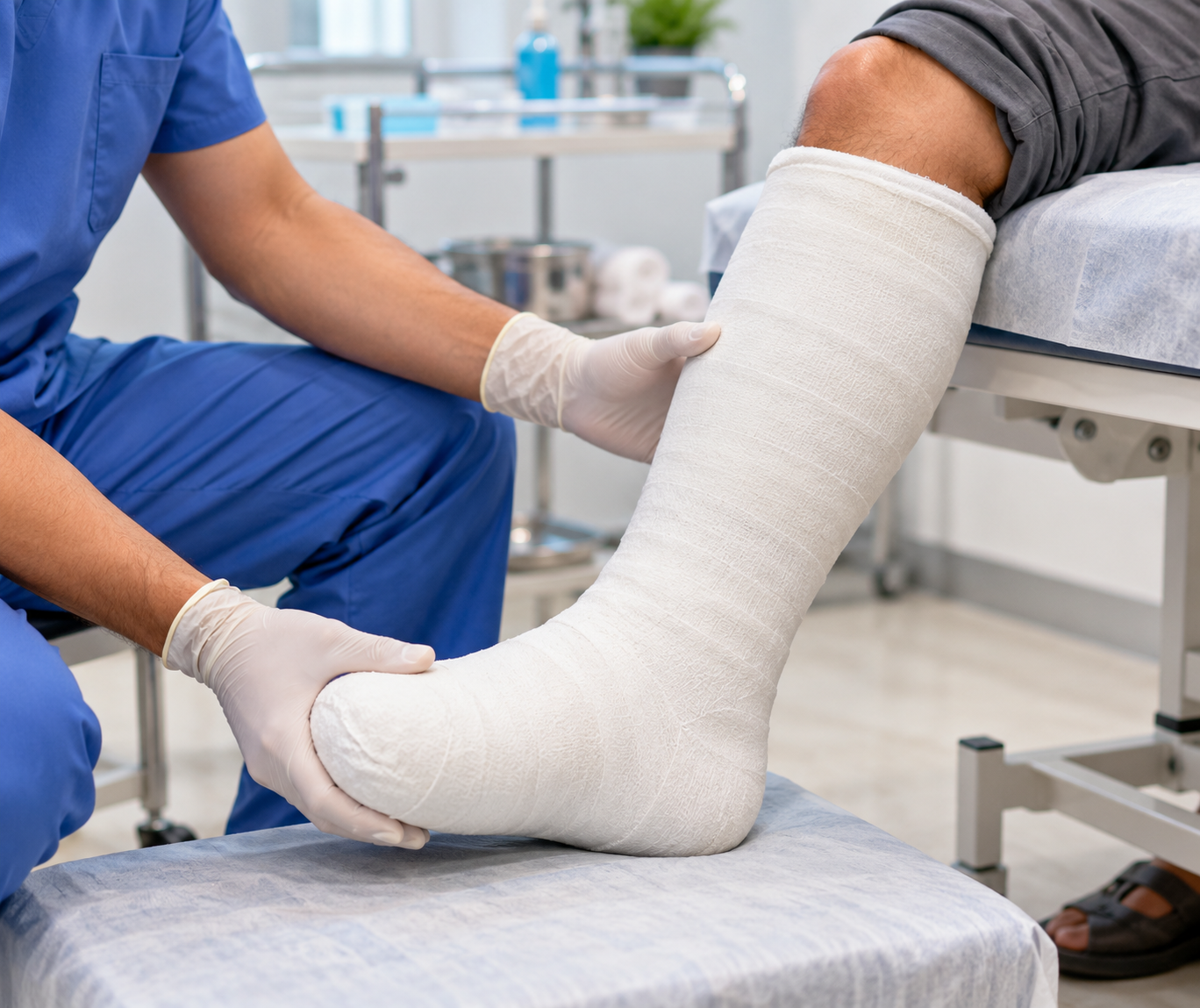
A close-fitting cast moulded to the leg and foot, reaching up to just below the knee, applied so that it cannot be taken off between appointments. It is removed only by the clinic, and replaced with a new one.
The "total contact" part is literal. The cast is moulded against the whole surface of the foot and lower leg rather than sitting loosely around it, so load is carried along the leg instead of being concentrated under the wound.
It is one of two devices the IWGDF guideline places in the same first-choice category. Its recommendation is to "choose either a total contact cast or non-removable knee-high walker based upon local resources and the person's individual factors and acceptability." How the full range of devices compares is set out in our guide to offloading footwear and boots.
How does offloading help an ulcer heal at all?
By taking the repeated pressure off the wound. Tissue under load does not close, and every step on an ulcer interrupts whatever healing happened since the last one.
That is the whole principle, and it is covered in detail in the offloading guide linked above. What matters for this page is the consequence: if the pressure is not actually removed for the great majority of the day, the rest of the treatment is working against a headwind.
Which is why the guideline's first recommendation is about the device rather than the dressing. IWGDF recommendation 1a is to "use a non-removable knee-high offloading device as the first choice of offloading treatment" for a neuropathic plantar forefoot or midfoot ulcer, graded strong.
Why does it matter that a total contact cast cannot be removed?
Because that is the mechanism, not an inconvenience attached to it. The guideline describes what a non-removable device provides as "enforced adherence", and its meta-analysis found non-removable devices "may cause large decreases in non-adherence".
Read that plainly. The device is not better at redistributing pressure than a well-fitted removable boot. It is better at being on your leg.
This is not a judgement about anybody's character. The problem with a removable device is not that patients are careless, it is that a boot has to come off for ordinary life, and the steps taken in those gaps are invisible. Nobody counts them. The wound does.
Why do removable devices often heal an ulcer more slowly?
Because of what happens in the gaps, not because of what happens while the device is on. The table below is an ordinary day.
| An ordinary moment | In a non-removable cast | In a removable device |
|---|---|---|
| Showering or bathing | Stays on, with the cast kept dry under a cover | Comes off, and some steps are taken without it |
| Sleeping, and getting up in the night | Stays on | Usually off, and the trip to the bathroom is unprotected |
| Answering the door or the phone | Stays on | Often skipped, because it is only a few steps |
| A long evening sitting at home | Stays on | Frequently taken off for comfort, then forgotten |
| Total unprotected steps over a week | Close to none | Accumulates quietly, and nobody is counting |
None of those moments feels like a decision to damage a wound. That is exactly the problem. The harm is spread across dozens of small reasonable choices rather than one obvious lapse, which is why asking people to try harder does not fix it and removing the choice does.
What is total contact cast diabetic foot treatment like to live with?
Inconvenient in specific, predictable ways, and most people adjust within the first week. Being told what those ways are in advance is most of what makes it tolerable.
- Bathing needs a plan. The cast has to stay dry, which means a waterproof cover and usually a seat in the shower. Ask the clinic to show you before you go home.
- Your gait changes. One leg becomes effectively longer, so the other hip, knee and your lower back take up the difference. A shoe balancer on the other foot is worth asking about.
- Sleep takes adjusting. Pillows under the leg help. So does knowing that the first two or three nights are the worst of it.
- You cannot inspect the wound. This unnerves people more than anything else, and it is the trade being made: the clinic inspects it at review instead of you inspecting it daily.
- Driving is usually out while the cast is on, if it is on the right foot, and often in any case. Check before you assume.
Day to day foot care around a cast, including what to do about the other foot, is covered in the EDFC home care guidance.
When must a total contact cast not be used?
When the wound needs to be seen more often than the cast allows, or when infection or poor blood supply is the dominant problem. These are not preferences, and the guideline is specific about them.
IWGDF addresses this directly in its recommendation 7 series. Where there is moderate infection or moderate ischaemia, it advises clinicians to "consider using a removable offloading device" instead. Where infection or ischaemia is severe, the instruction is to "primarily address the infection and/or ischaemia" first, with offloading following rather than leading.
Stated as a list, so nobody has to infer it.
- Severe infection. Treated first. A wound that may need daily inspection or drainage cannot be sealed inside a cast.
- Severe ischaemia. Poor arterial supply is addressed first, because offloading does not deliver blood to a wound.
- A wound needing frequent inspection or dressing changes, for any reason. IWGDF notes that where a wound is infected or ischaemic it "should be monitored more regularly via at least weekly visits".
- Heavy exudate, where drainage would sit against the skin between reviews.
- Balance or mobility that a knee-high cast would make unsafe. A fall is a worse outcome than a slower-healing ulcer.
- An ulcer that is not plantar, or not neuropathic. The first-choice recommendation is written for neuropathic plantar forefoot and midfoot ulcers specifically.
NICE takes a comparable line for the UK, recommending non-removable casting for plantar neuropathic, non-ischaemic, uninfected forefoot and midfoot ulcers, in its NG19 recommendations. Note how many qualifiers sit in that sentence. They are all doing work.
Why does a cast need regular review and recasting?
Because the leg inside it changes shape. Swelling settles in the first days, and a cast that fitted on Monday can be loose by the following week, which reintroduces movement and rubbing.
Review intervals are set clinically rather than by a fixed schedule, and they depend on swelling, drainage, the state of the wound and how you are managing. A first review is usually sooner than the ones that follow, precisely because of that early change in swelling.
What happens at a review: the cast comes off, the wound is inspected and debrided if needed, the skin around it and the rest of the foot are checked, and a new cast is applied if the plan is continuing. It is not a quick appointment and it should not be treated as one.
Which warning signs mean the cast must come off?
Anything suggesting a new problem inside it. You cannot see the wound, so the signals you have are indirect, and they should be acted on rather than waited out.
- New or increasing pain, particularly if it wakes you. A cast should not become more painful over time.
- Discharge, staining or smell coming from the cast.
- Fever, chills, or feeling generally unwell, with or without foot symptoms.
- A rise in blood glucose without another explanation, which can be the first sign of infection.
- A cast that has become loose, cracked, wet inside, or is rubbing at the top edge.
- New numbness, pins and needles, or a change in the colour of the toes.
If any of these appear, contact the clinic the same day rather than waiting for the scheduled review. Do not attempt to cut or remove the cast yourself, and do not push anything inside it to scratch or relieve pressure.
What happens when the cast comes off for good?
Offloading continues in a different form. Closing the wound is the end of one phase, not the end of treatment, because the pressure that caused the ulcer is still there and the new skin is fragile.
The usual sequence is a transition into prescribed footwear or an insole designed for your foot, with a review pattern that tapers rather than stops. What that footwear does and why it continues indefinitely is covered in the offloading guide.
Recurrence after a healed ulcer is common enough that the period just after closure deserves as much attention as the period before it. If an ulcer has not been closing despite treatment, the reasons are set out separately in our guide to a foot ulcer that stops healing.
How is offloading decided at EDFC, Surat?
By assessing the wound, the circulation and the person, in that order, then matching the device to all three. The guideline tells you which device is first choice. The assessment tells you whether you are the patient that recommendation was written for.
In our practice in Surat the commonest reason a cast is not the right choice on the day is circulation rather than the wound itself, and the second is that the wound needs inspecting more often than a cast allows. The commonest reason a removable device fails is the one this page is about: it was taken off for perfectly sensible reasons, several times a day, for weeks, and nobody realised the offloading was never actually happening.
An assessment covers the ulcer site and depth, whether there is infection, arterial assessment, sensation testing, your mobility and balance, your home circumstances including whether you can keep a cast dry, and what happens at review. The clinic's treatment programs set out how that fits into staged care.
Next step
If you have been offered a total contact cast and are unsure, or you are in a removable device and the ulcer is not closing, an assessment is the useful next step. Book through the EDFC contact page in Surat, and bring any device you are currently using with you.
This article is for education and is not a substitute for professional diagnosis or treatment. Whether a total contact cast suits you depends on your wound, your circulation and your circumstances, and can only be decided after an examination. Please consult Dr. Ashutosh A Shah or another qualified specialist about your own foot.
quiz Frequently Asked Questions
This article is general education, not a diagnosis. If you have a diabetic foot wound, please have it assessed in person. Send a photo on WhatsApp or book a consultation.
About the Author

Dr. Ashutosh Shah, Plastic, Reconstructive & Diabetic Foot Surgeon, Elegance Diabetic Foot & Ulcer Clinic, Surat
Dr. Ashutosh Shah is a board certified plastic and reconstructive surgeon with over 22 years of experience and more than 10,000 limbs and feet saved. He founded Elegance Diabetic Foot & Ulcer Clinic, India's first chain of clinics dedicated to foot care, with centres in Surat and OPD partners across South Gujarat. He is known for a limb first approach, safe wound care and ethical, natural results.