Written by Dr. Ashutosh Shah, Plastic & Microvascular Surgeon - Diabetic Foot & Limb Salvage Specialist, Elegance Diabetic Foot & Ulcer Clinic (EDFC), Surat. Practising since 2004 (22+ years). Read full bio.
Medically reviewed by Dr. Ashutosh Shah
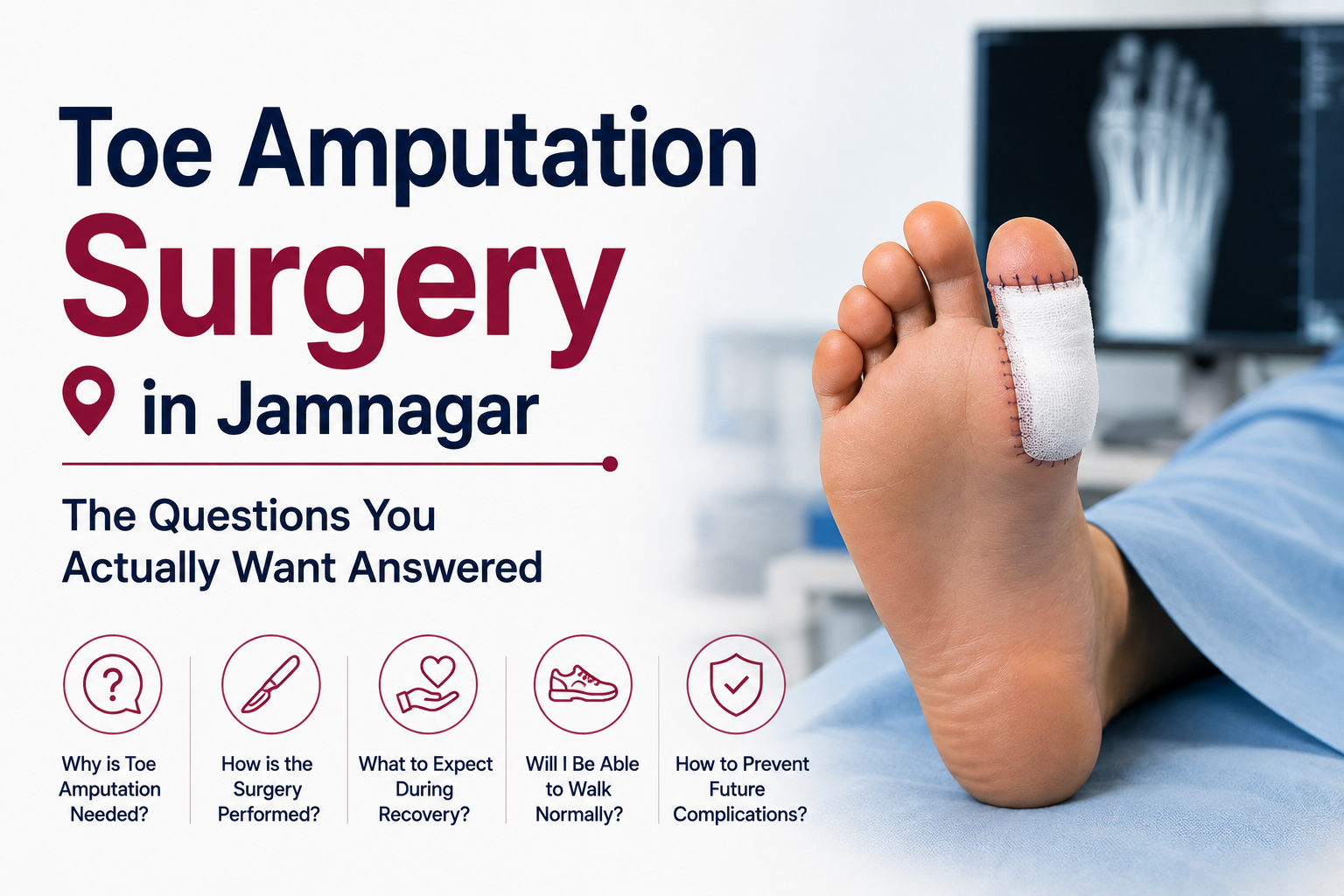
Most people facing toe amputation surgery in Jamnagar want to know about life afterwards, not about the operation. Most walk again in ordinary shoes. Losing the big toe affects balance and push-off more than losing a smaller toe, and protecting the remaining foot matters more than the surgery itself.
So this page answers the outcome questions first. The operation is explained further down, because it is rarely the part that worries people most.
Will you be able to walk again?
Almost certainly yes. A toe amputation removes a small part of the forefoot and leaves the weight-bearing structure of the foot intact. Most people walk unaided once the wound has healed and swelling has settled.
What changes is the fine detail of walking rather than the ability itself. Push-off may feel weaker, the gait may be slightly altered for a while, and long distances may tire the foot more than before. Physiotherapy helps the gait normalise faster than simply waiting does.
Will your balance be affected?
A little, and more so if it is the big toe. The great toe contributes significantly to push-off and to steadying the body at the end of each step, so its loss is felt more than that of a smaller toe.
Balance usually adapts over weeks. It adapts faster with balance and strengthening exercises, and it adapts worse if the person also has numb feet, since a numb foot already reports ground position poorly. Mention any unsteadiness at follow-up rather than accepting it.
Can you wear normal shoes afterwards?
Usually yes, but not the shoes you wore before. After healing, most people wear ordinary-looking footwear fitted with a custom insole that fills the gap and redistributes pressure.
This is not a cosmetic detail. The insole is what stops the foot loading unevenly onto the remaining toes, and it is the single most important thing you take home from the surgery. Ordinary chappals or unmodified shoes let pressure concentrate exactly where it caused the last problem.
Does losing one toe put the others at risk?
Yes, and this is the part most often overlooked. Removing a toe changes how load is distributed, so the neighbouring metatarsal heads take more pressure. A new ulcer at that site is called a transfer ulcer.
Transfer ulcers are largely preventable with custom insoles, correct footwear and regular review. Where the mechanics remain wrong despite insoles, corrective surgery such as a metatarsal osteotomy may be used to lower the pressure at that spot.
Which toe is being removed, and does it matter?
It matters a great deal. Not all toes carry the same load, and the honest answer differs depending on which one is involved.
| Toe | Effect on walking | What to expect |
|---|---|---|
| Great toe | Most significant. Push-off and balance both affected | Longer adaptation, custom insole essential, gait retraining useful |
| Second toe | Moderate. The big toe may drift towards the gap | Insole with a spacer often needed to prevent drift |
| Third or fourth toe | Least. Usually little functional change | Most people notice minimal difference once healed |
| Fifth toe | Minor, though footwear fit changes | Watch the outer border of the foot for new pressure |
| Ray amputation (toe plus part of the metatarsal) | Greater, as the forefoot narrows | Custom footwear needed; more adaptation required |
What does the operation involve?
A short procedure, usually under regional or spinal anaesthesia. The toe is removed at the joint or through the bone, dead and infected tissue is cleared, and the wound is either closed or left open to heal depending on infection.
- Circulation assessment first, through services such as our vascular services, because blood supply decides whether the wound will heal.
- Anaesthesia, commonly regional rather than general.
- Removal of the toe, at the joint or with part of the metatarsal in a ray amputation.
- Clearance of infected tissue and bone, with samples sent for culture where infection is present.
- Closure or open management, depending on how clean the tissue is. An infected foot is often left open initially and closed later.
- Dressing and offloading, managed under non-surgical wound management.
Where infection has reached bone, the extent of removal is decided by how far it has spread, which is discussed in our post on bone infection of the diabetic foot.
How long does healing take?
Usually three to eight weeks for the wound, longer if it was left open. Walking is restricted at first, then gradually increased in protective footwear.
- Week 1 to 2: elevation, minimal walking, wound checks, antibiotics if infection was present.
- Week 2 to 4: dressing changes, sutures removed where used, gradual increase in activity.
- Week 4 to 8: wound closure completed, custom insole fitted, walking distance built up.
- Months 2 to 6: gait settles, footwear reviewed, foot shape stabilises.
Healing is slower with poor sugar control, anaemia, kidney disease or smoking. The commonest reason a toe amputation fails to heal is inadequate blood supply that was never assessed beforehand.
Is a toe amputation a failure?
No. It is frequently what saves the leg. Removing dead or infected tissue at toe level stops infection spreading and allows the rest of the foot to heal.
The comparison worth making is not toe versus intact foot; that option has usually gone by the time surgery is offered. It is toe versus a larger amputation later. The wider decision-making around this is set out in our post on limb preservation surgery.
That said, one question is always worth asking before consenting: has my circulation been formally tested, and can any blockage be reopened? If the answer is no, ask for that assessment first.
How do you avoid needing another one?
By treating the remaining foot as high risk from now on. Someone who has had one amputation is at higher risk of another, and almost all of that risk is manageable.
- Wear the custom insole and footwear all the time, including indoors.
- Inspect both feet daily, paying attention to the toes next to the gap.
- Never walk barefoot.
- Report any new wound, blister or dark spot within days.
- Have callus reduced professionally, never at home.
- Keep blood sugar controlled and stop smoking.
- Attend scheduled reviews under preventive foot care, even when the foot feels fine.
Related problems are listed under foot conditions we treat, and surgical options under diabetic foot surgery.
When should you seek care urgently after surgery?
Same day for fever, spreading redness, discharge or a darkening wound edge. Early problems are far easier to treat than late ones.
- Fever, chills or feeling unwell.
- Redness spreading beyond the dressing.
- Pus, foul smell or increasing discharge.
- The wound edge turning dark or black.
- The foot becoming cold, pale or blue.
- A new wound elsewhere on either foot.
Where does EDFC fit in for someone in Jamnagar?
Elegance Diabetic Foot & Ulcer Clinic is in Surat, not Jamnagar, and we have no branch there. If surgery is needed urgently because of infection, that must happen locally, as set out in our post on gangrene treatment in Jamnagar.
Where we can help is before and after: a second opinion when toe amputation has been advised without circulation testing, reconstruction where a wound will not close, and planning to protect the remaining foot. For toe amputation surgery in Jamnagar decisions, send clear photographs and reports on WhatsApp and book a consultation. Follow EDFC on Facebook, Instagram and YouTube for real limb salvage stories.
The toe is not the point, the rest of the foot is
Most people walk again after a toe amputation and adapt within weeks. What decides the next five years is not the surgery but what happens afterwards: the insole, the footwear, the daily check and the speed with which the next small wound is reported.
Next step: if toe amputation has been advised, ask whether your circulation has been formally tested. For a second opinion or reconstruction planning, send your photos and reports to Dr. Ashutosh Shah at Elegance Diabetic Foot & Ulcer Clinic, Surat.
Medical disclaimer: This article is for educational purposes only and is not a substitute for professional medical diagnosis or treatment. Whether a toe can be saved, and whether an amputation will heal, depends on circulation, infection and general health, and can only be judged after in-person assessment. Elegance Diabetic Foot & Ulcer Clinic is located in Surat, Gujarat, and does not operate a facility in Jamnagar; do not delay urgent local care to seek a remote opinion. Please consult a qualified specialist about your condition. For further guidance, see the NHS guide to amputation and the IWGDF diabetic foot guidelines.
quiz Frequently Asked Questions
This article is general education, not a diagnosis. If you have a diabetic foot wound, please have it assessed in person. Send a photo on WhatsApp or book a consultation.
About the Author

Dr. Ashutosh Shah, Plastic, Reconstructive & Diabetic Foot Surgeon, Elegance Diabetic Foot & Ulcer Clinic, Surat
Dr. Ashutosh Shah is a board certified plastic and reconstructive surgeon with over 22 years of experience and more than 10,000 limbs and feet saved. He founded Elegance Diabetic Foot & Ulcer Clinic, India's first chain of clinics dedicated to foot care, with centres in Surat and OPD partners across South Gujarat. He is known for a limb first approach, safe wound care and ethical, natural results.