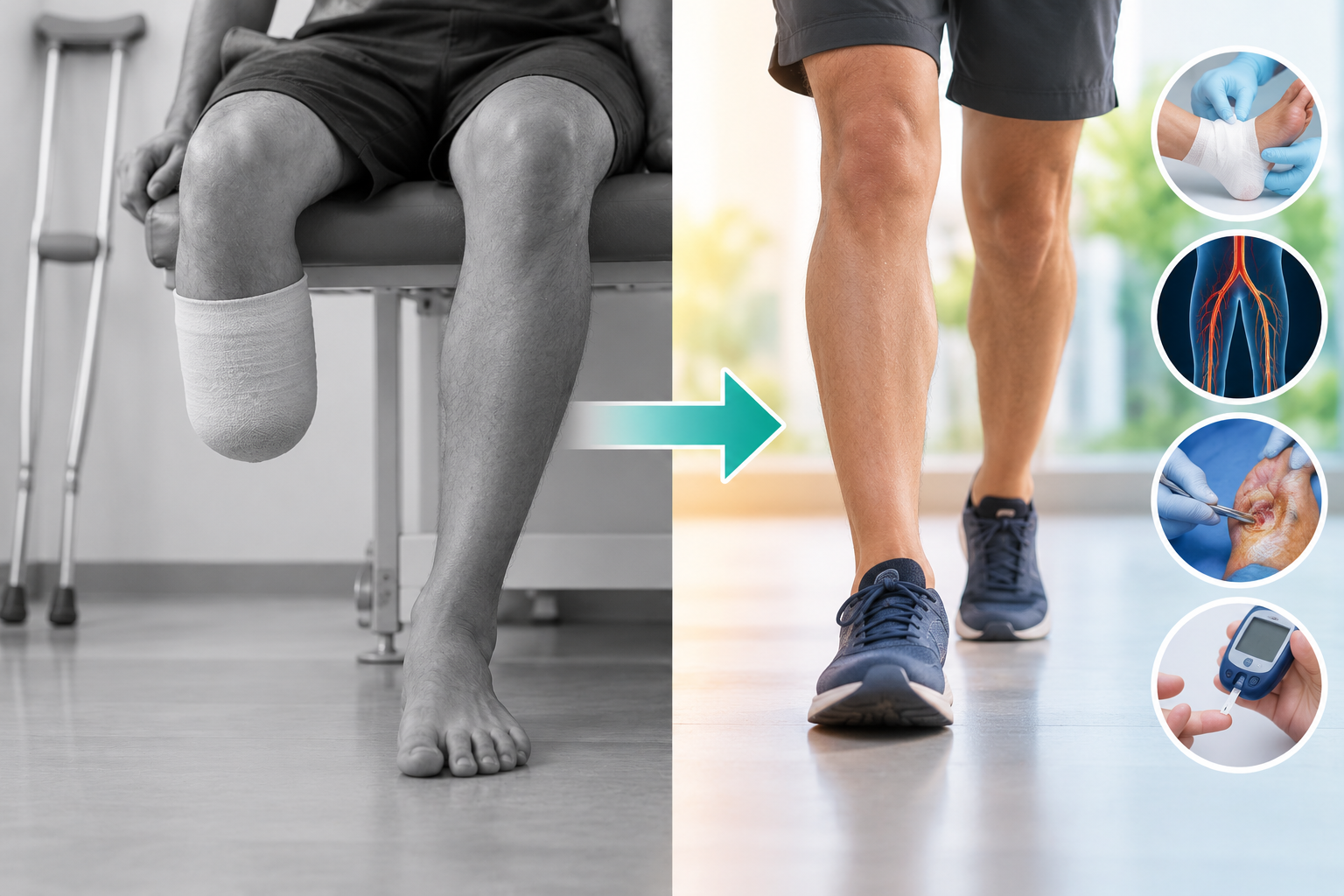
Limb salvage is possible when blood supply can be restored, infection can be controlled, enough tissue remains to rebuild a walking foot, and the patient can offload while it heals. If any one of these fails, or if sepsis is threatening life, amputation may be the safer choice.
Is amputation avoidable in diabetic foot disease? In some patients, yes. However, saving a diabetic foot depends on more than treating the visible wound. Blood flow must be adequate or restorable, infection must be controlled, enough healthy tissue must remain, and the foot must be protected from pressure during healing.
The purpose of limb salvage for diabetic foot is not to preserve every part of the foot at any cost. The goal is to control infection and tissue damage while preserving as much safe, functional limb as reasonably possible.
Sometimes this means avoiding amputation completely. In other cases, removing a toe or a limited portion of the foot may help preserve the rest of the limb. When severe infection or sepsis threatens life, however, delaying necessary surgery can be dangerous.
What does limb salvage involve in practice?
Limb salvage is usually a coordinated treatment pathway rather than a single operation.
The exact plan depends on circulation, infection, depth of the wound, bone involvement, tissue loss and the patient's general health.
Restoring blood supply
A diabetic foot wound needs adequate circulation to heal.
Diabetes is commonly associated with peripheral arterial disease, which can reduce blood flow to the foot. If circulation is inadequate, the vascular team may assess whether blood flow can be improved before or alongside wound treatment.
Depending on the arterial anatomy and the patient's overall condition, treatment may include angioplasty, bypass surgery or another vascular procedure.
Learn more about Limb salvage surgery.
Controlling infection
Infection is another major part of the salvage decision.
Treatment may require antibiotics, drainage of an abscess, removal of infected or dead tissue, or treatment of infected bone.
Antibiotics alone cannot restore dead tissue or replace surgical drainage when a deep collection needs to be opened.
Removing non-viable tissue
Limb salvage does not always mean avoiding every amputation.
If one toe or another limited area is irreversibly damaged, removing that portion may help control infection while preserving the remaining foot.
This is why a minor amputation can sometimes be part of limb salvage rather than evidence that salvage has failed.
Reconstructing the wound
Once circulation and infection are addressed, the remaining wound must be managed.
Depending on its size and location, this may involve ongoing wound care, staged closure, skin grafting or other reconstructive procedures.
The objective is not simply to cover the wound. The reconstructed foot should ideally have a reasonable chance of healing and providing useful function.
Protecting the foot from pressure
A wound that continues to bear damaging pressure may reopen or fail to heal.
Offloading can involve specialised footwear, casts, walkers or other devices according to the wound and treatment plan.
The Save My Foot programme provides more information about a structured diabetic foot treatment pathway.
Which four things must be true for salvage to be attempted?
When doctors consider alternatives to amputation, four factors are especially important.
1. Blood supply must be adequate or restorable
Healing requires blood carrying oxygen and nutrients to the affected tissue.
If circulation is poor, the first question is whether blood flow can realistically be improved.
A technically successful wound reconstruction may still fail if the tissue remains severely ischaemic.
2. Infection must be controllable
The team needs to determine how deep the infection extends and whether it can be controlled safely.
This may require:
- Antibiotics
- Drainage
- Debridement
- Removal of infected tissue
- Treatment or removal of infected bone
- Repeat wound assessment
If infection continues spreading despite treatment, attempting prolonged salvage can become unsafe.
3. Enough viable tissue must remain
Keeping a foot is useful only when enough healthy tissue remains to create a wound that can heal and a limb that can provide reasonable function.
Doctors assess the condition of skin, soft tissue, bone and other supporting structures.
Extensive irreversible tissue destruction can make meaningful reconstruction difficult or impossible.
4. The foot must be offloaded during healing
Even after successful vascular treatment and wound surgery, continued pressure can cause breakdown.
The patient and caregivers therefore need a practical plan for protecting the foot throughout recovery.
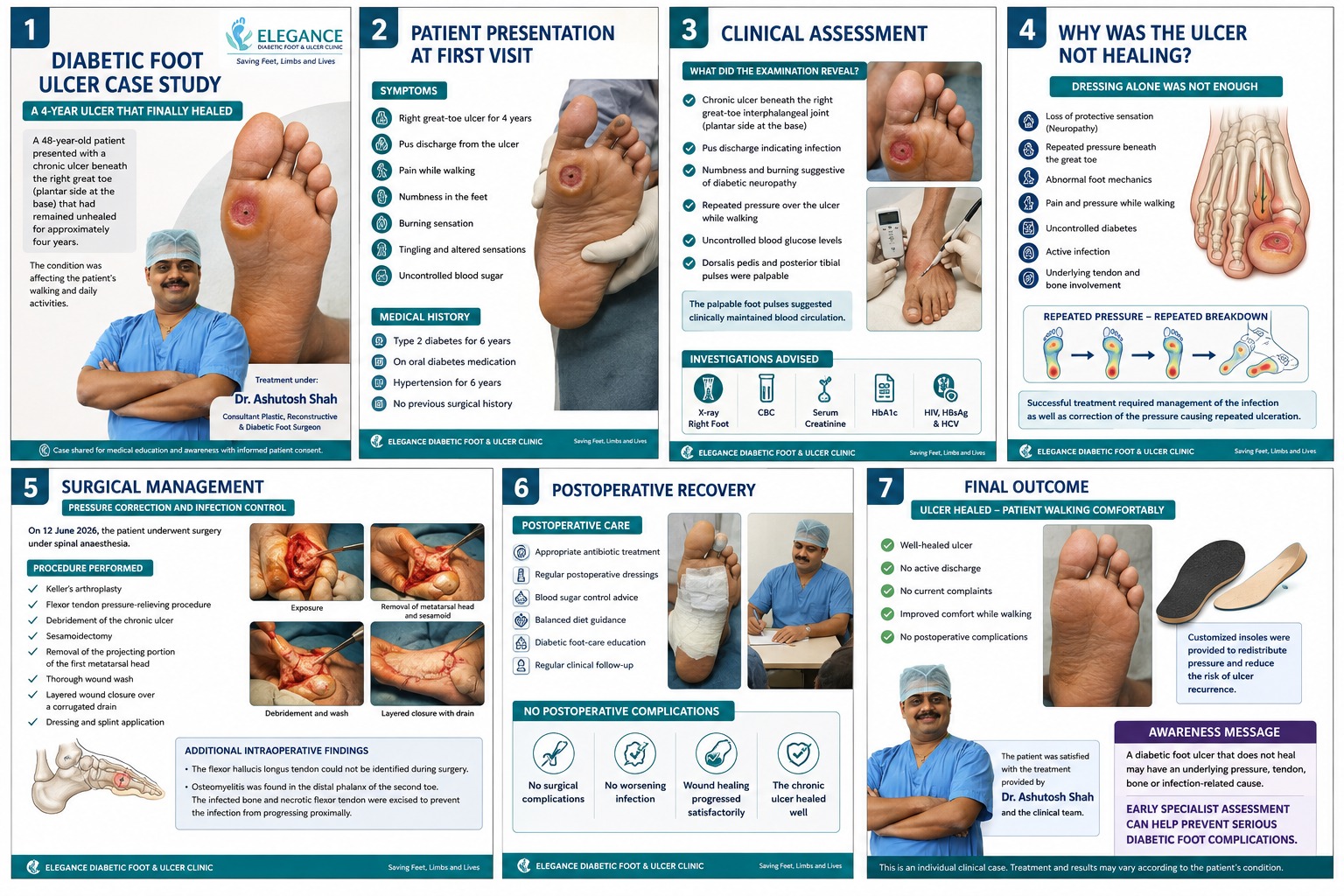
At EDFC (Elegance Diabetic Foot & Ulcer Clinic), Dr. Ashutosh Shah can assess infection, circulation, tissue loss and reconstructive requirements when evaluating whether limb salvage may be feasible.
When is amputation genuinely the safer choice?
The question “is amputation avoidable in diabetic foot disease?” should never become “How can amputation be avoided at any cost?”
There are circumstances in which amputation may provide the safest way to control disease and protect the patient's life.
Severe infection or sepsis
A diabetic foot infection can sometimes spread beyond the local wound and cause systemic illness.
When severe infection cannot be adequately controlled while retaining the affected tissue, removing the source may become urgent.
In this situation, amputation can be life-saving rather than optional.
Rapidly spreading infection
Increasing swelling, spreading redness, foul discharge, systemic illness or rapidly deteriorating tissue requires urgent assessment.
Waiting several days for an elective second opinion can be unsafe when infection is actively progressing.
Extensive dead tissue
Dead tissue cannot be made viable again.
If destruction is extensive enough that a healable and functional foot cannot realistically remain, repeated attempts at reconstruction may provide little benefit.
Blood supply cannot be adequately restored
Some patients have severe arterial disease in which sufficient circulation cannot be restored despite vascular assessment or intervention.
Without enough blood flow, major wounds and reconstructions may not heal.
Previous salvage attempts have failed
Repeated infection, wound breakdown and unsuccessful procedures can change the balance between further salvage and amputation.
The appropriate question becomes:
Can further treatment realistically produce a healed and functional limb without exposing the patient to unacceptable risk?
What is the difference between a minor and a major amputation?
Not all amputations have the same functional consequences.
Minor amputation
A minor amputation removes a limited portion of the foot while preserving the limb above the ankle.
Examples can include removal of a toe or part of the forefoot, depending on the location and extent of disease.
A minor amputation may remove irreversibly damaged tissue while allowing the remainder of the foot to heal.
Major amputation
A major lower-limb amputation occurs at a higher level, such as below or above the knee.
It may be necessary when infection, poor circulation or tissue destruction is too extensive for a lower-level procedure to heal safely.
Why does the amputation level matter?
Surgeons generally try to preserve as much useful limb length as is safely achievable.
However, performing an amputation at a very low level is not automatically better if the wound at that level is unlikely to heal.
Blood supply, infection, viable tissue, rehabilitation potential and overall health all influence the decision.
Read more about Amputation and level selection.
How long does a salvage pathway take and how many procedures?
There is no fixed number of operations or universal recovery period for diabetic foot limb salvage.
A small localised wound with adequate circulation can follow a very different course from a foot affected by severe arterial disease, deep infection and extensive tissue loss.
A complex treatment pathway might involve:
vascular assessment → restoration of circulation → infection control → debridement → wound management → reconstruction → offloading → rehabilitation
Some stages can happen during the same admission. Others may need to be separated while infection settles or tissue viability becomes clearer.
Why can repeated procedures be necessary?
The complete extent of infection is not always obvious during the first assessment.
After initial debridement, further non-viable tissue may become apparent. Some wounds therefore require repeated cleaning before definitive reconstruction is considered.
Likewise, circulation may need to be improved before major wound closure can be attempted.
Does limb salvage take longer than amputation?
It can.
Complex salvage may involve several procedures and prolonged wound care.
But amputation is not simply one operation followed by immediate recovery. Healing, rehabilitation, mobility training and, where appropriate, prosthetic fitting also take time.
The decision should therefore focus on which pathway offers the safest and most useful long-term outcome rather than simply which is fastest.
Individual treatment outcomes can be viewed in the Patient success stories, although another patient's result cannot predict an individual's outcome.
What should you ask before consenting to an amputation?
When the medical situation is stable enough to permit discussion, patients and families should understand why amputation is being recommended.
Important questions include:
- Is there a life-threatening or rapidly spreading infection?
- Which tissue is already irreversibly damaged?
- Has blood supply to the foot been assessed?
- Can circulation potentially be restored?
- Could a minor amputation preserve the rest of the foot?
- Is enough viable tissue available for reconstruction?
- What would an attempted salvage pathway involve?
- What are the chances that the proposed level will heal?
- What are the risks of delaying surgery?
- What function is expected after salvage versus amputation?
A second opinion before amputation may be worthwhile when the patient is stable and there is uncertainty about vascular or reconstructive options.
It should not delay emergency treatment when severe infection, sepsis or rapidly progressing tissue destruction is threatening health or life.
Salvage Feasibility Checklist
| Factor | What Is Assessed | Favourable Finding | Unfavourable Finding | When Delay Becomes Dangerous |
|---|---|---|---|---|
| Blood supply | Arterial circulation and potential for revascularisation | Adequate flow or circulation that can potentially be restored | Severe ischaemia with limited options to restore sufficient flow | Progressive tissue loss or acute deterioration requires urgent assessment |
| Infection control | Depth, spread, abscess, bone involvement and systemic infection | Infection appears controllable with appropriate medical/surgical treatment | Rapid or uncontrolled spread | Sepsis or rapidly spreading infection requires urgent hospital treatment |
| Tissue loss | Amount of viable skin, soft tissue and bone | Enough healthy tissue remains for a potentially functional reconstruction | Extensive irreversible destruction | Progressing necrosis or infection needs urgent reassessment |
| Offloading compliance | Ability to keep damaging pressure away from the wound | A practical offloading plan can be followed | Continued pressure is likely to compromise healing | New or rapidly worsening breakdown requires review |
| General fitness | Diabetes, kidney/cardiac health, nutrition and procedural risk | Patient can reasonably tolerate the necessary treatment | Severe medical illness substantially restricts options | Acute systemic deterioration requires hospital care |
| Sepsis | Systemic signs of severe infection and instability | No evidence of systemic instability | Infection threatens life | Emergency treatment should not be delayed for elective salvage opinions |
Conclusion
So, is amputation avoidable in diabetic foot disease? Sometimes, but successful limb salvage requires more than simply treating the visible ulcer.
Blood supply must be adequate or restorable, infection must be controllable, enough viable tissue must remain, and the foot must be protected during healing. A limited amputation can sometimes be part of this strategy if it removes irreversibly damaged tissue while preserving the rest of the limb.
When severe infection or sepsis threatens life, however, amputation may be the safer and potentially life-saving treatment.
quiz Frequently Asked Questions
This article is general education, not a diagnosis. If you have a diabetic foot wound, please have it assessed in person. Send a photo on WhatsApp or book a consultation.
About the Author

Dr. Ashutosh Shah, Plastic, Reconstructive & Diabetic Foot Surgeon, Elegance Diabetic Foot & Ulcer Clinic, Surat
Dr. Ashutosh Shah is a board certified plastic and reconstructive surgeon with over 22 years of experience and more than 10,000 limbs and feet saved. He founded Elegance Diabetic Foot & Ulcer Clinic, India's first chain of clinics dedicated to foot care, with centres in Surat and OPD partners across South Gujarat. He is known for a limb first approach, safe wound care and ethical, natural results.