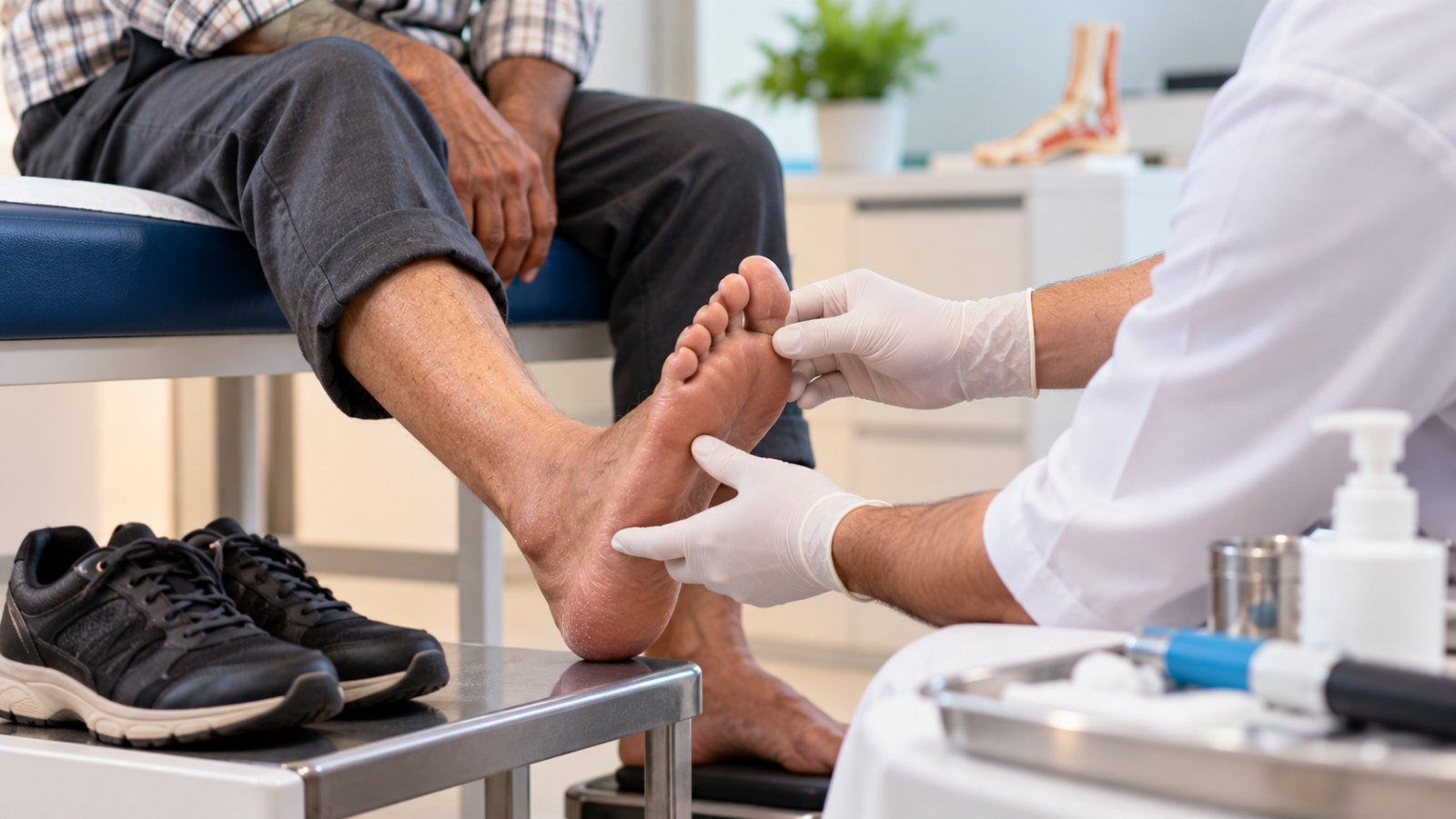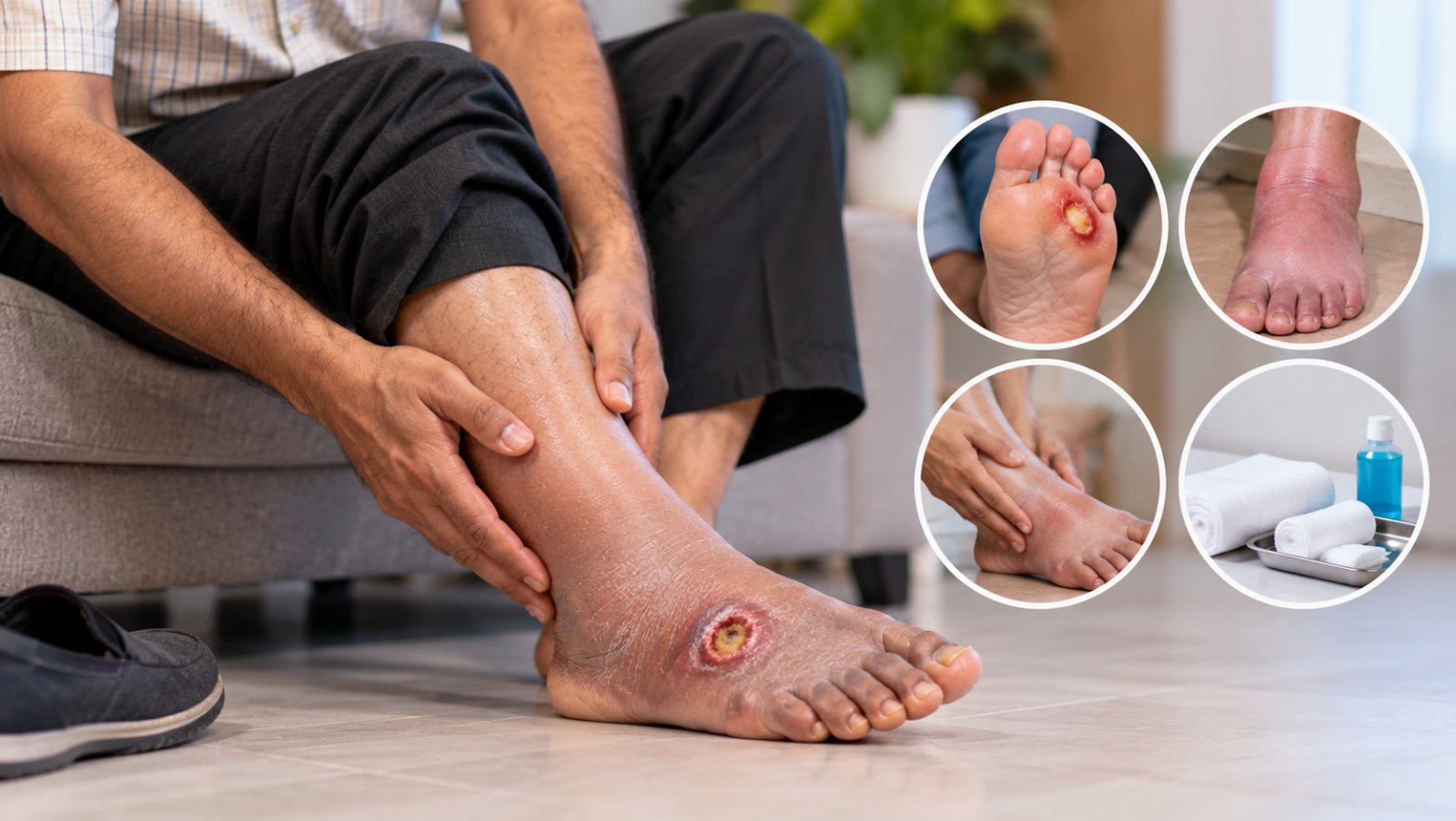
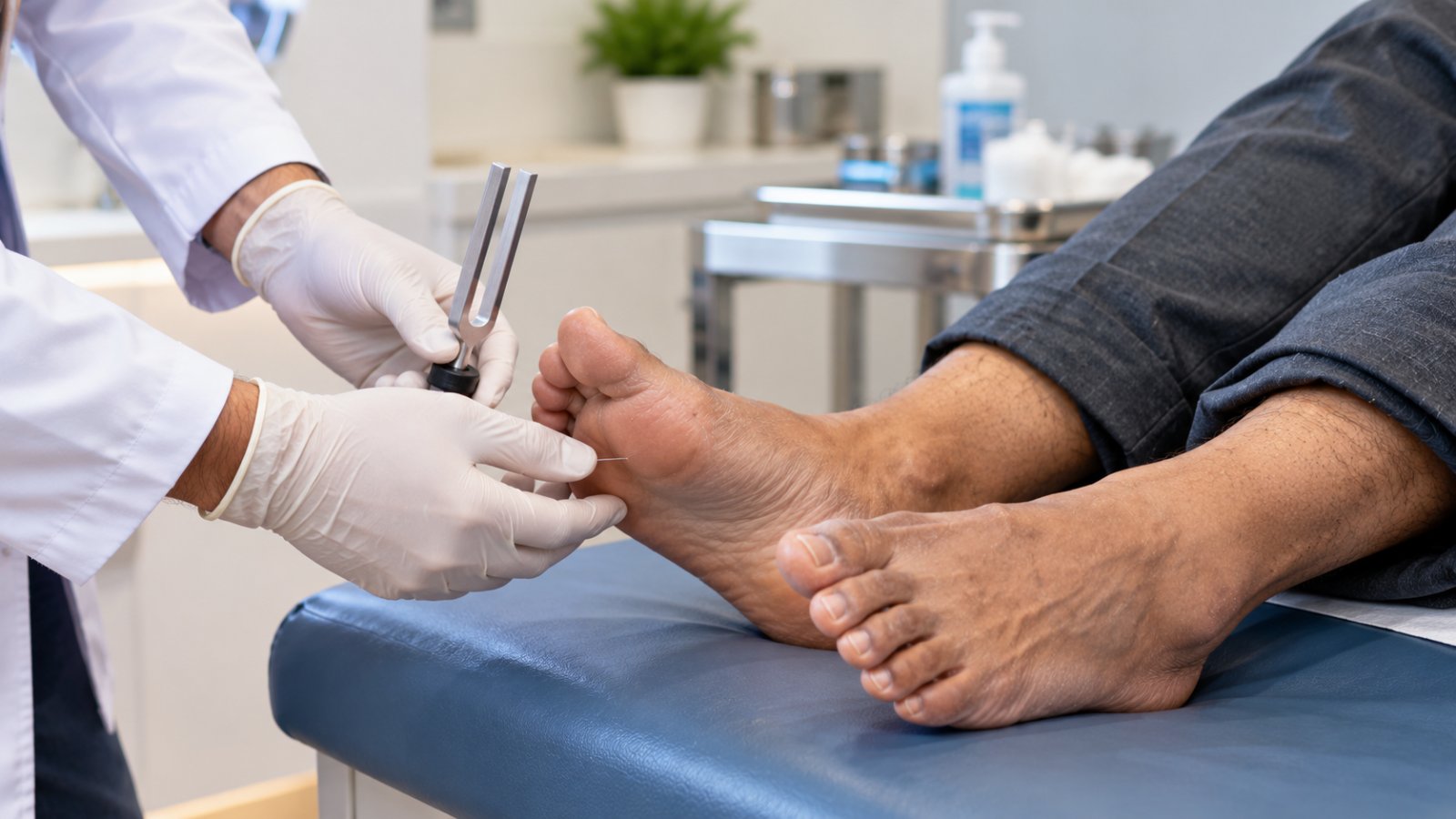
A diabetic foot screen in a physician's OPD takes about three minutes: inspect both feet and the footwear, test sensation with a 10 g monofilament or the Ipswich Touch Test, and feel the foot pulses. Any open wound, colour change, hot swollen foot or suspected infection needs referral to a foot team within days.
For busy general physicians, a practical diabetic foot check template helps standardise examinations and identify patients who need urgent care.
The goal is not to complete an extensive vascular investigation during every appointment. It is to recognise warning signs early, document risk and arrange timely referral.
Key Takeaways
-
Every person with diabetes should receive regular foot-risk assessment.
-
A rapid screen includes skin inspection, protective sensation, pedal pulses and footwear assessment.
-
A 10-g monofilament or Ipswich Touch Test can help detect loss of protective sensation.
-
A new diabetic foot ulcer requires prompt specialist assessment, ideally within one working day.
-
Spreading infection, gangrene or suspected acute limb ischaemia requires emergency evaluation.
-
A hot, swollen foot without an open wound may indicate acute Charcot neuro-osteoarthropathy.
-
Physicians should document findings and communicate referral urgency clearly.
-
Patients with neuropathy or peripheral artery disease require risk-based follow-up even when no wound is present.
Why Should Every Physician Perform a Diabetic Foot Screen?
Diabetes-related foot complications can develop gradually.
Peripheral neuropathy may reduce pain sensation, while peripheral artery disease can compromise tissue perfusion.
A patient may therefore develop a blister, callus or small wound without recognising its significance.
If the problem is missed, repeated pressure or infection can lead to deeper tissue damage.
Regular screening helps identify risk before an ulcer develops.
What Does a Foot Screen Detect?
A rapid examination can identify:
-
Loss of protective sensation
-
Absent or reduced foot pulses
-
Calluses and pressure points
-
Foot deformities
-
Skin cracks and blisters
-
Open wounds
-
Swelling and colour changes
-
Inappropriate footwear
These findings help determine whether the patient needs preventive education, further investigation or urgent referral.
Who Should Be Screened?
The International Working Group on the Diabetic Foot (IWGDF) recommends regular foot screening for people with diabetes.
The frequency depends on risk.
Patients without neuropathy or peripheral artery disease generally require annual screening.
Those with neuropathy, circulation problems, previous ulcers or amputations need more frequent assessment.
A rapid three-minute screen is useful in a busy OPD, but it does not replace a comprehensive foot examination when abnormalities are identified.
What Should a 3-Minute Foot Screen Include?
A practical diabetic foot check template can divide the examination into three short stages.
Minute 1: Inspect Both Feet and Footwear
Ask the patient to remove shoes and socks.
Examine the soles, heels, toes, interdigital spaces and nails.
Look for:
-
Open wounds
-
Blisters
-
Calluses
-
Cracked skin
-
Fungal changes
-
Redness
-
Swelling
-
Deformities
-
Skin discolouration
-
Signs of infection
Check whether footwear is tight, damaged or creating pressure points.
Ask about previous ulcers, amputations and current foot symptoms.
A patient with a previous ulcer should not be classified as low risk simply because the skin is currently intact.
Minute 2: Test Protective Sensation
Loss of protective sensation is a major risk factor for diabetic foot ulceration.
Two practical screening options are the 10-g monofilament and the Ipswich Touch Test.
Option A: 10-g Monofilament
A 10-g Semmes-Weinstein monofilament applies a standardised force when it bends.
Ask the patient to close their eyes.
Apply the monofilament perpendicular to the skin until it bends, following a validated testing protocol.
Avoid testing directly over calluses, ulcers or scar tissue.
Document the tested sites and whether the patient correctly detects the pressure.
An abnormal result suggests loss of protective sensation and requires further risk assessment.
Option B: Ipswich Touch Test
The Ipswich Touch Test is a simple bedside method that does not require specialised equipment.
Ask the patient to close their eyes.
Lightly touch the tips of the first, third and fifth toes on each foot for approximately one to two seconds.
Do not press, tap or push.
Ask the patient to indicate when a touch is felt.
Failure to detect two or more of the six touches suggests loss of protective sensation.
The test is useful when a monofilament is unavailable.
However, it should be performed consistently and documented accurately.
Minute 3: Check Pedal Pulses and Footwear Risk
Palpate the:
-
Dorsalis pedis pulse
-
Posterior tibial pulse
Assess both feet.
Also look for:
-
Cool skin
-
Colour changes
-
Delayed wound healing
-
Rest pain
-
Unusual swelling
-
Evidence of tissue loss
Absent pulses do not independently confirm peripheral artery disease, and palpable pulses do not completely exclude it.
When vascular disease is suspected, arrange further assessment such as Doppler-based testing, ankle-brachial pressure index or toe pressure measurement as appropriate.
Finish by checking footwear and providing brief preventive advice.
Which Findings Need Same-Day, Same-Week or Routine Referral?
Not every abnormal foot examination requires emergency admission.
However, some findings should never wait for a routine appointment.
A structured referral system helps physicians prioritise patients according to clinical urgency.
Diabetic Foot Referral Triage Table
| Clinical Finding | Referral Urgency | What to Do Before Referral |
|---|---|---|
| Spreading infection, wet gangrene or systemic illness | Emergency / same day | Arrange immediate hospital assessment; assess sepsis and begin appropriate treatment without delaying transfer |
| Suspected acute limb ischaemia, sudden cold foot or severe new colour change | Emergency / same day | Arrange urgent vascular assessment; avoid delaying transfer for routine tests |
| New hot, red, swollen foot with suspected acute Charcot | Same day | Immobilise and offload immediately; arrange urgent specialist assessment |
| New open diabetic foot ulcer | Promptly, ideally within one working day | Cover with a suitable dressing, reduce pressure, assess infection and circulation |
| Localised infection without systemic illness | Urgent, generally within 24 hours | Assess severity and start appropriate management while arranging specialist care |
| Bleeding beneath callus or a pre-ulcerative lesion | Within one week, sooner if deterioration occurs | Protect the area, reduce pressure and arrange trained assessment |
| Neuropathy without an active wound | Routine risk-based follow-up | Document risk, provide footwear advice and schedule review |
| Reduced or absent pulses without acute symptoms | Timely vascular assessment | Document findings and arrange appropriate vascular testing |
Referral timing should follow clinical severity and local service arrangements.
A new ulcer should not routinely be left untreated while waiting a full week for specialist review.
Findings That Require Emergency Action
Immediate escalation is particularly important when the patient has:
-
Fever or systemic illness with foot infection
-
Rapidly spreading redness
-
Crepitus or suspected deep tissue infection
-
Wet gangrene
-
Severe pain with a suddenly cold or pale foot
-
Rapidly progressive tissue loss
-
Signs of sepsis
These patients may require hospital admission, antibiotics, imaging, surgical drainage or vascular intervention.
Can a Hot, Swollen Foot Be Charcot Without a Wound?
Yes.
Acute Charcot neuro-osteoarthropathy may present with warmth, redness and swelling even when the skin is intact.
It is particularly important to consider in a patient with diabetes and neuropathy.
The affected foot may be substantially warmer than the opposite foot.
If acute Charcot is suspected, immediate immobilisation and offloading are important while urgent specialist assessment and imaging are arranged.
Do not advise the patient to continue normal weight-bearing activity while waiting for evaluation.
Downloadable Diabetic Foot Check Template for Physicians
The following diabetic foot check template can be copied into an OPD record, printed as a checklist or adapted to an electronic medical record.
Patient Details
-
Patient name:
-
Patient ID:
-
Examination date:
-
Diabetes type:
-
Duration of diabetes:
-
Latest HbA1c, if available:
-
Previous foot ulcer: Yes / No
-
Previous amputation: Yes / No
-
History of peripheral artery disease: Yes / No
Foot Examination
| Examination | Right Foot | Left Foot |
|---|---|---|
| Skin intact | Yes / No | Yes / No |
| Callus present | Yes / No | Yes / No |
| Blister or ulcer | Yes / No | Yes / No |
| Redness or swelling | Yes / No | Yes / No |
| Foot deformity | Yes / No | Yes / No |
| Protective sensation | Normal / Abnormal | Normal / Abnormal |
| Dorsalis pedis pulse | Present / Absent | Present / Absent |
| Posterior tibial pulse | Present / Absent | Present / Absent |
| Footwear-related pressure | Yes / No | Yes / No |
Clinical Decision
Suspected foot-risk category: Very low / Low / Moderate / High / Requires urgent assessment
Referral urgency: Emergency / Same day / Within one working day / Within one week / Routine
Reason for referral:
Treatment or protection provided:
Referring physician:
Contact details:
Date and time of referral:
This template is intended for initial screening and referral. A comprehensive assessment may require additional vascular, neurological, infection and wound investigations.
How Should the Diabetic Foot Referral Letter Be Written?
A useful referral letter should allow the receiving team to understand the clinical problem immediately.
Avoid vague descriptions such as "diabetic foot problem" without further details.
Instead, include the abnormal findings, symptom duration and urgency.
Essential Referral Information
A referral should contain:
-
Patient identification and contact details.
-
Diabetes duration and relevant medical history.
-
Previous ulcers or amputations.
-
Current wound location and size, if present.
-
Signs of infection or systemic illness.
-
Sensation test findings.
-
Pedal pulse findings.
-
Relevant blood tests and imaging.
-
Current medicines and allergies.
-
Treatment already provided.
-
Required referral urgency.
Example Referral Letter
Subject: Urgent diabetic foot assessment
Dear Diabetic Foot Team,
I am referring an adult patient with type 2 diabetes and a newly identified plantar foot ulcer.
The wound has been present for approximately five days. Examination shows a small open ulcer with surrounding callus and reduced protective sensation.
Pedal pulses are palpable. There are no reported systemic symptoms.
The wound has been covered with a protective dressing, and pressure reduction has been advised.
Please assess the ulcer, foot-risk status and need for further treatment.
Kind regards,
Referring Physician
This is an illustrative example. Actual referral urgency depends on the patient's clinical findings.
What Happens After Referral to EDFC?
After identifying a concerning foot finding, the referring physician should arrange assessment through an appropriate diabetic foot service.
At Elegance Diabetic Foot & Ulcer Clinic (EDFC), Dr. Ashutosh Shah is associated with the evaluation and management of complex diabetic foot conditions.
A specialist assessment may include:
-
Detailed wound examination
-
Neuropathy assessment
-
Vascular assessment
-
Infection evaluation
-
Pressure and footwear assessment
-
Imaging when indicated
-
Individual treatment planning
Patients with severe infection or acute ischaemia require emergency hospital care rather than waiting for a routine clinic appointment.
Physicians can use the refer a patient to EDFC page to review available referral information.
What Information Should Accompany the Patient?
Provide the screening findings, relevant investigations, current medications and details of treatment already started.
Where possible, include the date and time of the referral.
The referring physician should also explain to the patient why the assessment is urgent.
Specific acknowledgement times and appointment availability should be confirmed with the receiving service.
How Is the Patient Handed Back for Shared Care?
Diabetic foot treatment often requires collaboration between the referring physician and the specialist team.
The specialist may manage the ulcer, infection, offloading or vascular problem.
The general physician continues to play an important role in:
-
Diabetes control
-
Blood pressure management
-
Kidney health
-
Medication review
-
Cardiovascular risk reduction
-
Smoking cessation
-
Long-term foot surveillance
What Should the Specialist Communicate?
Where a shared-care arrangement is established, the treating team should communicate:
-
Diagnosis
-
Treatment provided
-
Wound status
-
Recommended medicines
-
Offloading instructions
-
Follow-up requirements
-
Warning signs
-
Responsibilities for continuing care
A clear communication pathway reduces confusion and helps patients receive consistent advice.
Information about professional collaboration is available through EDFC for doctors.
Diabetic Foot Referral in Jamnagar for Physicians: How to Coordinate Care
A structured referral pathway can help physicians recognise patients who need specialist foot assessment before complications progress.
For clinicians searching for diabetic foot referral in jamnagar for physicians, the priority is to document the examination, identify urgency and contact the appropriate receiving service.
The referral should specify whether the patient has an active ulcer, suspected infection, loss of protective sensation, vascular compromise or possible Charcot neuro-osteoarthropathy.
At EDFC, Dr. Ashutosh Shah is associated with diabetic foot care and clinical assessment. Referring physicians should confirm current referral arrangements, available services and appointment procedures directly with the clinic.
Why Is Training Important?
Consistent screening depends on staff knowing how to:
-
Perform monofilament testing
-
Conduct the Ipswich Touch Test
-
Recognise infection warning signs
-
Identify suspected acute Charcot
-
Assess pedal pulses
-
Document abnormalities
-
Select the appropriate referral urgency
Physicians interested in structured professional education can review diabetic foot training for doctors.
Advanced surgical education information is available through the fellowship in diabetic foot surgery.
Conclusion
A three-minute diabetic foot examination can help physicians identify high-risk patients during routine diabetes consultations.
A practical diabetic foot check template should include visual inspection, protective sensation testing, pedal pulse assessment and footwear evaluation.
The most important outcome is not simply completing the checklist. It is recognising which findings require immediate treatment, urgent specialist assessment or routine preventive follow-up.
A new ulcer, suspected infection, acute Charcot foot or signs of limb ischaemia should never be treated as a routine screening finding.
At Elegance Diabetic Foot & Ulcer Clinic, Dr. Ashutosh Shah is associated with diabetic foot assessment and treatment planning.
Consistent screening, timely referrals and coordinated shared care can help reduce avoidable diabetic foot complications.
quiz Frequently Asked Questions
This article is general education, not a diagnosis. If you have a diabetic foot wound, please have it assessed in person. Send a photo on WhatsApp or book a consultation.
About the Author

Dr. Ashutosh Shah, Plastic, Reconstructive & Diabetic Foot Surgeon, Elegance Diabetic Foot & Ulcer Clinic, Surat
Dr. Ashutosh Shah is a board certified plastic and reconstructive surgeon with over 22 years of experience and more than 10,000 limbs and feet saved. He founded Elegance Diabetic Foot & Ulcer Clinic, India's first chain of clinics dedicated to foot care, with centres in Surat and OPD partners across South Gujarat. He is known for a limb first approach, safe wound care and ethical, natural results.