
Introduction
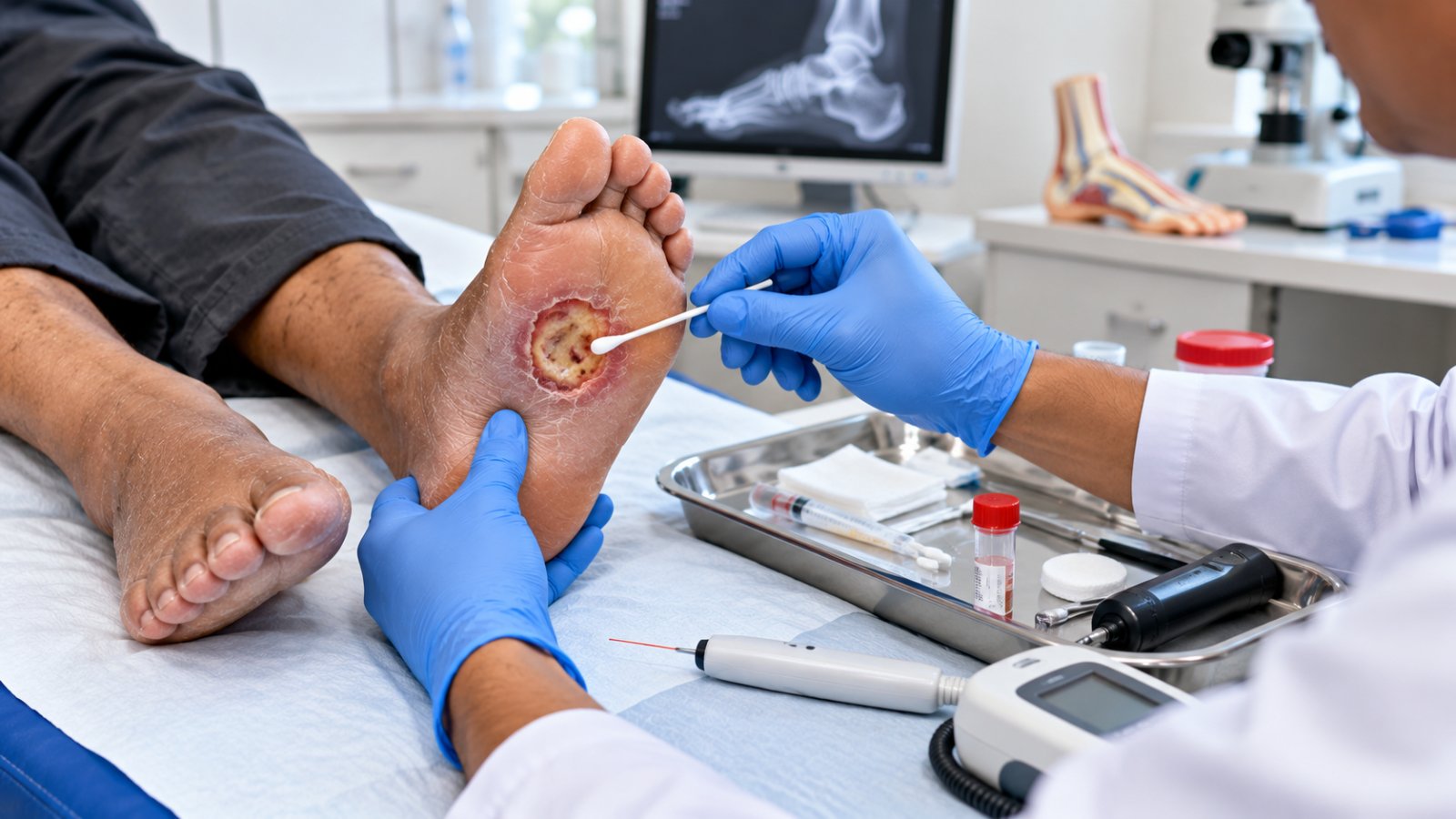
Diabetic foot infection tests help doctors determine whether a foot ulcer is infected, how deeply the infection has spread, and whether bone or surrounding tissues are affected. Doctors begin with a clinical examination and may recommend blood tests, wound cultures, X-rays, or MRI scans based on the patient's symptoms and wound condition.
Early diagnosis is important because people with diabetes may experience reduced sensation, poor circulation, and delayed wound healing.
A small wound may develop a serious infection without causing significant pain. Understanding how doctors investigate diabetic foot infections can help patients recognise why different examinations are necessary.
What Are Diabetic Foot Infection Tests?
Diabetic foot infection tests are clinical assessments and investigations that help doctors identify infection in the skin, soft tissues, or bones of the foot.
Not every patient requires every test. Doctors select investigations based on the wound's appearance, infection severity, medical history, and examination findings.
The assessment usually focuses on three important questions:
-
Is the wound clinically infected?
-
Has the infection spread into deeper tissues or bone?
-
What treatment is necessary to control the infection?
Doctors also evaluate blood circulation, nerve sensation, and other factors that may affect healing.
1. Clinical Examination: The First Step in Diagnosing Infection
A diabetic foot wound examination usually begins with a detailed physical assessment.
The doctor checks the wound for:
-
Redness around the affected area
-
Swelling and local warmth
-
Pain or tenderness
-
Pus or purulent discharge
-
Dead or damaged tissue
-
Wound depth and surrounding skin condition
-
Signs of infection spreading beyond the wound
A diabetic foot infection is primarily a clinical diagnosis. Doctors generally look for purulent discharge or at least two characteristic local signs of inflammation, while considering other possible causes.
Why Is Clinical Examination Important?
Some patients with diabetic neuropathy do not experience significant pain, even when a serious infection develops.
Doctors therefore assess the entire foot rather than relying only on pain or visible discharge.
They may also examine the spaces between the toes, the sole, and areas exposed to repeated pressure.
For more information about infection management, see diabetic foot infection treatment.
2. Wound Culture Test: Identifying the Bacteria
A wound culture test helps identify bacteria that may be causing a diabetic foot infection.
Doctors may recommend this test when an ulcer shows clinical signs of infection, particularly when the infection is moderate, severe, recurrent, or not responding to treatment.
How Is a Wound Culture Collected?
The process may involve:
-
Cleaning the wound surface.
-
Removing dead or contaminated tissue when appropriate.
-
Collecting a tissue sample using an appropriate sterile technique.
-
Sending the specimen to a laboratory.
-
Reviewing bacterial identification and antibiotic susceptibility results.
A properly collected tissue specimen is generally preferred over a superficial wound swab.
Why Are Wound Culture Results Important?
Culture results can help doctors select or adjust antibiotics.
However, bacteria may be present in an open wound without causing infection. Therefore, a positive culture result alone does not confirm that antibiotics are necessary.
Doctors interpret laboratory findings together with clinical symptoms and examination results.
3. Blood Tests: Checking for Inflammation and Infection
Blood tests can provide additional information when doctors suspect a diabetic foot infection.
Common investigations include:
|
Blood Test |
Purpose |
|---|---|
|
Complete Blood Count (CBC) |
Checks white blood cell levels and other blood components |
|
C-Reactive Protein (CRP) |
Helps assess inflammation |
|
Erythrocyte Sedimentation Rate (ESR) |
May support assessment of inflammation and suspected bone infection |
|
Blood Glucose |
Evaluates current blood sugar levels |
|
HbA1c |
Assesses longer-term glucose control |
|
Kidney Function Tests |
Help guide treatment and medication selection |
Blood tests cannot independently confirm or exclude every diabetic foot infection.
For example, some patients with a clinically significant infection may have a normal white blood cell count.
Doctors combine these results with clinical examination and imaging when necessary.
4. Diabetic Foot X-Ray: Checking for Bone Problems
A diabetic foot x-ray is often an initial imaging investigation when doctors suspect bone involvement or a deeper infection.
An X-ray may help identify:
-
Bone destruction associated with established infection
-
Fractures or deformities
-
Gas in the soft tissues
-
Foreign objects that are visible on X-ray
-
Other structural abnormalities
Can an X-Ray Detect Every Bone Infection?
No. Early bone infection may not produce visible changes on a standard X-ray.
If doctors continue to suspect osteomyelitis despite an inconclusive X-ray, they may recommend additional investigations.
This is particularly important for deep ulcers, longstanding wounds, or wounds located over prominent bones.
5. MRI Scan: Investigating Deep Infection
MRI provides detailed images of soft tissues and bone.
Doctors may recommend MRI when the diagnosis of diabetic foot osteomyelitis remains uncertain after clinical assessment, initial X-rays, and laboratory investigations.
MRI can help evaluate:
-
Possible bone infection
-
Deep tissue abscesses
-
Infection involving muscles or tendons
-
The extent of soft-tissue involvement
MRI is not necessary for every diabetic foot ulcer.
Doctors choose imaging based on the likelihood of deeper infection and whether the results will influence treatment.
6. Probe-to-Bone Test: Checking for Possible Bone Involvement
The probe-to-bone test is a clinical examination used when doctors suspect osteomyelitis.
A trained healthcare professional gently examines an open ulcer with a sterile, blunt instrument to determine whether bone can be contacted through the wound.
What Does a Positive Probe-to-Bone Test Mean?
A positive result raises concern for possible bone infection, especially in a patient with a deep ulcer or other suspicious findings.
However, the result does not establish the diagnosis by itself.
Doctors interpret it alongside X-rays, inflammatory markers, and other investigations.
Patients should never attempt this test at home.
7. Blood Circulation Tests: Understanding Healing Potential
Although circulation tests do not directly diagnose infection, they help doctors assess whether the wound has enough blood supply to support healing.
Poor circulation can increase the risk of delayed healing and serious complications.
Doctors may recommend:
-
Foot pulse examination
-
Handheld Doppler assessment
-
Ankle-brachial index (ABI)
-
Toe pressure measurements
-
Duplex ultrasound or other vascular imaging when indicated
People with diabetes may have calcified arteries, which can make ABI results misleading. Toe pressure measurements and Doppler waveforms can provide additional information.
Learn more about vascular assessment and services.
8. How Doctors Interpret Diabetic Foot Infection Tests Together
Doctors do not rely on a single investigation to diagnose every infection.
Diabetic foot infection tests are most useful when combined with the patient's symptoms, medical history, physical examination, and wound characteristics.
For example:
-
A superficial ulcer with no clinical signs of infection may not require an infection culture or antibiotics.
-
An ulcer with pus, redness, and swelling may require culture-guided antibiotic treatment.
-
A deep ulcer with suspected bone involvement may require X-rays, probe-to-bone assessment, and additional imaging.
-
A rapidly spreading infection may require immediate hospital care and urgent surgical evaluation.
This approach helps doctors select appropriate investigations without delaying necessary treatment.
9. What Happens After a Diabetic Foot Infection Is Diagnosed?
Once doctors establish the diagnosis and assess severity, they create an individualised treatment plan.
Treatment may involve:
Antibiotic Treatment
Doctors prescribe antibiotics when clinical infection is present. The medication, route, and duration depend on severity, likely organisms, culture results, and patient-specific factors.
Wound Cleaning and Debridement
Removing unhealthy tissue when appropriate can support infection control and wound management.
Pressure Offloading
Reducing pressure on the affected area helps prevent repeated tissue damage.
Specialised devices or therapeutic footwear may form part of the treatment plan.
Blood Circulation Management
Patients with significant peripheral arterial disease may require vascular specialist assessment.
Regular Monitoring
Follow-up appointments allow doctors to review wound healing, infection control, and the need for additional treatment.
Read more about non-surgical diabetic foot management.
10. When Should You Seek Urgent Medical Attention?
A diabetic foot infection can progress quickly, particularly when poor circulation or reduced sensation is present.
Seek urgent medical evaluation if you notice:
-
Rapidly spreading redness or swelling
-
Pus or increasing wound discharge
-
Black or discoloured tissue
-
Sudden worsening of an existing ulcer
-
Fever, chills, or marked weakness
-
Severe pain or an unexpected change in foot sensation
-
A deep wound with exposed structures
Confusion, rapidly deteriorating health, or signs of sepsis require emergency hospital care.
Spreading skin infection, including foot cellulitis, should not be ignored.
11. Diabetic Foot Infection Evaluation at Elegance Diabetic Foot & Ulcer Clinic
At Elegance Diabetic Foot & Ulcer Clinic, Dr. Ashutosh Shah provides diabetic foot wound assessment and treatment planning based on the patient's clinical condition. The evaluation may include examination of the wound, assessment of circulation and nerve sensation, and recommendations for appropriate investigations when infection is suspected. Treatment decisions focus on identifying infection, addressing factors that delay healing, and reducing the risk of serious foot complications.
Conclusion
Early diagnosis plays an important role in preventing complications from diabetic foot infections.
Diabetic foot infection tests help doctors understand whether an ulcer is infected, identify possible bacterial causes, and investigate deeper tissue or bone involvement.
Clinical examination remains the foundation of diagnosis, while blood tests, wound cultures, X-rays, and MRI provide additional information when necessary.
Patients with diabetes should seek medical evaluation for new wounds, worsening symptoms, or signs of infection rather than relying on home treatment alone.
quiz Frequently Asked Questions
This article is general education, not a diagnosis. If you have a diabetic foot wound, please have it assessed in person. Send a photo on WhatsApp or book a consultation.
About the Author

Dr. Ashutosh Shah, Plastic, Reconstructive & Diabetic Foot Surgeon, Elegance Diabetic Foot & Ulcer Clinic, Surat
Dr. Ashutosh Shah is a board certified plastic and reconstructive surgeon with over 22 years of experience and more than 10,000 limbs and feet saved. He founded Elegance Diabetic Foot & Ulcer Clinic, India's first chain of clinics dedicated to foot care, with centres in Surat and OPD partners across South Gujarat. He is known for a limb first approach, safe wound care and ethical, natural results.