
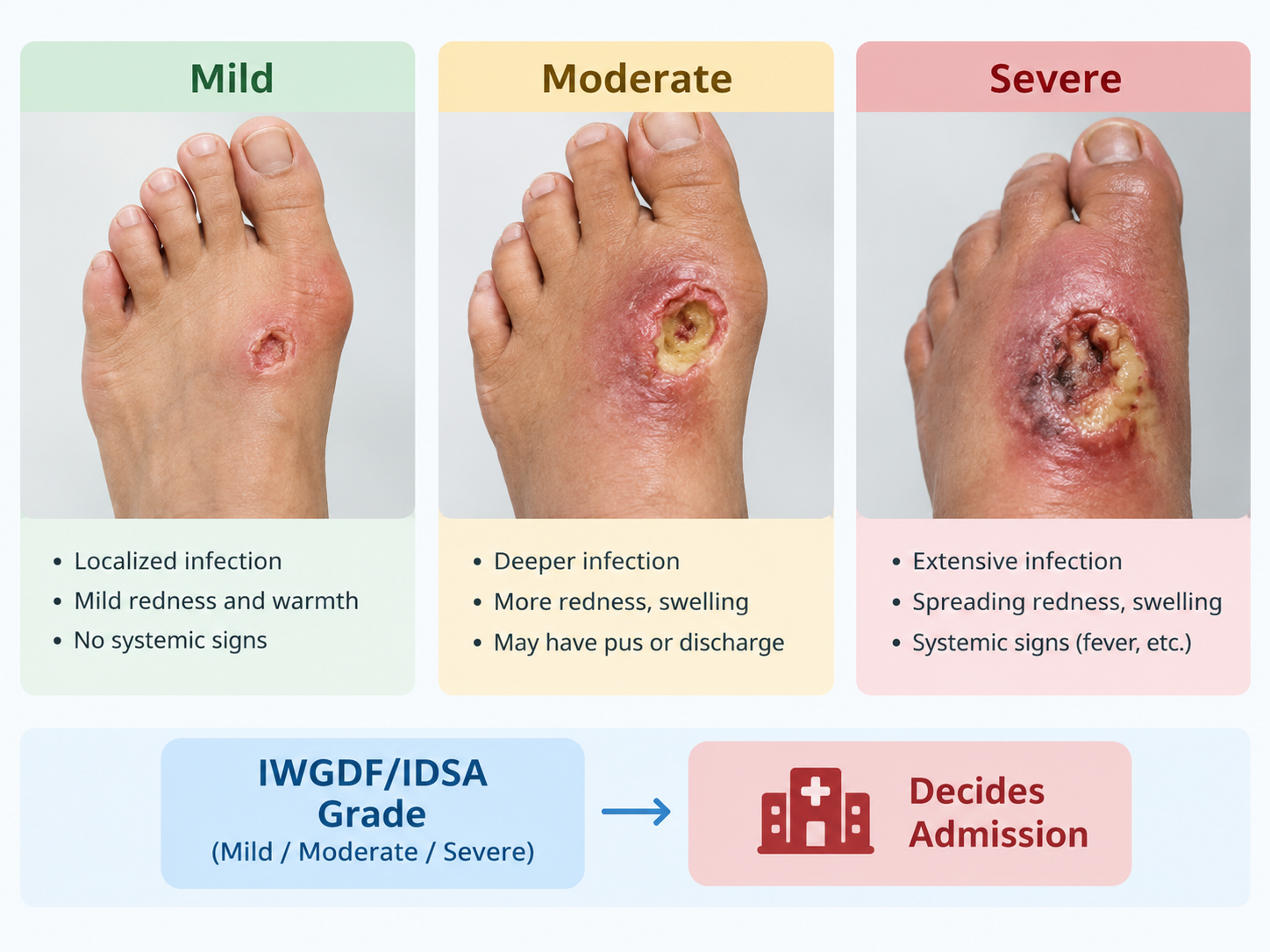
The IWGDF/IDSA system grades diabetic foot infection as mild (skin only, redness under 2 cm around the wound), moderate (redness over 2 cm or deeper tissue, bone or joint) or severe (with fever, fast pulse or high white count). Severe infections, and most moderate ones with poor circulation, need admission and urgent surgical review.
Diabetic foot infection classification helps doctors determine how serious a foot infection is and whether hospital admission is necessary. The IWGDF/IDSA system divides infections into mild, moderate and severe categories based on local tissue involvement and systemic illness. Severe infections generally require hospitalisation, while moderate infections with significant complications may also need admission and urgent surgical assessment.
Key Takeaways
-
The IWGDF/IDSA system classifies diabetic foot infections as uninfected, mild, moderate or severe.
-
Mild infections usually involve the skin or subcutaneous tissue without systemic illness.
-
Moderate infections involve more extensive redness or deeper structures but do not meet the criteria for severe systemic infection.
-
Severe infections involve systemic inflammatory response and generally require hospital admission.
-
Osteomyelitis can be present without systemic illness and requires additional assessment.
-
Doctors use clinical findings, circulation, laboratory investigations and imaging to determine treatment.
-
The first 72 hours are important for monitoring response and identifying the need for additional intervention.
What Is Diabetic Foot Infection Classification?
A diabetic foot infection develops when microorganisms invade and multiply in foot tissues, producing an inflammatory response or other clinical evidence of infection.
People with diabetes may develop infections after skin breakdown, ulcers, minor injuries or pressure-related tissue damage.
Neuropathy can reduce pain sensation, making it difficult to recognize the seriousness of an injury.
Peripheral arterial disease may also reduce blood supply and complicate healing.
The diabetic foot infection classification system developed by the International Working Group on the Diabetic Foot (IWGDF) and the Infectious Diseases Society of America (IDSA) helps clinicians assess infection severity consistently.
The system considers the extent of local infection and whether systemic inflammatory signs are present.
It helps guide decisions about investigations, antibiotic treatment, surgical consultation and hospital admission.
Patients can learn more about diabetic foot infection and why early assessment matters.
How Is a Diabetic Foot Infection Graded?
The IWGDF IDSA classification uses four main grades.
| Grade | Clinical Definition | Usual Care Setting |
|---|---|---|
| Grade 1: Uninfected | No clinical evidence of infection | Wound care and monitoring |
| Grade 2: Mild | Local infection involving only skin or subcutaneous tissue, with surrounding erythema greater than 0.5 cm but no more than 2 cm, and no systemic manifestations | Usually outpatient |
| Grade 3: Moderate | Local infection with erythema greater than 2 cm or involvement of deeper structures, without systemic inflammatory response meeting severe criteria | Outpatient or hospital, depending on complications |
| Grade 4: Severe | Foot infection accompanied by systemic inflammatory response meeting at least two specified criteria | Usually hospital admission |
| Osteomyelitis suffix (O) | Added when osteomyelitis is present, such as 3(O) or 4(O) | Depends on overall severity and clinical condition |
The classification applies after the clinician has established that infection is present.
Infection is generally diagnosed clinically using local or systemic signs rather than a positive wound culture alone.
The grading system should also be interpreted alongside vascular status, metabolic stability and the patient's overall health.
What Are the Signs of a Mild Diabetic Foot Infection?
A mild diabetic foot infection generally affects the skin and subcutaneous tissue without evidence of deeper infection or systemic illness.
Clinical signs may include:
-
Local redness around an ulcer
-
Warmth
-
Swelling or induration
-
Tenderness or pain, although neuropathy may reduce pain
-
Purulent discharge
For a mild infection, surrounding redness typically extends more than 0.5 cm but no more than 2 cm from the wound margin.
The infection should not involve deeper structures such as muscle, tendon, joint or bone.
A person with a mild infection may otherwise feel well.
However, mild does not mean harmless.
An infection can progress if it is not treated appropriately.
Can a Mild Diabetic Foot Infection Be Treated Without Admission?
Many mild infections can be treated as outpatient cases.
Treatment may include appropriate oral antibiotics, wound care, pressure relief and scheduled clinical reassessment.
The choice of antibiotics depends on clinical circumstances, local resistance patterns, allergies and relevant medical history.
Not every diabetic foot ulcer requires antibiotics. An ulcer without clinical infection should not receive antibiotics simply to promote healing.
For infected wounds, clinicians should also identify the factors that caused the skin breakdown.
Appropriate infection management should address the infection and the underlying wound problem.
What Makes a Diabetic Foot Infection Moderate Rather Than Mild?
A moderate diabetic foot infection is more extensive than a mild infection but does not meet the systemic criteria for severe infection.
It may be classified as moderate when:
-
Redness extends more than 2 cm from the wound margin.
-
Infection involves deeper tissues.
-
An abscess is present.
-
Tendons, muscles or joints are involved.
-
Osteomyelitis is identified without systemic criteria for severe infection.
A patient can have a moderate infection without fever.
This is important because some patients assume that the absence of fever means the infection is minor.
For example, an ulcer with deep tissue involvement may be moderate even if the patient feels generally well.
Why Does Spreading Redness Matter?
Redness extending around a diabetic foot wound can indicate infection spreading into surrounding tissues.
The doctor may examine whether the redness is increasing, whether swelling is worsening and whether deeper structures are involved.
A spreading skin infection may include cellulitis.
However, redness can also result from non-infectious conditions, so clinical assessment remains essential.
A clinician may mark the visible border of redness and use photographs to help monitor changes over time.
Which Systemic Signs Make a Diabetic Foot Infection Severe?
A severe diabetic foot infection is classified as Grade 4 when a foot infection is accompanied by systemic inflammatory response meeting at least two specified criteria.
The IWGDF/IDSA criteria include:
| Systemic Finding | Severe Infection Criterion |
|---|---|
| Temperature | Above 38°C or below 36°C |
| Heart rate | Greater than 90 beats per minute |
| Respiratory rate | Greater than 20 breaths per minute or PaCO₂ below 32 mmHg |
| White blood cell count | Above 12,000/mm³, below 4,000/mm³ or more than 10% immature forms |
At least two systemic inflammatory response criteria are required for Grade 4 under this classification.
These findings must be interpreted in the context of an established foot infection and the patient's overall clinical condition.
Importantly, severe infection may occur without all of the classic symptoms.
Older adults and patients with neuropathy, immune dysfunction or other medical conditions may have less obvious inflammatory responses.
A patient with a rapidly deteriorating foot, black tissue, suspected deep abscess or critical circulation problems may need emergency care even without meeting the Grade 4 criteria.
Who Needs Hospital Admission for a Diabetic Foot Infection?
Hospital admission depends on infection severity and the presence of additional complications.
The IWGDF/IDSA 2023 guideline recommends considering hospitalisation for patients with severe diabetic foot infections and for moderate infections associated with important relevant morbidities.
Patients More Likely to Need Admission
Hospital assessment may be necessary when a patient has:
-
Severe infection with systemic inflammatory response
-
Moderate infection with significant peripheral arterial disease
-
Suspected deep abscess or necrotising infection
-
Extensive gangrene
-
Compartment syndrome
-
A need for urgent surgery or intravenous treatment
-
Significant metabolic instability
-
Inability to receive necessary treatment safely as an outpatient
Admission is not automatically required for every moderate infection.
However, a patient with moderate infection and compromised circulation may have a substantially greater risk of poor outcomes.
The clinical decision should consider infection severity, vascular status, the need for procedures and the availability of safe outpatient care.
Diabetic Foot Infection Treatment in Surat: When Is Urgent Specialist Care Needed?
Patients seeking diabetic foot infection treatment in surat should obtain prompt clinical assessment when a wound develops spreading redness, increasing discharge, swelling, black tissue or other concerning changes.
At Elegance Diabetic Foot & Ulcer Clinic (EDFC), diabetic foot evaluation under Dr. Ashutosh Shah, Consultant Plastic, Reconstructive & Diabetic Foot Surgeon, focuses on identifying infection severity and the factors affecting wound healing.
Clinical assessment may include examination of the wound, evaluation of circulation, review of medical history and relevant investigations.
Patients with suspected severe infection or rapidly progressing tissue damage should attend an appropriate emergency facility immediately.
Online photographs or routine appointments should not delay emergency treatment.
Does Bone Infection Change the Diabetic Foot Infection Grade?
Bone infection, also called osteomyelitis, is an important complication of diabetic foot ulcers.
The IWGDF/IDSA classification uses an (O) suffix to indicate osteomyelitis.
For example:
-
Grade 3(O): Moderate infection with osteomyelitis
-
Grade 4(O): Severe infection with osteomyelitis
Osteomyelitis does not automatically mean that the patient has a severe Grade 4 infection.
A patient may have bone infection without systemic inflammatory response.
Diagnosis may require a combination of clinical examination, probe-to-bone testing, plain X-rays, inflammatory markers and further imaging when necessary.
The presence of osteomyelitis affects treatment planning, including antibiotic selection, treatment duration and possible surgical management.
Which Blood Tests Help Assess a Severe Foot Infection?
Blood tests can support clinical assessment but cannot determine infection severity on their own.
Common investigations include:
Complete Blood Count
A complete blood count provides information about white blood cells and other blood components.
An elevated or reduced white blood cell count may contribute to the assessment of systemic inflammatory response.
However, a normal white blood cell count does not exclude serious infection.
C-Reactive Protein (CRP)
CRP is an inflammatory marker.
It may help support the assessment of infection and can sometimes be useful when monitoring treatment response.
CRP is not specific to diabetic foot infection and should not be used alone to classify severity.
Erythrocyte Sedimentation Rate (ESR)
ESR may be useful as part of the evaluation when osteomyelitis is suspected.
However, elevated ESR can occur in other inflammatory conditions.
Blood Glucose and Kidney Function
Blood glucose, electrolytes and kidney function tests help assess the patient's overall medical condition and guide safe treatment.
Blood cultures may be indicated in selected patients with systemic illness.
The treating doctor decides which investigations are necessary.
When Is Surgery Needed for an Infected Diabetic Foot?
Some diabetic foot infections require surgical treatment in addition to antibiotics and wound care.
Urgent surgical consultation is recommended for severe infection and for moderate infection complicated by extensive gangrene, necrotising infection, signs suggesting a deep abscess, compartment syndrome or severe lower-limb ischaemia.
Surgical treatment may involve drainage of an abscess, removal of infected or dead tissue, or other procedures depending on the findings.
For moderate and severe infections, early surgery within approximately 24–48 hours may be considered when removal of infected and necrotic tissue is necessary.
Why Is Necrotising Infection an Emergency?
Necrotising infections can spread rapidly through soft tissues and may become life-threatening.
Necrotising fasciitis requires immediate emergency assessment and often urgent surgery.
Possible warning signs include rapid progression, severe systemic illness, skin discolouration, tissue destruction or other concerning clinical findings.
Patients should never wait for routine wound dressing appointments when a rapidly progressing infection is suspected.
How Is Response to Treatment Monitored in the First 72 Hours?
The first 72 hours after treatment begins are an important period for reassessing infection and determining whether the management plan is working.
The exact monitoring schedule depends on the patient's condition and treatment setting.
First 24 Hours
The clinical team may:
-
Document the infection grade
-
Record vital signs and relevant laboratory findings
-
Assess circulation and wound depth
-
Identify the need for urgent surgical intervention
-
Start appropriate infection treatment
-
Mark the visible border of redness when useful
Patients with severe infection require close monitoring in an appropriate clinical setting.
Between 24 and 48 Hours
The treating team reviews whether the patient's condition is improving, stable or deteriorating.
Assessment may include changes in fever, heart rate, redness, swelling, discharge and systemic symptoms.
The clinician also reviews available culture results and whether the selected antibiotics remain appropriate.
If there is inadequate improvement or deterioration, further examination, imaging or surgical assessment may be necessary.
Between 48 and 72 Hours
The team reassesses the overall response to treatment.
Clinical improvement may include reduced spreading redness, improving systemic observations and stabilization of the wound.
CRP may be repeated when clinically indicated, but a single inflammatory marker should not replace examination.
Failure to improve requires reassessment of infection source control, circulation, antibiotic suitability and other contributing problems.
First 72-Hour Monitoring Table
| Infection Grade | Monitoring Priorities | Action if Worsening |
|---|---|---|
| Mild | Local redness, swelling, discharge, symptoms and adherence to treatment | Prompt clinical reassessment |
| Moderate | Wound extent, deeper infection, circulation, systemic observations and response to treatment | Urgent reassessment; consider hospital or surgical evaluation |
| Severe | Frequent vital signs, organ function, infection progression, treatment response and source control | Immediate escalation of hospital-based care |
The 72-hour period is not a waiting rule. Any rapidly worsening infection needs immediate reassessment, even within the first few hours of treatment.
Why Does Early Classification Matter?
Early diabetic foot infection classification helps clinicians avoid both undertreatment and unnecessary treatment.
For example, a patient with an uninfected ulcer may require wound care and pressure relief rather than antibiotics.
A patient with a mild infection may be managed with suitable outpatient treatment and close follow-up.
A moderate infection may require deeper investigations, more intensive treatment or hospital assessment.
A severe infection generally requires hospitalisation and urgent multidisciplinary management.
Accurate grading also improves communication between doctors, surgeons, wound-care teams and patients.
The classification is not intended to predict every outcome. It is a practical tool for guiding clinical decisions.
Conclusion
Diabetic foot infection classification provides a structured way to assess infection severity and guide treatment decisions.
The IWGDF/IDSA system distinguishes mild, moderate and severe infections using the extent of local tissue involvement and the presence of systemic inflammatory response.
Mild infections are often managed as outpatient cases, while severe infections generally require hospital admission.
Moderate infections need individualized assessment, particularly when poor circulation, deep infection or other significant complications are present.
At Elegance Diabetic Foot & Ulcer Clinic (EDFC), Dr. Ashutosh Shah emphasizes clinical evaluation, infection assessment and appropriate treatment planning for patients with diabetic foot problems.
Early recognition, correct grading and timely escalation of care are essential to reducing the risk of serious complications.
quiz Frequently Asked Questions
This article is general education, not a diagnosis. If you have a diabetic foot wound, please have it assessed in person. Send a photo on WhatsApp or book a consultation.
About the Author

Dr. Ashutosh Shah, Plastic, Reconstructive & Diabetic Foot Surgeon, Elegance Diabetic Foot & Ulcer Clinic, Surat
Dr. Ashutosh Shah is a board certified plastic and reconstructive surgeon with over 22 years of experience and more than 10,000 limbs and feet saved. He founded Elegance Diabetic Foot & Ulcer Clinic, India's first chain of clinics dedicated to foot care, with centres in Surat and OPD partners across South Gujarat. He is known for a limb first approach, safe wound care and ethical, natural results.