Written by Dr. Ashutosh A Shah, M.B.B.S., M.S., M.Ch., D.N.B., Consultant Plastic and Reconstructive Surgeon, Elegance Diabetic Foot and Ulcer Clinic, Surat. Reg. no. [REG NO]. 22+ years in reconstructive surgery and limb salvage.
Medically reviewed by Dr. Ashutosh A Shah · Published 30 September 2026 · Last reviewed 30 September 2026
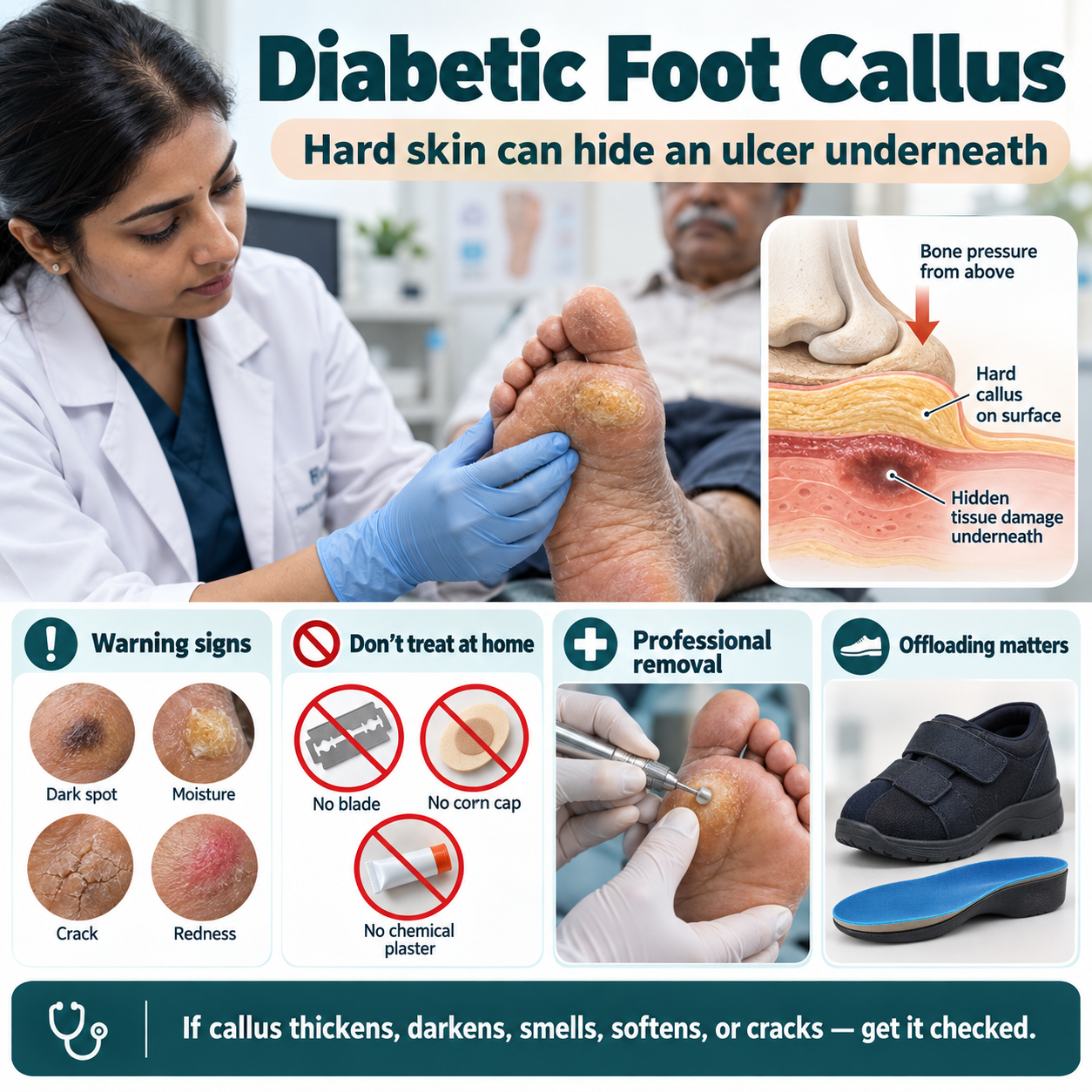
Diabetic foot callus is thickened skin formed by repeated pressure, and in diabetes it matters because damage can build underneath it without being felt. Removal is needed when the callus thickens, darkens or has anything beneath it, and it should be done professionally rather than at home.
Most people treat hard skin on a foot as a nuisance. On a foot with diabetes it is closer to a printed message about where that foot is being loaded, and the message is worth reading.
This page covers why callus forms where it does, what happens underneath it, the signs that it has stopped being harmless, and why it must be dealt with by someone else rather than by you. That last part is the most important thing on this page and it is section six.
What is a callus, and why does it form where it forms?
It is skin thickening itself in response to repeated pressure. It forms exactly where the pressure is, which is why its position tells you something.
The NHS defines it simply: "Corns and calluses are hard or thick areas of skin that can be painful." And the cause is mechanical rather than medical: "Corns and calluses are caused by pressure or rubbing of the skin on the hands or feet."
On a hand, that is a useful adaptation. Skin toughens where you grip, and nothing goes wrong. On a foot it starts the same way, and on a foot with diabetes it stops being an adaptation and becomes a problem, for the reasons in the next section.
Where callus appears is the information. It builds under the ball of the foot, at the tip or top of a clawed toe, along the edge of the heel, or over any bony point that a shoe presses on. Each of those is a place where load is concentrated rather than spread, and the skin is reporting it.
So the first useful question about a callus is not how to get rid of it. It is why the pressure is there.
Why is a diabetic foot callus different from one on any other foot?
Because on a foot with diabetes the callus can keep growing without hurting, and it keeps growing in a place where the tissue underneath is already being crushed.
Two things change on a diabetic foot, and they compound:
- Sensation may be reduced. Pain is the signal that normally makes you shift your weight, change shoes or stop walking. Without it, the loading that created the callus continues unchanged.
- Healing and circulation may be reduced. So when the tissue under that callus does break down, it does not repair itself quietly the way it would on another foot.
The consequence is a loop. Pressure builds callus. Callus is itself harder and less yielding than skin, so it raises the pressure on the tissue underneath. That raises the rate at which more callus forms. Nothing in that loop hurts, and nothing in it stops on its own.
This is why the international guideline treats callus as a clinical finding rather than a cosmetic one. The IWGDF 2023 practical guidelines list it among the things a clinician should look for at examination: "assess skin colour, temperature, presence of callus or oedema, fungal infection, pre-ulcerative signs such as haemorrhage or fissures".
Callus sits in that sentence alongside the things everyone already worries about. It belongs there.
What is happening underneath the hard skin?
The tissue below is being compressed between the bone above it and the hardened skin below it, and that is where the damage accumulates.
This is the part that is genuinely counter-intuitive, and it is worth slowing down for. The callus is not the injury. The callus is the lid.
- Pressure concentrates at one point, usually over a bony prominence or under a toe joint.
- The skin thickens there. That thickened plate does not flex the way normal skin does.
- The soft tissue between bone and plate takes the load, repeatedly, every step.
- That tissue can break down beneath an intact surface. A cavity or a bleed can form under skin that still looks whole from above.
- Eventually the surface gives way, and what appears is not a new problem. It is an old one becoming visible.
The guideline has a term for the stage before the surface gives way. IWGDF instructs clinicians to "Treat any (modifiable) pre-ulcerative sign on the foot including protecting blisters, or draining them if necessary." A thickened callus over a pressure point, with anything under it, is exactly that: a pre-ulcerative sign, and a treatable one.
So the honest framing of this whole page is that an ulcer under a callus is usually not a sudden event. It is a slow one that nobody could see.
Which signs mean a callus has stopped being harmless?
Any change in colour under or around it, any moisture, any smell, any softness, and any callus that keeps coming back faster than before. None of these needs to hurt to matter.
| What you see or feel | What it suggests | How soon to act |
|---|---|---|
| A dark, red or brownish patch within or under the callus | Bleeding into the tissue beneath the surface | Have it seen promptly rather than watched |
| Any moisture, discharge or staining on the sock | The surface may already have broken beneath the callus | Same week, and sooner if it is new |
| A soft or boggy feel where it used to be firm | Fluid or breakdown underneath an intact surface | Have it seen promptly |
| Any smell | Infection, whether or not anything is visible | Urgently, and do not wait for pain |
| A crack or fissure running through it | A route through the skin barrier | Have it seen promptly |
| Callus rebuilding faster after each removal | The pressure causing it has not been addressed | At your next review, and raise it explicitly |
| Redness or warmth in the surrounding skin | Inflammation or infection spreading beyond the callus | Urgently |
Notice that pain is not in that list. Its absence is not reassurance, and section five is about why.
Why might you not feel the warning at all?
Because the nerves that would report it may no longer be working. That is not a failure of attention on your part, and it is the single most misunderstood thing about a diabetic foot.
Loss of protective sensation is exactly what the name says: the loss of the sensation that protects you. It does not feel like numbness in an obvious way. Most people describe their feet as fine.
What it means in practice:
- A stone in the shoe is not noticed.
- A shoe rubbing is not noticed.
- A callus building under the foot is not noticed, because building callus is not painful even on a normal foot.
- Tissue breaking down beneath it is not noticed either, which is the serious one.
This is why the guideline shifts the job from feeling to looking. IWGDF states that "In particular those persons stratified as IWGDF risk 1 or higher, should be encouraged to wash and examine their feet daily and to learn how to recognize (pre-) ulcerative lesions."
Read the verbs. Wash, examine, recognise. Not one of them is feel. If you cannot see the sole of your foot easily, a mirror on the floor works, and so does asking somebody. Both are ordinary things to do and neither is fussing.
How your own risk level is assessed, and the wider set of things to look for, is set out on our post about diabetic foot warning signs.
Why must a callus never be cut, filed or treated at home?
Do not cut, shave, file or use any corn cap, corn plaster or medicated preparation on a callus on a diabetic foot. Not once, not carefully, not with a new blade.
That instruction is not ours alone, and you do not have to take it from a clinic. The NHS states it in plain terms: "If you have diabetes, problems with your circulation, a weakened immune system, or are an older person, do not try to treat corns and calluses yourself." It repeats the general version for everybody: "do not try to cut off corns or calluses yourself".
IWGDF gives the clinical version, and it names the products specifically: "Do not use any kind of heater or a hot-water bottle to warm feet; do not use chemical agents or plasters to remove corns and calluses; see the appropriate healthcare professional for these problems".
Why each of those is dangerous on this particular foot:
- Blades and files. A cut you cannot feel, on a foot that heals slowly, is the start of exactly the wound this page exists to prevent. The danger is not that you will be clumsy. It is that you will not know if you were.
- Corn caps, corn plasters and chemical preparations. These work by damaging skin. On a foot with reduced sensation and reduced healing, deliberately damaging the skin barrier at a pressure point is the worst possible intervention, and the damage continues after the pain would have told anybody else to stop.
- Heat. IWGDF names it in the same breath, and for the same reason. A foot that cannot report a burn will not report a burn.
There is one more reason, and it is the one people find most persuasive. Removing the callus at home removes the lid without addressing the pressure that built it. Even done perfectly, it treats the visible half of the problem and leaves the half that matters.
The NHS names who should do it instead: "A foot specialist, such as a podiatrist, may be able to offer treatments".
What does professional removal actually involve?
The thickened tissue is pared back carefully by a clinician who can see what is underneath as it comes away, and who stops when the tissue changes.
That last part is the whole difference. Somebody removing callus professionally is not performing a cosmetic task quickly. They are reading the tissue layer by layer, and the moment a colour change, a cavity or moisture appears, the procedure stops being a removal and becomes an assessment of what has been found.
IWGDF frames it as a clinical instruction rather than an optional service: "Provide appropriate treatment of excess callus on the foot, for ingrown toe nails, and for fungal infections on the foot."
What to expect:
- It should not hurt, and on a foot with reduced sensation it usually does not register at all.
- It takes minutes rather than a session, and it is generally done as part of a wider foot review rather than on its own.
- The foot is inspected properly first, because what is underneath changes what happens next.
- If something is found, the visit changes. The callus stops being the appointment and whatever is beneath it becomes it.
Where a wound is found underneath, what follows is a different pathway entirely, set out on our post about why a foot ulcer stops healing.
Why is removing it not the end of the problem?
Because the callus is the result and the pressure is the cause. Remove the result and the cause is still there, doing the same thing it was doing before.
This is the section most often skipped, by clinics as well as by patients, and skipping it is why people end up having callus removed repeatedly for years without anyone asking why it keeps arriving.
The rate it returns is a measurement in its own right:
- Slow return suggests the loading is reasonably distributed and the removal is maintenance.
- Fast return, in the same spot means the pressure at that point has not changed at all.
- Return in a new spot means the load has moved, which happens after a change in footwear, a change in walking, or a change in the shape of the foot.
So the useful thing to tell whoever reviews your feet is not that you have hard skin. It is how quickly it came back and whether it is in the same place. That sentence redirects the appointment from removal to cause.
How is pressure taken off so it does not simply return?
By changing how load is distributed across the foot, which is what offloading means and which is a subject in its own right. It is the other half of every callus treatment, and it is covered in full on our post about offloading, footwear and casting.
The short version is that appropriate footwear and, where needed, a device that redistributes load are what stop the callus rebuilding. Removing callus without addressing the loading is treating a symptom on a schedule.
How is a callus assessed at Elegance Diabetic Foot and Ulcer Clinic, Surat?
By looking at where it is before deciding anything about it, because position tells us what the foot is doing and the thickness tells us how long it has been doing it.
In our practice in Surat, the most common thing we see is somebody who has been managing hard skin at home for a long time, quite carefully, with no idea that it was the wrong thing to be doing. They are often embarrassed when told. There is nothing to be embarrassed about: hard skin looks like a chore rather than a clinical finding, and almost nobody is told otherwise until they are sitting in a foot clinic.
The second most common is someone arriving with what they describe as a callus that has become sore, which on examination is a wound with callus around its edge. By the time it is sore on a foot with reduced sensation, it has usually been there a while.
An assessment covers where the callus is and what that says about loading, what is underneath it, whether protective sensation is intact, the circulation, and how quickly it has returned since it was last dealt with. Removal happens as part of that rather than instead of it. Where a wound is found, the pathway changes on the day, and the wider limb salvage picture is set out on our post about preventing a diabetic foot amputation.
Nobody here will tell you off for having tried to manage it yourself.
Next step
If you have hard skin on a foot and you have diabetes, the useful step is having it looked at rather than dealt with at home. You can book an assessment to have the callus examined, find out what is underneath it, and work out why the pressure is there.
This page is for education and is not a substitute for professional assessment. Do not cut, file, shave or apply any corn cap, plaster or chemical preparation to a callus on a foot affected by diabetes. Any darkening, moisture, smell or spreading redness should be seen urgently rather than watched. Please consult Dr. Ashutosh A Shah or another qualified clinician.
quiz Frequently Asked Questions
This article is general education, not a diagnosis. If you have a diabetic foot wound, please have it assessed in person. Send a photo on WhatsApp or book a consultation.
About the Author

Dr. Ashutosh Shah, Plastic, Reconstructive & Diabetic Foot Surgeon, Elegance Diabetic Foot & Ulcer Clinic, Surat
Dr. Ashutosh Shah is a board certified plastic and reconstructive surgeon with over 22 years of experience and more than 10,000 limbs and feet saved. He founded Elegance Diabetic Foot & Ulcer Clinic, India's first chain of clinics dedicated to foot care, with centres in Surat and OPD partners across South Gujarat. He is known for a limb first approach, safe wound care and ethical, natural results.