
Written by Dr. Ashutosh Shah, Plastic & Microvascular Surgeon - Diabetic Foot & Limb Salvage Specialist, Elegance Diabetic Foot & Ulcer Clinic (EDFC). Practising since 2004 (22+ years). Read full bio.
Medically reviewed by Dr. Ashutosh Shah
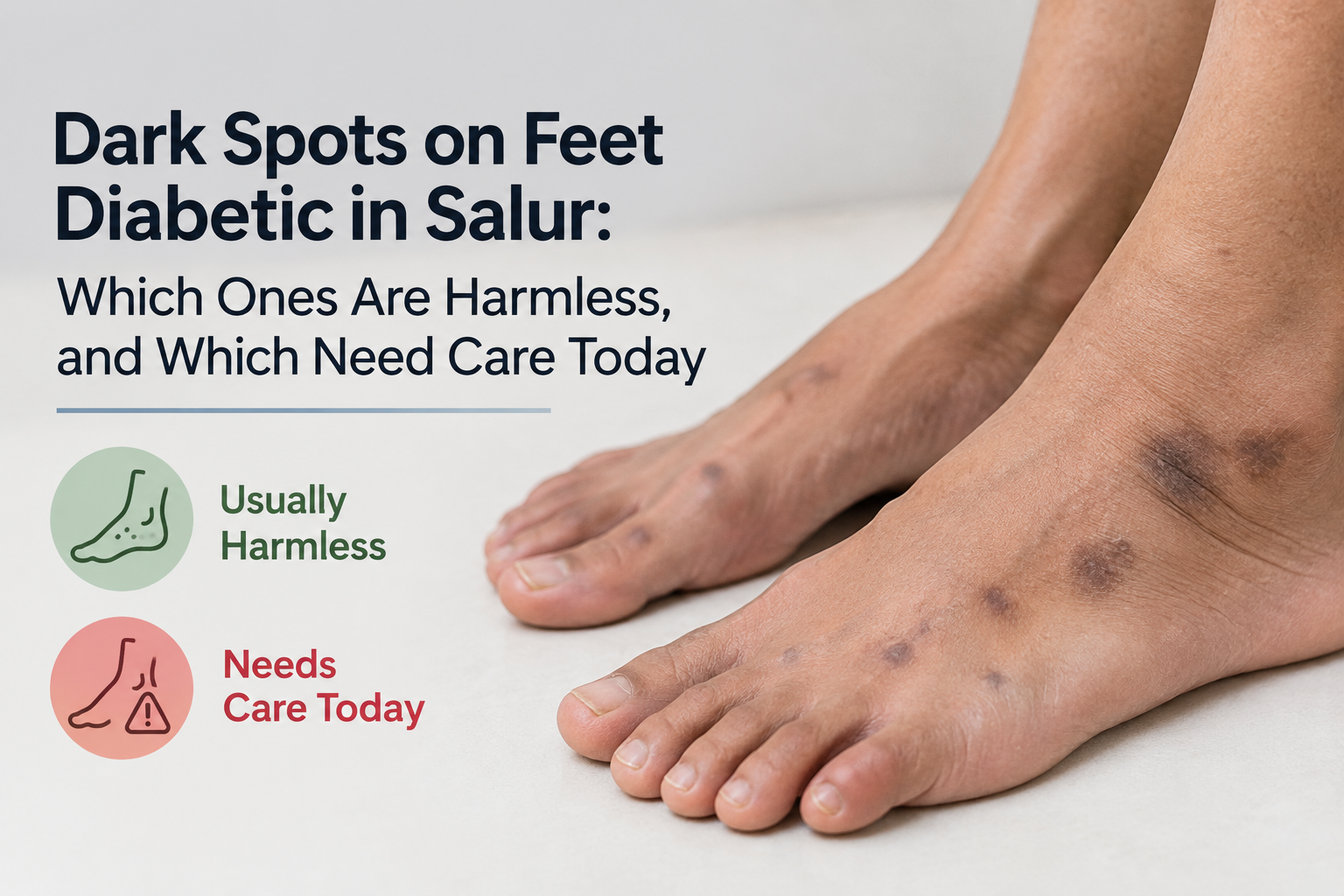
Dark spots on feet diabetic in Salur range from completely harmless pigmentation to dying tissue that needs same-day care. What matters is not the colour alone but where the spot is, how fast it appeared, and whether the skin, temperature or sensation around it has changed.
Because that range is so wide, this guide is arranged by urgency rather than by cause. Check the red list first. If nothing there applies, work down through amber and green, and read the detailed explanations afterwards.
Red: which dark spots need care today?
Seek care the same day if a dark spot appeared suddenly, is spreading, sits on a cold or painful foot, or comes with fever, swelling, discharge or foul smell. These suggest tissue death or serious infection, where hours matter.
- A toe or part of the foot turning black, brown or deep purple, especially if the area is cold or numb.
- A dark area that is spreading visibly over hours or a day.
- Any dark spot with fever, chills or feeling generally unwell.
- Dark discolouration with swelling, spreading redness, pus or foul smell.
- A sudden blue or purple toe on an otherwise warm foot, which can mean a small clot has blocked a vessel.
- A dark blister filled with blood-stained fluid.
- Severe pain out of proportion to what you can see, or new pain in a foot that is normally numb.
These are the presentations of gangrene and severe deep infection. Both are covered in more detail in our posts on diabetic gangrene treatment and necrotizing fasciitis of the foot. Do not send a photo and wait for a reply in this situation; go to a hospital.
Amber: which need review within days?
Arrange an assessment within a few days if there is a dark spot inside a callus, a dark mark that will not fade, a new or changing pigmented patch, or a dark streak under a toenail. None of these is an emergency, but none should be watched for months either.
- A dark or reddish spot inside a callus on the sole, ball of the foot or heel.
- A bruise-like mark with no remembered injury.
- A dark patch that is growing, changing shape or changing colour.
- A brown or black streak running lengthwise under a toenail, particularly if it is new, widening, or the skin at the nail base is also pigmented.
- A dark spot on a heel in someone who is bed-bound or in a cast.
- Dark discolouration with cold feet, weak pulses or calf pain on walking.
Green: which are usually harmless?
Long-standing, stable, painless pigmentation is usually harmless. Small brown patches on the shins, old scar marks, and general darkening around the ankles in someone with varicose veins rarely need treatment, though they are worth mentioning at your next check.
- Small round brown patches on the shins that have been there for years and do not hurt.
- Darkening where a previous wound or blister healed.
- Brownish staining around the ankles with swollen legs and varicose veins.
- Freckles or moles unchanged for years, matching others on your body.
| Urgency | Typical picture | What to do |
|---|---|---|
| Red | Sudden, spreading, cold or painful foot, fever, discharge, black toe | Hospital or clinic the same day |
| Amber | Dark spot in a callus, unexplained bruise, changing patch, nail streak | Assessment within a few days |
| Green | Old, stable, painless pigmentation with normal skin | Mention at your next routine foot check |
What actually causes dark spots on a diabetic foot?
Several different processes produce dark marks, and they are not variations of one problem. The main groups are harmless pigmentation, bleeding under the skin, poor circulation and tissue death, venous staining, infection, and, uncommonly, skin cancer.
Diabetic dermopathy: the common harmless one
These are small, round or oval, light brown, slightly depressed patches, usually on the shins and often on both legs. They are painless, develop slowly and are strongly associated with long-standing diabetes.
They need no treatment and do not turn into ulcers. Their value is as a signal: they are associated with longer diabetes duration and other complications, so their appearance is a reasonable prompt for a full foot and circulation review rather than a reason for worry about the spots themselves.
Bleeding under a callus: the one that matters most
A dark red, purple or brown spot inside a thickened callus is not a simple bruise. It is bleeding within the skin caused by repeated pressure, and it usually means tissue underneath is already breaking down. An ulcer is forming beneath an intact surface.
This is the single most useful thing to recognise on a diabetic foot. When callus is trimmed professionally at this stage, an open wound is frequently found immediately underneath. Treated now it is a small problem; left another month it becomes a deep ulcer with a risk of infection reaching bone.
What to do: do not cut or dig at it yourself, keep weight off that area as far as possible, and arrange assessment within days. Blisters behave similarly and are covered in our post on blisters on the foot with diabetes.
Poor circulation and dying tissue
When blood supply to part of the foot fails, the tissue darkens through dusky red to purple, then brown or black. The area is often cold, and in a numb foot it may be painless, which delays people from seeking help.
Clues that circulation is the problem include cold feet, weak or absent pulses, shiny hairless skin, slow-growing nails, night pain relieved by hanging the leg down, and calf pain on walking, described in our post on calf pain when walking with diabetes. Circulation is assessed through our vascular services, and established tissue death is gangrene.
A suddenly blue or black toe with a warm foot
If one or more toes turn blue or dark suddenly while the foot stays warm and pulses are still present, a small clot or piece of plaque may have travelled from a larger artery and blocked a small vessel in the toe.
This matters because it suggests a source further up the leg that may send more. It is treated as urgent, not as a bruise, even though the foot looks well perfused.
Venous staining around the ankles
Brown or rust-coloured discolouration around the inner ankle, with swollen legs, varicose veins and sometimes itchy dry skin, is caused by iron from red blood cells leaking into the skin over years of raised vein pressure.
It is not dangerous in itself, but it marks skin that breaks down easily and heals slowly. It is also the setting in which venous leg ulcers form, so it deserves proper assessment rather than cosmetic treatment.
Pressure damage on the heel
A purple, maroon or black patch on the heel of someone who is bed-bound, in a cast or recently immobile is pressure damage. The skin may still be intact while the tissue beneath has already died.
This is deep tissue injury, and it is more serious than it looks. Prevention and management are covered in our post on pressure ulcers of the foot. One important caution: a dry, stable black heel scab with no swelling or discharge should not be picked off, especially where circulation is poor.
Infection
Dark discolouration with swelling, spreading redness, warmth, pus or foul smell means infection, and in a diabetic foot infection can move fast. Dark blisters containing blood-stained fluid are a particular warning sign.
Skin cancer: uncommon, but do not ignore it
A pigmented patch on the sole, or a dark lengthwise streak under a toenail, can occasionally be a melanoma. This type occurs on palms, soles and under nails, and it is not related to sun exposure, so it appears in places people never think to check.
Features that warrant prompt review are a new pigmented area in an adult, a patch that is growing or changing colour, irregular borders or several shades within one lesion, a nail streak that is widening, and pigment spreading onto the skin at the base of the nail. These are uncommon findings, and most dark marks are not cancer, but this is the reason a persistent unexplained pigmented spot on the foot should be looked at rather than watched for a year.
How can you check your own feet properly?
Check both feet daily in good light, including the soles, between the toes and the heels. Use a mirror or ask someone to look if you cannot see the underside comfortably. What you are looking for is change, not perfection.
- Compare left with right. Something present on one foot only deserves more attention.
- Press gently on a red or dark area. If it does not go pale, that is significant.
- Feel the temperature of both feet with the back of your hand.
- Look inside any callus for a dark or reddish centre.
- Check the nails, including for lengthwise dark streaks.
- Photograph anything new, with a coin or scale beside it, so change is measurable.
- Check inside your shoes for stones, seams or worn areas that could be causing pressure.
What will happen at an assessment?
Assessment covers the spot itself, the circulation, the sensation and the mechanical cause. The aim is to place the mark into one of the groups above and treat accordingly, which sometimes means simply reassuring you.
- Examination of both feet, including the soles and between the toes.
- Circulation testing: pulses, Doppler, ankle brachial index or toe pressures.
- Sensation testing for neuropathy.
- Careful debridement of callus to see what lies beneath a dark spot.
- Photography and measurement so change can be tracked objectively.
- Referral or biopsy where a pigmented lesion needs a definite answer.
- A plan covering offloading, footwear and follow-up, under preventive foot care.
What should you never do to a dark spot on your foot?
Do not treat a dark spot as a cosmetic problem. Cutting, scrubbing, bleaching or applying home remedies to it risks turning an intact warning sign into an open wound on a foot that heals badly.
- Do not cut or dig at a callus to see what is underneath.
- Do not use skin-lightening creams, scrubs or acids on it.
- Do not apply hot compresses or heat to a dark or cold area.
- Do not massage a dark patch, which damages injured tissue further.
- Do not have it treated at a roadside or salon.
- Do not wait months to see whether it fades on its own.
Wound care, if a wound is found, is managed under non-surgical wound management, with surgical options under diabetic foot surgery. The broader range of problems is listed under foot conditions we treat.
Diabetic foot assessment for Salur
Elegance Diabetic Foot & Ulcer Clinic (EDFC), led by Dr. Ashutosh Shah, provides foot assessment, circulation testing, ulcer treatment, reconstruction and limb salvage from its centre in Surat, with diabetic foot care expanding across northern Andhra Pradesh, including Salur. If you have noticed dark spots on feet diabetic in Salur, the useful step is placing the mark on the red, amber or green list above and acting accordingly.
For amber and green findings, you can send a clear, well-lit photo of the area to our team on WhatsApp for initial guidance and book a foot assessment. For anything on the red list, go to a hospital the same day rather than waiting for a reply. Follow EDFC on Facebook, Instagram and YouTube for foot care guidance and real limb salvage stories.
Colour is a message, not a blemish
Most dark spots on a diabetic foot are harmless, and a few are the earliest visible sign of something serious. The difference is usually in the detail: how quickly it appeared, whether it sits inside a callus, whether the foot is cold, and whether it is changing.
Next step: book a foot and circulation assessment with Dr. Ashutosh Shah at Elegance Diabetic Foot & Ulcer Clinic, or send a clear photo on WhatsApp today for initial guidance on which list your spot belongs to.
Medical disclaimer: This article is for educational purposes only and is not a substitute for professional medical diagnosis or treatment. A dark spot on the foot cannot be diagnosed from a description or a photograph alone. Sudden, spreading or painful discolouration, or discolouration with fever, swelling or discharge, needs immediate in-person assessment. Please consult Dr. Ashutosh Shah or a qualified specialist about your condition. For further guidance, see the NHS guide to gangrene and the IWGDF diabetic foot guidelines.
quiz Frequently Asked Questions
This article is general education, not a diagnosis. If you have a diabetic foot wound, please have it assessed in person. Send a photo on WhatsApp or book a consultation.
About the Author

Dr. Ashutosh Shah, Plastic, Reconstructive & Diabetic Foot Surgeon, Elegance Diabetic Foot & Ulcer Clinic, Surat
Dr. Ashutosh Shah is a board certified plastic and reconstructive surgeon with over 22 years of experience and more than 10,000 limbs and feet saved. He founded Elegance Diabetic Foot & Ulcer Clinic, India's first chain of clinics dedicated to foot care, with centres in Surat and OPD partners across South Gujarat. He is known for a limb first approach, safe wound care and ethical, natural results.