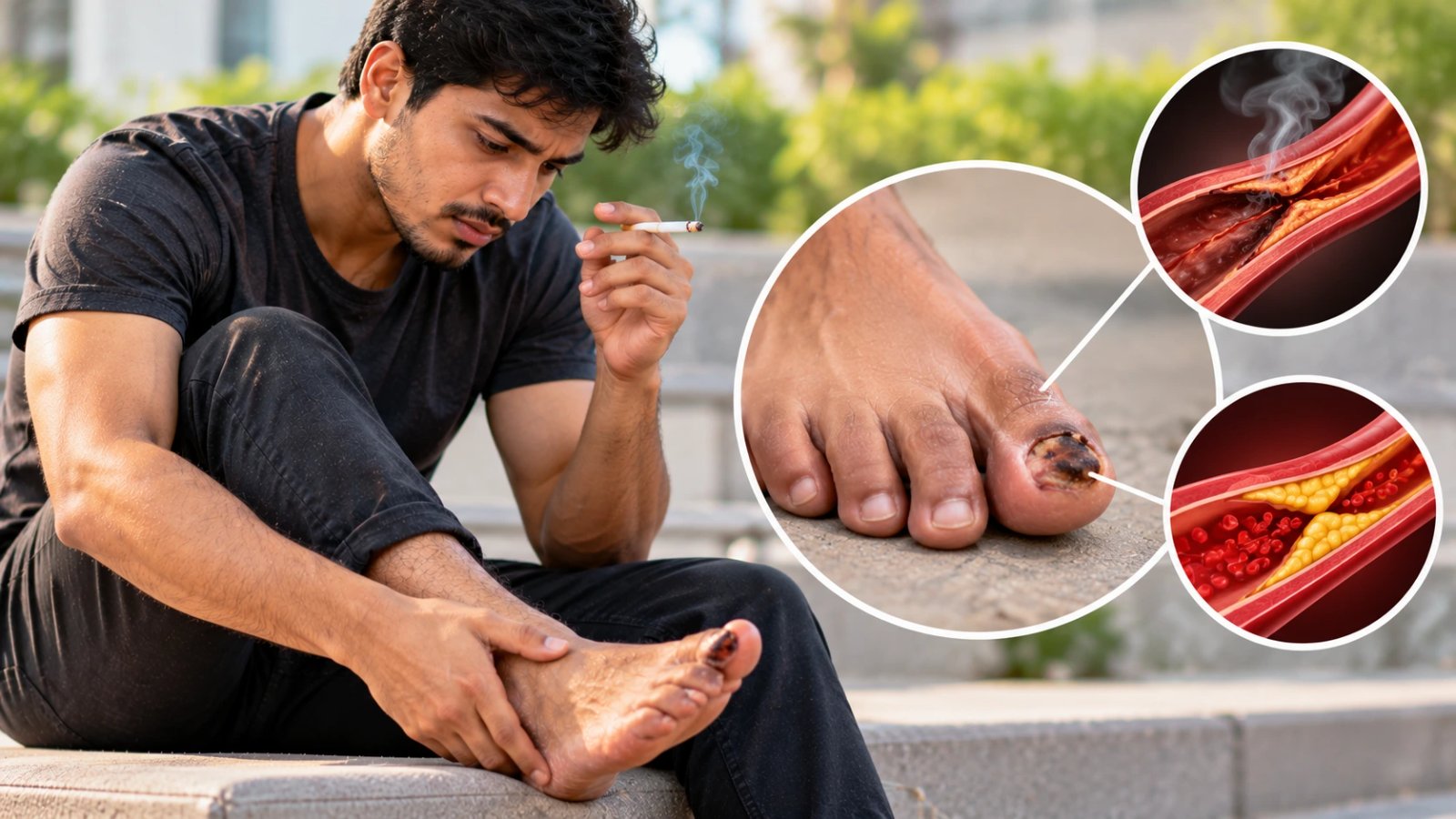
Buerger's disease (thromboangiitis obliterans) blocks small and medium arteries of the legs and hands in young tobacco users, usually men under 45, and causes painful toe ulcers even without diabetes. Unlike diabetic foot, stopping all tobacco, including bidis and smokeless forms, is the single treatment that decides whether the limb is saved.
A painful toe ulcer in a young smoker should never automatically be diagnosed as a diabetic foot ulcer. Although both conditions can reduce blood supply and damage tissue, their underlying causes and treatment priorities differ.
Understanding buerger's disease vs diabetic foot helps patients recognise warning signs and seek appropriate vascular assessment before irreversible tissue damage develops.
Key Takeaways
-
Buerger's disease is an inflammatory, non-atherosclerotic condition affecting small and medium-sized blood vessels.
-
It is strongly associated with tobacco exposure and often develops in younger adults.
-
Painful toe ulcers can occur even when the patient does not have diabetes.
-
Buerger's disease may also affect the fingers and hands.
-
Diabetic foot ulcers commonly involve neuropathy, pressure and sometimes peripheral arterial disease.
-
Complete tobacco cessation is the most important treatment for preventing progression of Buerger's disease.
-
Arterial Doppler, vascular imaging and blood tests help distinguish different causes of toe ulcers.
-
Persistent rest pain, blackening toes or rapidly worsening wounds require urgent vascular assessment.
What Is Buerger's Disease and Who Gets It?
Buerger's disease, medically known as thromboangiitis obliterans, is a rare inflammatory disease that affects blood vessels, particularly the small and medium-sized arteries of the arms and legs.
The condition can cause inflammation and clot formation within affected vessels.
As blood flow decreases, tissues may receive insufficient oxygen and nutrients.
This can lead to pain, skin changes, ulcers and, in advanced cases, gangrene.
Who Is Most Likely to Develop Buerger's Disease?
Buerger's disease has traditionally been associated with:
-
Adults younger than 45–50 years
-
Current or previous tobacco users
-
People who smoke cigarettes or bidis
-
People who use other tobacco products
-
Patients with unexplained distal limb ischaemia
-
Individuals with finger or toe ulcers despite normal blood glucose
The disease was historically reported more often in men, although women can also develop it.
Not every young tobacco user with a toe ulcer has Buerger's disease. Other vascular, inflammatory and traumatic causes must be excluded.
What Are the Early Symptoms?
Symptoms may include:
-
Pain in the feet while walking
-
Pain in the toes at rest
-
Cold fingers or toes
-
Colour changes in the skin
-
Tingling or burning sensations
-
Small painful ulcers
-
Recurrent superficial vein inflammation
-
Pain or ulcers affecting the hands
Rest pain is particularly concerning because it can indicate significantly reduced tissue perfusion.
Why Does Buerger's Disease Affect the Toes?
The disease commonly involves distal arteries that supply the hands and feet.
When these vessels become blocked, blood flow to the toes decreases.
Minor injuries may then fail to heal.
A small ulcer can become progressively painful because the surrounding tissue does not receive sufficient oxygen.
Patients can read more about Buerger's disease ulcers.
How Is Buerger's Disease Different From a Diabetic Foot Ulcer?
The main difference is the underlying disease process.
Buerger's disease is a tobacco-associated inflammatory vascular condition.
Diabetic foot ulcers commonly result from neuropathy, repeated pressure, peripheral arterial disease or a combination of these factors.
Buerger's Disease vs Diabetic Foot: Comparison Table
| Feature | Buerger's Disease | Diabetic Foot |
|---|---|---|
| Typical age | Often younger adults, traditionally under 45–50 | More common after years of diabetes |
| Tobacco exposure | Strongly associated and central to disease progression | Not required, but increases vascular risk |
| Diabetes | Not required; blood glucose may be normal | Diabetes is present |
| Hand involvement | Fingers and hands may be affected | Less typical |
| Neuropathy | Not the defining feature | Common contributor to ulcer formation |
| Arterial disease | Usually distal small and medium vessels | May affect multiple arterial levels |
| Ulcer location | Frequently toes, fingers and distal extremities | Often pressure-bearing areas of the foot |
| Ulcer pain | Frequently severe due to ischaemia | May be painless with neuropathy or painful with ischaemia |
| Blood sugar tests | May be normal | Diabetes is confirmed by appropriate testing |
| Treatment priority | Complete tobacco cessation and vascular assessment | Offloading, diabetes control, infection care and circulation assessment |
Why Can Diabetic Foot Ulcers Be Painless?
Diabetes can damage peripheral nerves.
This reduces the ability to feel pain, heat and pressure.
As a result, patients may continue walking on an injured area without recognising the problem.
Repeated pressure can deepen the wound.
However, diabetic ulcers associated with poor arterial circulation may also be painful.
Why Are Buerger's Ulcers Often Painful?
Buerger's disease reduces blood flow to the distal extremities.
When tissue perfusion becomes severely compromised, patients may experience persistent pain even while resting.
Pain may worsen at night or when the affected limb is elevated.
A patient with severe rest pain should receive prompt vascular evaluation.
Can Both Conditions Look Similar?
Yes.
Both conditions may cause:
-
Non-healing toe wounds
-
Tissue discolouration
-
Reduced blood supply
-
Infection
-
Gangrene
-
Risk of amputation
This is why visual examination alone is insufficient for diagnosis.
Which Tests Help Diagnose Buerger's Disease?
There is no single blood test or imaging finding that independently confirms Buerger's disease.
Diagnosis depends on characteristic clinical findings and exclusion of other causes of distal arterial obstruction.
A specialist may use the Shionoya criteria and other recognised diagnostic frameworks.
1. Medical and Tobacco History
The doctor asks about:
-
Age when symptoms began
-
Cigarette or bidi smoking
-
Chewing tobacco
-
Duration of tobacco exposure
-
Rest pain
-
Previous ulcers
-
Finger involvement
-
Episodes of superficial thrombophlebitis
-
Diabetes and other cardiovascular risk factors
Accurate tobacco history is particularly important.
2. Blood Glucose and HbA1c
Blood glucose and HbA1c testing help determine whether the patient has diabetes.
Normal results do not establish Buerger's disease, but they help distinguish it from diabetes-related complications.
3. Arterial Doppler Ultrasound
Arterial Doppler assesses blood flow through the arteries.
It can help identify reduced flow or arterial obstruction.
However, Doppler findings must be interpreted alongside symptoms, examination and other investigations.
4. CT Angiography or Catheter Angiography
Vascular imaging can show the location and pattern of arterial blockages.
Buerger's disease often produces distal, segmental arterial occlusions.
Angiography may demonstrate collateral vessels with a characteristic corkscrew appearance.
However, these findings are not exclusive to Buerger's disease.
5. Tests to Exclude Other Conditions
The specialist may investigate:
-
Diabetes
-
Atherosclerotic peripheral artery disease
-
Autoimmune vasculitis
-
Hypercoagulable conditions
-
Embolic disease
-
Other causes of distal ischaemia
The choice of tests depends on the patient's clinical presentation.
What Are the Shionoya Diagnostic Criteria?
The traditional Shionoya criteria include:
-
A history of smoking.
-
Disease onset before age 50.
-
Infrapopliteal arterial occlusions.
-
Upper-limb involvement or migratory superficial thrombophlebitis.
-
Absence of atherosclerotic risk factors other than smoking.
These criteria support clinical assessment but should not be treated as an inflexible substitute for specialist judgment.
For broader information about arterial circulation problems, see peripheral artery disease.
Why Is Complete Tobacco Cessation Essential?
Complete tobacco cessation is the most important intervention for patients with Buerger's disease.
Continued tobacco exposure is strongly associated with ongoing disease activity and progression.
Reducing the number of cigarettes is not the same as stopping tobacco completely.
Does Smoking Only One Cigarette Matter?
Even small amounts of continued tobacco exposure may be associated with ongoing disease activity.
Patients should aim for complete abstinence rather than simply reducing consumption.
This includes avoiding cigarettes, bidis and other tobacco products.
Is Chewing Tobacco Also Harmful?
Yes.
Smokeless tobacco products can expose users to nicotine and other harmful substances.
Patients with Buerger's disease should not assume that chewing tobacco is a safe replacement for smoking.
Complete tobacco cessation remains the goal.
What About Vaping and Nicotine Replacement?
Nicotine-containing vaping products are not a proven safe alternative for people with Buerger's disease.
The use of nicotine replacement therapy requires individual specialist advice because nicotine exposure may be a concern in this condition.
Smoking cessation support should be coordinated with the treating clinician.
Non-nicotine medications and behavioural support may be considered when appropriate.
How Can Patients Stop Tobacco Successfully?
A structured cessation plan may include:
-
Setting a quit date
-
Identifying tobacco triggers
-
Behavioural counselling
-
Family support
-
Avoiding environments associated with tobacco use
-
Follow-up appointments
-
Appropriate prescription cessation treatment
Patients should discuss withdrawal symptoms and cessation options with their healthcare professional.
Complete tobacco abstinence offers the best opportunity to prevent further progression of Buerger's disease.
However, existing tissue damage may not fully reverse after quitting.
What Treatment Options Exist When Pain and Ulcers Persist?
Treatment aims to reduce pain, protect tissue, improve circulation where possible and prevent further damage.
Complete tobacco cessation remains essential throughout treatment.
1. Wound Care
Toe ulcers require careful assessment.
Treatment may include:
-
Gentle wound cleaning
-
Appropriate dressings
-
Protection from pressure
-
Infection assessment
-
Monitoring of tissue viability
-
Avoidance of unnecessary trauma
Patients should not attempt to cut away dead tissue or perform home debridement.
2. Pain Management
Rest pain can be severe.
Treatment may involve appropriate analgesics, specialist pain management and selected vascular therapies.
Pain treatment should be individualised, especially when kidney disease or other medical conditions are present.
3. Medicines to Improve Symptoms
Selected patients may receive vasodilator treatment or other medications under specialist supervision.
Intravenous prostanoid therapy, such as iloprost where available, has been studied for severe ischaemic symptoms and ulcer healing.
However, medicines do not replace tobacco cessation, and evidence for many drug treatments remains limited.
4. Endovascular or Surgical Revascularisation
Some patients may benefit from procedures intended to improve blood flow.
However, Buerger's disease frequently affects small distal arteries, making conventional bypass or endovascular treatment difficult.
The specialist must assess whether a suitable target vessel exists.
Patients can explore the clinic's vascular services for information about vascular evaluation and treatment.
5. Treatment of Ischaemic Ulcers
Ulcers caused by inadequate blood supply require careful evaluation.
Management may involve:
-
Protecting the affected tissue
-
Managing infection
-
Assessing arterial circulation
-
Addressing pain
-
Considering revascularisation when feasible
-
Monitoring for gangrene
Additional information is available about ischaemic ulcers.
6. When Is Amputation Necessary?
Amputation may be considered when tissue becomes irreversibly damaged, infection cannot be controlled or severe pain persists despite appropriate treatment.
The level and timing depend on circulation, tissue viability and the patient's overall condition.
Not every patient with Buerger's disease requires amputation.
Early diagnosis and complete tobacco cessation can substantially improve the outlook.
Buerger's Disease Doctor in Surat: When to Seek Specialist Assessment
A young adult with a painful toe ulcer, cold toes or persistent rest pain should undergo prompt vascular assessment, especially when there is a history of tobacco use.
Patients searching for a buerger's disease doctor in surat should prioritise a clinician or vascular team able to evaluate distal arterial circulation and distinguish Buerger's disease from diabetes-related ulcers and other vascular disorders.
At Elegance Diabetic Foot & Ulcer Clinic (EDFC), Dr. Ashutosh Shah, a Plastic and Reconstructive Surgeon, is associated with assessment and management of complex lower-limb wounds.
Evaluation of suspected Buerger's disease may require collaboration with vascular specialists and appropriate arterial imaging. The exact diagnostic tests and treatment options should be confirmed during consultation.
When Is Emergency Care Necessary?
Seek emergency medical attention if you develop:
-
Sudden severe foot pain
-
A rapidly cold or pale foot
-
Blue or black toes
-
Rapidly spreading infection
-
Severe swelling with tissue discolouration
-
New numbness or weakness
-
Fever with a worsening foot wound
These symptoms may indicate acute or severe limb-threatening disease.
Do not wait for a routine appointment.
Why Are Follow-Up Visits Important?
Follow-up helps assess whether symptoms and tissue perfusion are improving.
A clinician may monitor:
-
Tobacco abstinence
-
Rest pain
-
Ulcer size
-
Tissue colour
-
Signs of infection
-
Vascular findings
-
Need for additional treatment
Reviews at approximately two, six and twelve weeks may be used as an example of a structured follow-up plan, but actual appointments depend on clinical urgency and individual needs.
Conclusion
Understanding buerger's disease vs diabetic foot is important when a younger tobacco user develops a painful toe ulcer.
Buerger's disease is a tobacco-associated inflammatory vascular condition that can cause severe distal ischaemia even when blood glucose is normal.
Diabetic foot ulcers, by contrast, commonly involve neuropathy, pressure and diabetes-related vascular complications.
Although both conditions can threaten the limb, they require different diagnostic and treatment priorities.
Complete tobacco cessation is the most important step in managing Buerger's disease.
Patients with persistent rest pain, non-healing toe ulcers or tissue discolouration should seek prompt vascular assessment.
At Elegance Diabetic Foot & Ulcer Clinic, Dr. Ashutosh Shah is associated with evaluation and management of complex lower-limb wounds, with vascular specialist involvement when indicated.
Early assessment, complete tobacco abstinence and appropriate treatment can help reduce the risk of serious complications.
quiz Frequently Asked Questions
This article is general education, not a diagnosis. If you have a diabetic foot wound, please have it assessed in person. Send a photo on WhatsApp or book a consultation.
About the Author

Dr. Ashutosh Shah, Plastic, Reconstructive & Diabetic Foot Surgeon, Elegance Diabetic Foot & Ulcer Clinic, Surat
Dr. Ashutosh Shah is a board certified plastic and reconstructive surgeon with over 22 years of experience and more than 10,000 limbs and feet saved. He founded Elegance Diabetic Foot & Ulcer Clinic, India's first chain of clinics dedicated to foot care, with centres in Surat and OPD partners across South Gujarat. He is known for a limb first approach, safe wound care and ethical, natural results.