Short blockages and some below-knee artery disease may be treated with angioplasty because it is minimally invasive and does not require open bypass surgery. Longer or complex blockages, failed angioplasty, and selected patients with a suitable vein may benefit from bypass. The choice between angioplasty vs bypass for a diabetic leg depends on the angiogram, wound severity, kidney function, overall health and whether a durable blood supply can be restored to the foot.
A diabetic foot ulcer may fail to heal even with regular dressings, antibiotics and wound care when the foot is not receiving enough blood. In these cases, restoring circulation called revascularisation may become an important part of limb-salvage treatment.
Two major options are angioplasty and surgical bypass. Neither is automatically better for every patient. The vascular team considers the location and length of the blockage, available arteries below the knee, wound severity, kidney function, surgical fitness and previous procedures before recommending treatment.
Why does a foot ulcer often need the arteries opened first?
A wound needs adequate blood flow to deliver oxygen, nutrients, immune cells and other components required for tissue repair.
Diabetes can damage arteries and accelerate peripheral artery disease. When blood supply to the foot becomes severely reduced, an ulcer may remain open despite appropriate dressings and pressure relief.
Poor circulation may contribute to:
- Slow or absent wound healing
- Increasing tissue loss
- Black or gangrenous areas
- Recurrent infection
- Rest pain in some patients
- Failure of surgical wounds to heal
This is why treating the visible ulcer alone may not be enough.
If significant ischaemia is present, the team may need to improve blood supply before or alongside debridement, reconstruction or other wound procedures.
Read more about Ischaemic ulcers.
What is revascularisation?
Revascularisation means restoring blood flow through narrowed or blocked arteries.
This can broadly be achieved through:
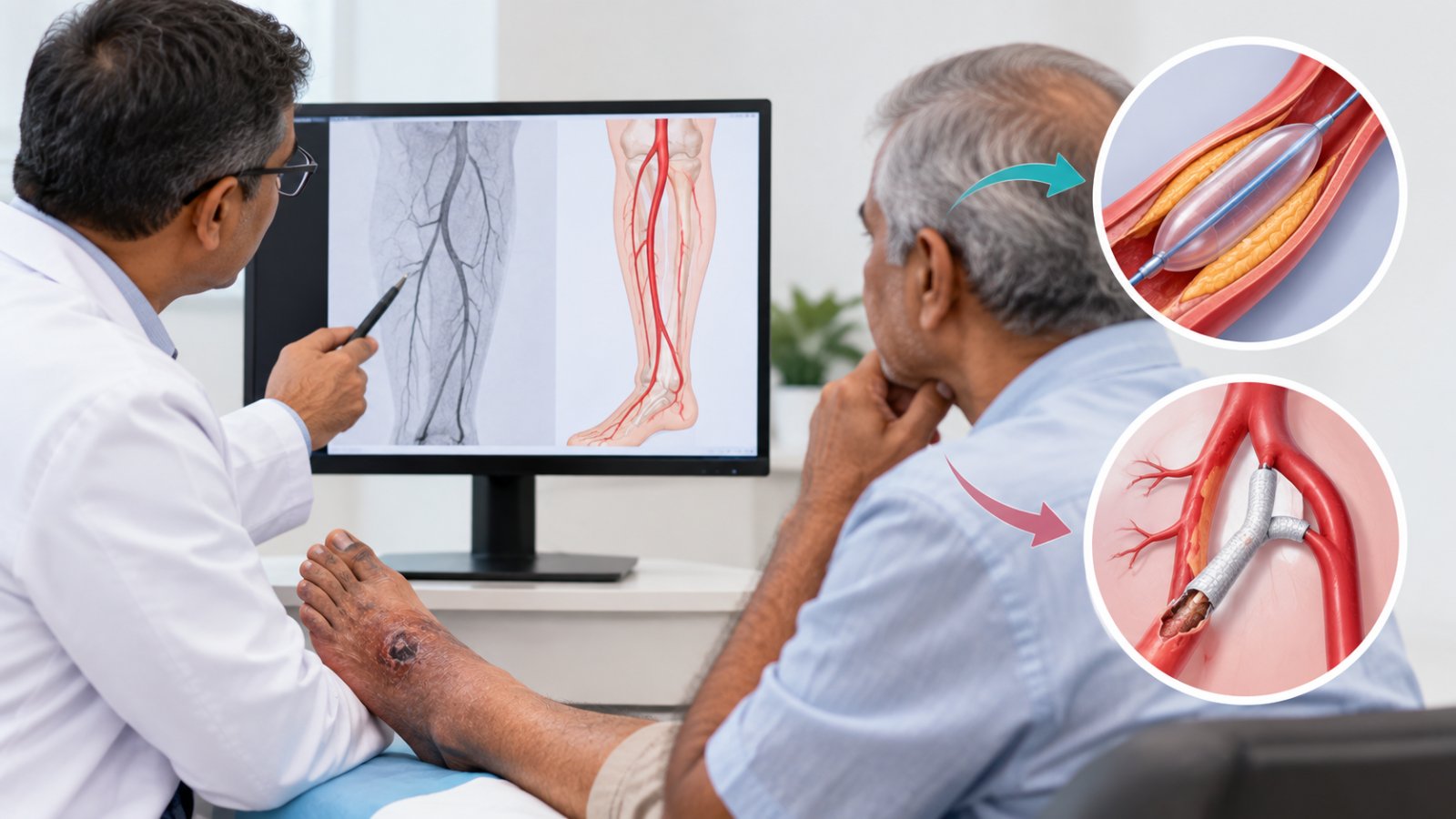
Angioplasty: A catheter-based procedure used to cross and open a narrowed or blocked artery. Depending on the lesion and clinical plan, additional endovascular techniques may be used.
Bypass surgery: An operation that creates a new route for blood to travel around a blocked arterial segment using a suitable conduit, often a vein when appropriate.
The aim is not simply to produce a better-looking angiogram. The clinical goal is to restore useful blood flow to tissue that needs to heal.
What decides between angioplasty and bypass?
The choice of angioplasty vs bypass for a diabetic leg requires more than asking which procedure is less invasive.
The vascular anatomy and the patient's overall condition both matter.
Length and complexity of the blockage
Shorter or technically accessible lesions may be suitable for an endovascular approach.
Long, complex or repeatedly treated blockages can sometimes make bypass a more appropriate option, particularly when there is a suitable target artery and conduit.
Location of the disease
People with diabetes frequently develop disease in arteries below the knee.
The team needs to determine whether enough blood flow can be restored toward the part of the foot where the ulcer or tissue loss is located.
Previous angioplasty
A previous endovascular procedure does not automatically prevent another one.
However, repeated failure or anatomy that is unlikely to respond adequately may make surgical bypass worth considering.
Fitness for surgery
Bypass is a larger operation than angioplasty.
Heart disease, lung disease, frailty and other medical conditions may affect whether a patient is suitable for open surgery.
Availability of a usable vein
When bypass is being considered, the surgical team may assess whether an appropriate vein is available for use as a conduit.
Kidney function
Kidney function matters because angiography and many endovascular procedures may involve contrast agents.
Poor kidney function does not automatically rule out revascularisation, but it can influence imaging strategy, contrast use and procedural planning.
Severity of tissue loss
A small ulcer and extensive gangrene do not represent the same clinical problem.
When substantial tissue is threatened, the urgency and durability of restoring blood flow become especially important.
Learn about Endovascular treatment and Open vascular surgery.
Angioplasty vs Bypass Decision Table
| Clinical Finding | What It Suggests | Angioplasty or Bypass? | Why |
| Short, accessible blockage | May be suitable for catheter-based treatment | Often angioplasty | Less invasive and may restore flow without open surgery |
| Long or complex blockage | Endovascular treatment may be more difficult or less durable in some anatomy | Bypass may be considered | Can provide an alternative route around extensive disease |
| Below-knee disease | Common in diabetes and requires detailed arterial mapping | Depends on anatomy | Treatment must restore useful flow toward the threatened foot |
| Poor kidney function | Contrast exposure requires additional planning | Individualised | Kidney function can affect imaging and endovascular strategy |
| Severe tissue loss | Blood supply may need urgent improvement for limb salvage | Whichever can provide appropriate effective flow | Wound healing depends on adequate perfusion |
| Unfit for major anaesthesia/surgery | Open surgery may carry greater risk | Angioplasty may be favoured when feasible | It is generally less invasive |
| No usable vein | May limit some bypass options | Angioplasty or alternative surgical strategy | Conduit availability affects bypass planning |
This table provides general guidance only. The final decision depends on the individual angiogram, clinical condition and multidisciplinary assessment.
What does the angiogram actually show?
An angiogram maps the arteries and helps the vascular team understand the pattern of disease.
It can show:
- Where an artery becomes narrow
- Where it is completely blocked
- How long the diseased segment is
- Whether several arterial levels are involved
- Which arteries remain open below the knee
- Where blood flow returns beyond a blockage
- Potential target vessels for treatment
The angiogram therefore helps answer a practical question:
Is there a route that can be opened from inside the artery, or would creating a bypass around the diseased segment provide a better option?
Why below-knee arteries matter in diabetic foot disease
Restoring circulation to the leg is not enough if useful blood flow still fails to reach the foot.
This is particularly relevant when planning revascularisation for a foot ulcer because the team wants to improve perfusion to the threatened tissue.
Angiography is interpreted together with the wound location, clinical examination and other vascular assessments rather than in isolation.
What are the recovery differences?
Recovery after angioplasty and bypass can be quite different.
After angioplasty
Because angioplasty is catheter-based, there is no long bypass incision.
Depending on the procedure and the patient's condition, recovery may therefore be shorter than after open surgery.
The medical team still needs to monitor:
- The access site
- Foot circulation
- Kidney function when relevant
- Wound condition
- Blood glucose
- Prescribed medicines
- Signs of recurrent or persistent ischaemia
A successful procedure does not mean the diabetic foot ulcer will disappear immediately. The wound still requires appropriate wound care and pressure management.
After bypass
Bypass involves open surgery and therefore generally requires more recovery than angioplasty.
The team monitors the surgical wounds as well as circulation through the bypass.
Patients may require ongoing assessment of:
- Incision healing
- Foot perfusion
- Graft function
- Swelling
- Infection
- Diabetes control
- The original foot ulcer
Recovery time varies considerably according to the operation and the patient's overall health.
What happens if circulation is not restored before wound surgery?
Removing unhealthy tissue may be necessary when a diabetic foot is infected or contains dead tissue. However, healing after wound surgery also depends on adequate blood supply.
If severe ischaemia remains untreated, the wound may struggle to heal after surgery.
Potential problems include:
- Persistent open wounds
- Wound-edge breakdown
- Recurrent tissue death
- Continuing infection
- Failure of reconstruction
- Progression of gangrene
- Greater risk of amputation
This does not mean revascularisation must always happen before every wound procedure.
A severe infection may require urgent drainage or debridement while vascular assessment and revascularisation are coordinated. The sequence depends on infection severity, tissue viability, circulation and the patient's overall condition.
At EDFC (Elegance Diabetic Foot & Ulcer Clinic), Dr. Ashutosh Shah evaluates the wound together with tissue viability, infection and circulation when planning diabetic foot limb-salvage care.
Read more about Limb salvage surgery.
Which warning signs after the procedure mean going in immediately?
After angioplasty or bypass, patients should follow the discharge instructions given by their vascular team.
Some changes require urgent medical attention rather than waiting for a routine follow-up.
Seek urgent assessment for symptoms such as:
- Sudden severe or worsening leg or foot pain
- A foot that suddenly becomes cold
- New marked paleness, blue colour or darkening
- Sudden numbness or weakness
- Significant bleeding from the access or surgical site
- Rapidly increasing swelling
- Fever with worsening wound symptoms
- New foul-smelling or increasing wound discharge
- Rapid deterioration of the diabetic foot
Symptoms can differ depending on the procedure. Follow the specific emergency instructions provided at discharge.
Conclusion
The decision between angioplasty vs bypass for a diabetic leg is based on much more than choosing the smaller procedure.
The angiogram shows the location, length and complexity of arterial disease, while kidney function, surgical fitness, wound severity, previous treatment and availability of a suitable vein help determine which approach may be appropriate.
For a diabetic foot ulcer with poor circulation, restoring blood flow can be an important part of wound healing and limb salvage. The vascular procedure must still be combined with appropriate infection control, wound care, pressure management and diabetes treatment.
quiz Frequently Asked Questions
This article is general education, not a diagnosis. If you have a diabetic foot wound, please have it assessed in person. Send a photo on WhatsApp or book a consultation.
About the Author

Dr. Ashutosh Shah, Plastic, Reconstructive & Diabetic Foot Surgeon, Elegance Diabetic Foot & Ulcer Clinic, Surat
Dr. Ashutosh Shah is a board certified plastic and reconstructive surgeon with over 22 years of experience and more than 10,000 limbs and feet saved. He founded Elegance Diabetic Foot & Ulcer Clinic, India's first chain of clinics dedicated to foot care, with centres in Surat and OPD partners across South Gujarat. He is known for a limb first approach, safe wound care and ethical, natural results.