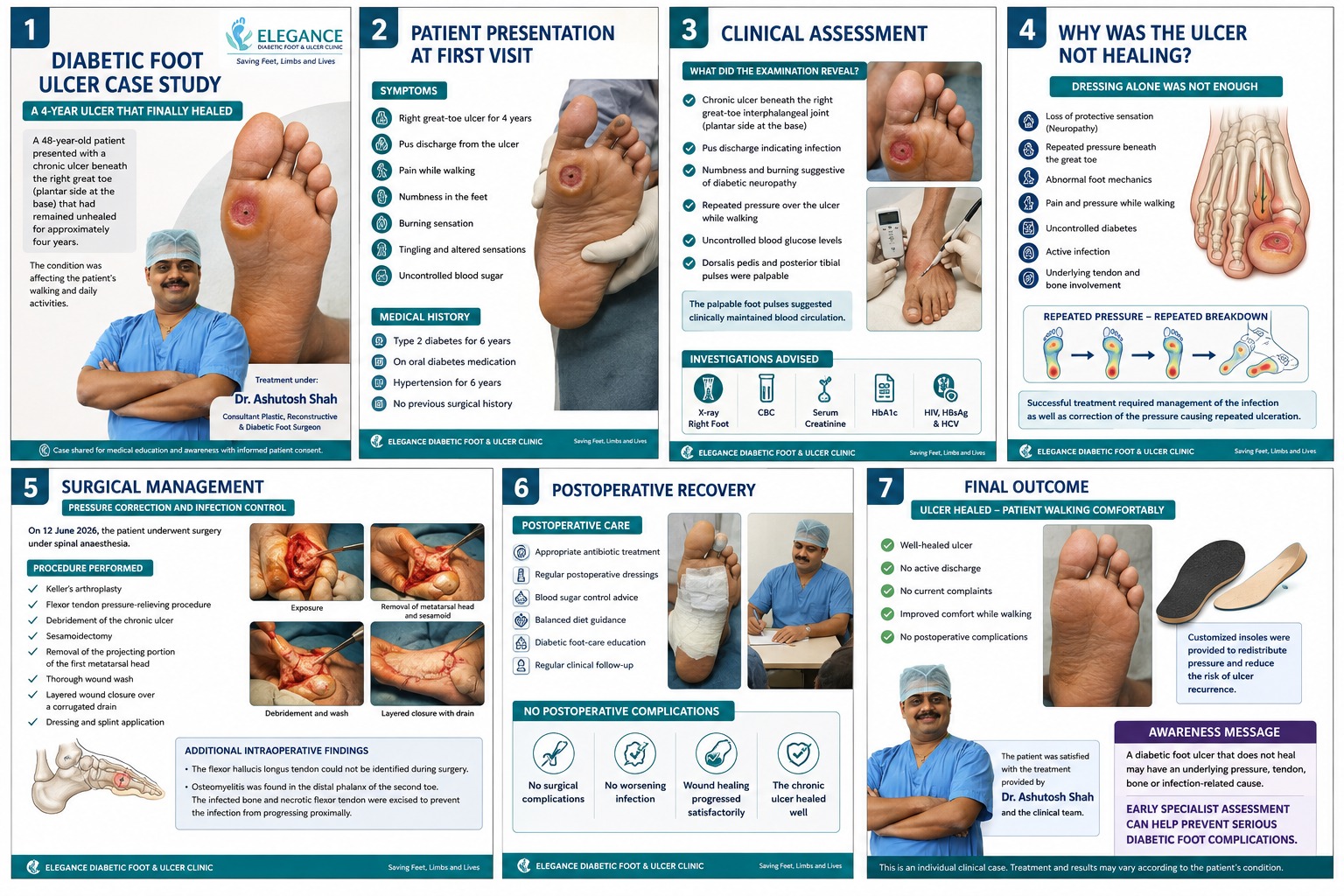
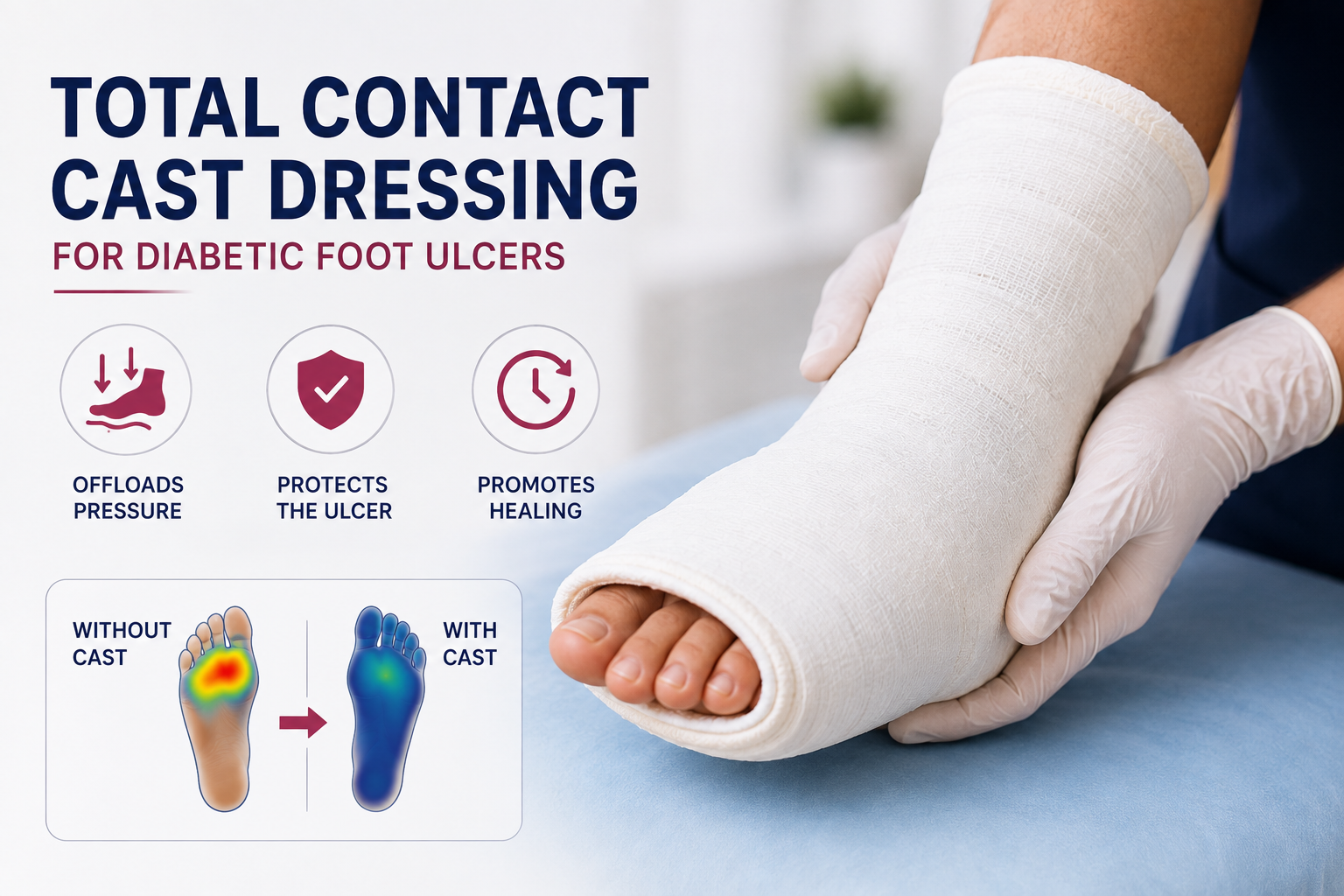
A total contact cast diabetic foot ulcer treatment works by moulding the cast to the whole sole so pressure is spread rather than concentrated over the wound. Because the cast cannot routinely be removed, it provides offloading during every step. Casts are changed weekly at first, and most plantar ulcers close in approximately six to eight weeks.
At Elegance Diabetic Foot & Ulcer Clinic, Dr. Ashutosh A Shah assesses the wound, circulation, infection risk and ability to attend regular reviews before deciding whether total contact casting is a suitable offloading method.
What Does a Total Contact Cast Actually Do?
A diabetic foot ulcer on the sole often remains open because pressure continues to act on the same area whenever the patient stands or walks.
This is especially important when neuropathy has reduced sensation. A person may continue walking on an injured area because the normal warning signal of pain is weak or absent.
A total contact cast, commonly called a TCC, moulds closely around the foot and lower leg. Instead of allowing body weight to remain concentrated over the ulcer, it distributes load across a larger area.
This pressure redistribution is known as offloading.
Another important advantage is that the cast cannot routinely be removed by the patient. This means the offloading treatment remains in place for every step rather than depending on the patient remembering to put a removable device back on.
Read more about Offloading and preventive surgery.
Patients can also learn more about the type of pressure-related wound commonly associated with reduced sensation on the Neuropathic ulcer page.
Why Does a Total Contact Cast Diabetic Foot Ulcer Treatment Help Healing?
A dressing can protect a wound, but it does not automatically remove the pressure responsible for repeatedly damaging the tissue.
For a plantar ulcer, wound care and pressure management therefore need to work together.
The purpose of total contact cast diabetic foot ulcer treatment is to reduce concentrated pressure at the ulcer site while still providing structured support around the foot.
Because the device stays in place, it also reduces the problem of inconsistent use that can occur with removable offloading devices.
The supplied treatment plan states that most plantar ulcers close in approximately six to eight weeks. This is a general treatment timeline rather than a guarantee that every ulcer will heal within the same period.
Healing can still vary from patient to patient, which is why regular clinical review remains necessary.
How Is a Total Contact Cast Applied and How Often Is It Changed?
A total contact cast dressing is carefully moulded around the contours of the foot and lower leg.
Its purpose is not simply to cover the ulcer. The cast needs to redistribute pressure so that the wound is not repeatedly overloaded during standing and walking.
The wound itself also continues to require assessment and appropriate dressing care.
According to the 30 September treatment plan, the cast is changed weekly at first.
At each review, the clinical team can reassess the wound and determine whether continued casting remains appropriate.
Regular changes are particularly important because the ulcer cannot be directly inspected by the patient while it remains enclosed inside the cast.
More information about wound management is available on the Diabetic foot wound care page.
Why Are Weekly Reviews Important?
A total contact cast is not a “put it on and forget it” treatment.
The wound needs continued monitoring.
Regular reviews allow the clinical team to assess how the ulcer is progressing and whether the cast continues to provide appropriate offloading.
They also provide an opportunity to identify complications that may otherwise remain hidden underneath the cast.
This is why a patient's ability to return for regular reviews is part of deciding whether TCC is appropriate.
Who Cannot Have a Total Contact Cast?
Not every diabetic foot ulcer is suitable for total contact casting.
The supplied rewrite brief identifies three important contraindications.
Active Infection
A total contact cast can be inappropriate when an active infection is present.
The infection needs to be recognised and managed rather than simply enclosing the wound inside a cast.
Severe Ischaemia
Severe ischaemia means the foot has seriously inadequate blood supply.
Because circulation is fundamental to wound healing, severe ischaemia needs assessment and makes total contact casting unsafe or inappropriate according to the supplied plan.
Inability to Attend Weekly Reviews
A patient who cannot return for weekly reviews may not be suitable for a total contact cast.
The wound is hidden beneath the cast, so regular clinical monitoring is an essential part of treatment.
These factors should be checked before beginning total contact cast diabetic foot ulcer treatment.
How Does a Total Contact Cast Compare With Removable Boots and Footwear?
Several methods can be used to reduce pressure on a diabetic foot ulcer.
The supplied plan requires comparison of:
-
total contact cast
-
non-removable walker
-
removable walker
-
half shoe
-
felted foam
The most appropriate option depends on the wound location, clinical findings, patient compliance and contraindications.
| Offloading Option | Healing | Compliance | Best-Suited Ulcer Site | Contraindications / Limitations |
|---|---|---|---|---|
| Total contact cast | Used to support plantar ulcer healing | High because it cannot routinely be removed | Plantar pressure-related ulcer | Active infection, severe ischaemia or inability to attend weekly reviews |
| Non-removable walker | Used for offloading selected ulcers | High because removal is restricted | Selected pressure-related ulcers | Requires individual suitability assessment |
| Removable walker | Provides offloading when worn correctly | Depends strongly on consistent use | Selected plantar ulcers | Benefit may decrease if frequently removed |
| Half shoe | Provides selected pressure redistribution | Depends on correct use | Selected pressure areas | Not suitable for every ulcer |
| Felted foam | Provides local pressure redistribution | Depends on application and use | Selected pressure points | Requires appropriate wound and pressure assessment |
The supplied plan does not provide exact comparative healing percentages for these options. Therefore, fixed percentages should not be added without another verified source.
Why Can a Non-Removable Cast Be Useful?
A removable device only provides offloading while the patient is actually wearing it.
If the device is removed and the patient walks without it, pressure returns to the ulcer.
A total contact cast is different because the patient cannot routinely remove it.
That means pressure relief remains in place for every step.
However, this advantage also creates an important responsibility: because the patient cannot simply remove the cast and inspect the wound, warning signs between visits must be taken seriously.
What Can You Do Day to Day While Wearing a Total Contact Cast?
Daily life with a TCC requires careful cast protection and attention to changes.
Attend Every Scheduled Review
Do not miss the planned cast changes.
Weekly reviews are particularly important during the initial treatment period.
Protect the Cast
Do not deliberately alter, cut or damage the cast.
If it cracks or becomes loose, it may no longer redistribute pressure correctly.
Watch for Indirect Warning Signs
You may not be able to see the ulcer, but changes such as smell, discharge staining, fever or new pain can indicate a problem that needs assessment.
Plan for Longer-Term Offloading
Healing the ulcer does not necessarily remove the pressure that originally caused it.
Once the wound has closed, longer-term pressure management may include appropriate footwear.
Read more about Therapeutic footwear.
Can I Bathe While Wearing a Total Contact Cast?
The supplied plan includes bathing as an FAQ but does not provide a specific waterproofing or bathing protocol.
Patients should therefore follow the cast-care instructions provided by their treating clinical team.
The cast should not be allowed to become wet or damaged in a way that compromises its structure or function.
What Must You Report Between Cast Changes Without Waiting?
This is one of the most important safety sections in total contact cast diabetic foot ulcer care.
Because the wound cannot be directly inspected at home, certain indirect signs require prompt attention.
Smell From the Cast
A new or unpleasant smell may indicate a problem beneath the cast.
Come in for assessment the same day.
Discharge Staining the Cast
New discharge or fluid appearing through the cast should not simply be observed until the next appointment.
It requires same-day review.
Fever
Fever while a diabetic foot wound is being treated can indicate a significant problem.
Do not wait for the scheduled cast change.
New Pain
New pain is another warning sign specifically identified in the treatment brief.
A foot that was previously comfortable or numb but develops new pain should be assessed.
Cracked Cast
A cracked cast may no longer provide the intended pressure distribution.
It should be reviewed rather than continuing to walk on it until the next routine appointment.
Loose Cast
If the cast becomes loose, its fit and offloading effect may change.
A loose cast can also allow unwanted movement or rubbing.
Smell, discharge staining, fever, new pain, cracking or loosening of the cast all require same-day assessment.
How Long Does a Total Contact Cast Diabetic Foot Ulcer Take to Heal?
The supplied plan states that most plantar ulcers close in approximately six to eight weeks.
This does not mean every diabetic foot ulcer will follow exactly the same timeline.
Regular cast changes allow the treating team to monitor wound progress and determine whether the same offloading strategy should continue.
The duration of casting should therefore follow the wound's progress rather than a fixed calendar date alone.
What Happens After the Ulcer Closes?
Wound closure is an important milestone, but preventing recurrence is also necessary.
If the pressure that contributed to the original plantar ulcer remains unchanged, the healed area may continue to be exposed to mechanical stress.
Long-term management may therefore include appropriate therapeutic footwear or another pressure-relief strategy.
The aim is not only to close the existing wound but also to reduce the pressure conditions that contributed to its development.
Total Contact Cast or Removable Walker: Which Should Be Used?
The decision depends on the individual wound and patient.
A total contact cast has the practical advantage of remaining in place, so the patient receives offloading during every step.
A removable walker provides offloading only when it is being worn correctly.
However, TCC is not appropriate simply because it is non-removable.
Active infection, severe ischaemia and inability to attend weekly reviews are important reasons why another approach may be necessary.
The choice should therefore be based on both the ulcer and the patient's overall treatment circumstances.
Why Does Circulation Matter Before Casting?
The 30 September rewrite brief specifically identifies severe ischaemia as a contraindication to total contact casting.
This means circulation needs consideration before selecting the offloading method.
Similarly, active infection needs to be recognised rather than hidden beneath a cast.
A total contact cast should therefore be considered one component of a broader diabetic foot treatment plan rather than a stand-alone dressing for every plantar ulcer.
Key Takeaways
-
A total contact cast diabetic foot ulcer treatment redistributes pressure away from a plantar wound.
-
The cast stays in place, providing offloading during every step.
-
Casts are changed weekly at first.
-
Most plantar ulcers are described in the supplied plan as closing in approximately six to eight weeks.
-
TCC may be unsuitable with active infection, severe ischaemia or inability to attend weekly reviews.
-
Non-removable walkers, removable walkers, half shoes and felted foam are alternative offloading options.
-
Smell, discharge staining, fever, new pain, a cracked cast or a loose cast require same-day review.
-
Pressure management remains important even after the ulcer closes.
Conclusion
A total contact cast diabetic foot ulcer treatment provides continuous offloading by spreading pressure across the foot instead of concentrating it over the plantar wound. Regular cast changes and clinical reviews are essential because the ulcer remains hidden while the cast is in place.
Dr. Ashutosh A Shah at Elegance Diabetic Foot & Ulcer Clinic can assess the ulcer, circulation, infection risk and offloading requirements before deciding whether a total contact cast or another offloading option is appropriate.
quiz Frequently Asked Questions
This article is general education, not a diagnosis. If you have a diabetic foot wound, please have it assessed in person. Send a photo on WhatsApp or book a consultation.
About the Author

Dr. Ashutosh Shah, Plastic, Reconstructive & Diabetic Foot Surgeon, Elegance Diabetic Foot & Ulcer Clinic, Surat
Dr. Ashutosh Shah is a board certified plastic and reconstructive surgeon with over 22 years of experience and more than 10,000 limbs and feet saved. He founded Elegance Diabetic Foot & Ulcer Clinic, India's first chain of clinics dedicated to foot care, with centres in Surat and OPD partners across South Gujarat. He is known for a limb first approach, safe wound care and ethical, natural results.