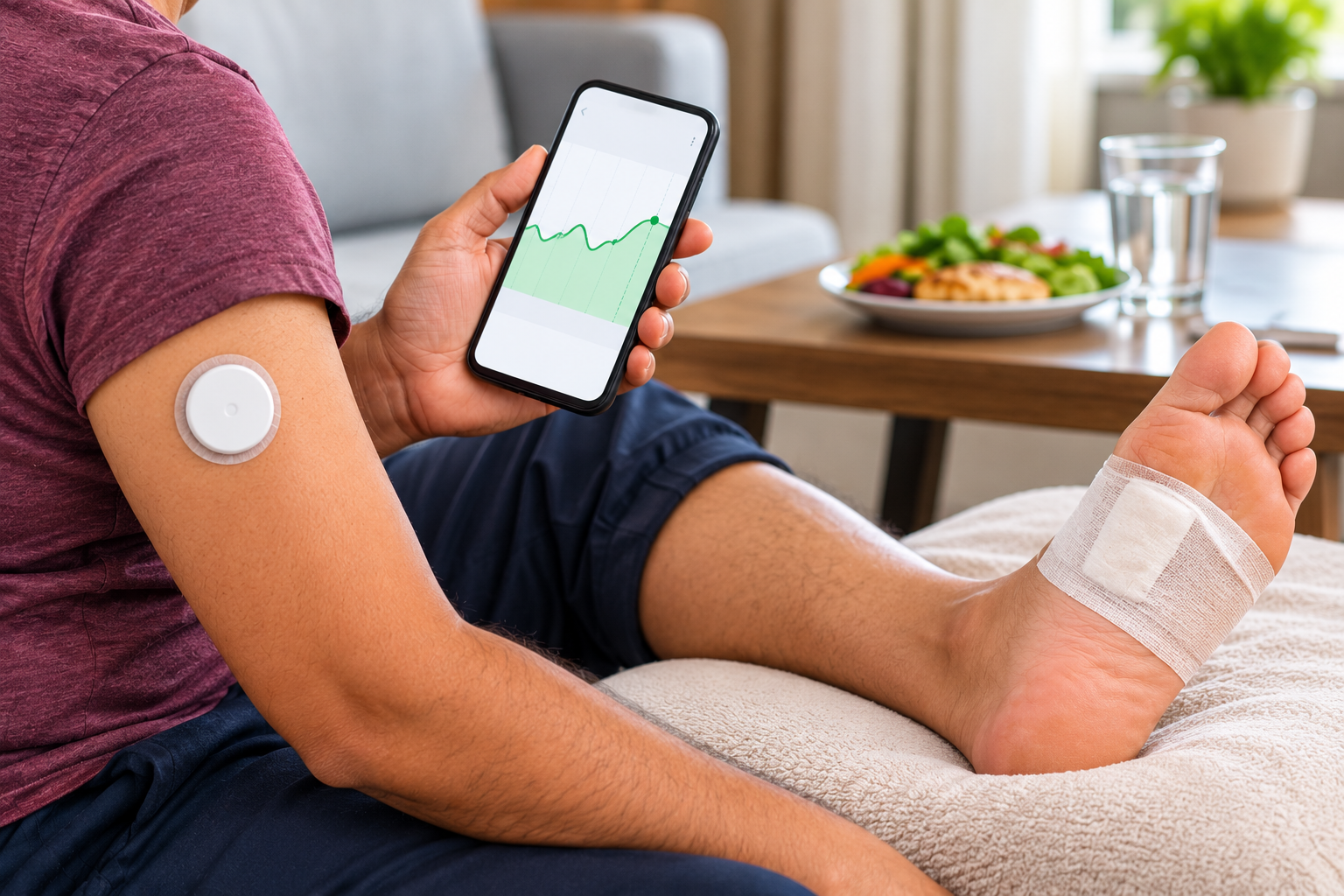

The ankle brachial index (ABI) compares blood pressure at the ankle with blood pressure in the arm. In long-standing diabetes, however, calcified arteries may not compress properly, causing ABI to read falsely normal or high. A toe pressure test can provide additional information about blood flow and whether a diabetic foot wound has enough circulation to heal.
These circulation tests are important before planning treatment for a diabetic foot ulcer. Dressings, debridement and pressure relief matter, but a wound with inadequate arterial blood flow may struggle to heal until the circulation problem is addressed.
An ABI test for diabetic foot is therefore not simply a number on a report. It is one part of a wider vascular assessment that should be interpreted alongside pulses, symptoms, wound appearance and other vascular tests.
What Is the Ankle Brachial Index Measuring?
The ankle brachial index in diabetes is a non-invasive test used to assess arterial circulation in the legs.
Blood pressure is measured in the arms and at the ankles, commonly with a blood-pressure cuff and Doppler device. The ankle systolic pressure is then compared with the arm pressure.
In simplified terms:
ABI = ankle systolic pressure ÷ brachial systolic pressure
The result helps indicate whether blood reaching the ankle is reduced.
Why Does Circulation Matter for a Foot Ulcer?
Healing requires oxygen and nutrients delivered through the bloodstream.
When arteries supplying the leg and foot are narrowed or blocked, a wound may receive insufficient blood flow.
Poor circulation can contribute to:
- Delayed wound healing
- Tissue breakdown
- Ischaemic pain
- Tissue loss
- Infection risk
- Gangrene
- Increased risk of amputation
A patient may have neuropathy and poor circulation at the same time. That combination is particularly concerning because reduced sensation can hide an injury while poor arterial flow makes healing more difficult.
Learn more about vascular assessment.
Why Can ABI Be Falsely Normal in Diabetes?
An important limitation of an ABI test for diabetic foot is that diabetes can make the result misleading.
People with long-standing diabetes may develop arterial calcification. The artery becomes stiff and difficult to compress with an ordinary blood-pressure cuff.
What Happens When an Artery Will Not Compress?
If the ankle artery does not compress normally, the machine may record an artificially high ankle pressure.
The resulting ABI can therefore appear normal—or even unusually high—despite clinically important arterial disease.
An ABI above approximately 1.3 can raise suspicion of poorly compressible or calcified arteries, although thresholds and interpretation vary.
This means a seemingly reassuring ABI should not automatically override concerning clinical findings.
When Should You Be Suspicious of a Normal ABI?
Further assessment may be needed when a person with diabetes has a "normal" ABI but also has findings such as:
- A foot ulcer that is not healing
- Weak or absent pulses
- Cool foot or toes
- Colour changes
- Tissue loss
- Rest pain
- Gangrene
- Other signs suggesting poor circulation
The clinician should interpret the ABI as part of the whole vascular assessment rather than treating it as a stand-alone pass-or-fail test.
Read about peripheral artery disease and its effect on the diabetic foot.
What Does the Toe Pressure Add?
A toe pressure test for wound healing measures systolic pressure at the toe rather than relying only on the ankle.
Digital arteries in the toes may be less affected by medial arterial calcification than larger ankle arteries, so toe pressure can sometimes provide useful additional information when ABI is falsely elevated or difficult to interpret.
A small cuff is placed around the toe and blood flow is detected using appropriate vascular equipment.
Is a Toe Pressure Test Painful?
It is generally a non-invasive test.
The cuff temporarily applies pressure around the toe, similar in principle to a blood-pressure measurement.
Patients should tell the clinician if they have significant pain, wounds or other problems affecting the toe being tested.
Why Is Toe Pressure Useful Before Ulcer Treatment?
Toe pressure helps the clinical team estimate whether enough blood is reaching the distal foot to support wound healing.
A higher pressure is generally more reassuring than a very low reading, while substantially reduced pressure increases concern about significant ischaemia.
Toe pressure should still not be interpreted in isolation.
The wound itself, infection, pulses, Doppler waveforms and other circulation findings all contribute to treatment decisions.
At EDFC (Elegance Diabetic Foot & Ulcer Clinic), Dr. Ashutosh Shah uses vascular findings together with the wound examination and the patient's overall diabetic foot condition to determine whether wound treatment alone is appropriate or further vascular assessment is required.
What Values Suggest a Wound Will Not Heal Without Intervention?
No single ABI or toe-pressure number can guarantee whether an ulcer will or will not heal.
However, markedly abnormal values increase concern about impaired perfusion.
The values in the table below should therefore be understood as clinical interpretation ranges rather than guarantees of healing.
ABI and Toe Pressure Interpretation Table
| Reading | What It May Mean | Healing Likelihood | Typical Next Step | Same-Day Vascular Referral? |
|---|---|---|---|---|
| ABI >1.3 | Arteries may be poorly compressible/calcified | ABI alone may not reliably predict healing | Toe pressure, Doppler waveform or another perfusion test | Depends on wound and clinical signs |
| ABI 0.9–1.3 | Often considered broadly within expected range | May be reassuring, but diabetes can make ABI misleading | Correlate with pulses, wound and clinical examination | Not from ABI alone |
| ABI 0.5–0.9 | Suggests reduced arterial circulation | Healing may be impaired depending on severity | Further vascular assessment | Depends on wound severity and symptoms |
| ABI <0.5 | Significant arterial impairment is a concern | Healing potential may be substantially reduced | Prompt specialist vascular assessment | May be urgent depending on clinical presentation |
| Toe pressure >50 mmHg | More reassuring distal perfusion | Generally more favourable than lower readings | Continue wound plan while considering full clinical picture | Usually not from this number alone |
| Toe pressure 30–50 mmHg | Borderline/reduced perfusion | Healing may be slower or uncertain | Further vascular assessment may be appropriate | Depends on wound and other findings |
| Toe pressure <30 mmHg | Severe ischaemia is a concern | Spontaneous wound healing is less likely | Urgent vascular assessment/revascularisation consideration | Often warrants urgent specialist evaluation, especially with tissue loss or infection |
These ranges are useful guides, but the decision to perform revascularisation should not be made from a single measurement alone.
A low toe pressure, non-healing wound, tissue loss or other signs of ischaemia should prompt appropriate vascular assessment.
For related wound problems, see ischaemic ulcer.
Which Test Comes Next When Values Are Borderline?
A borderline ABI or toe pressure does not necessarily provide the complete answer.
Additional testing may be needed when:
- ABI and clinical findings do not match
- ABI is unusually high
- The arteries appear non-compressible
- Toe pressure is borderline
- An ulcer fails to heal as expected
- Pulses are difficult to detect
- Tissue loss suggests significant ischaemia
Doppler Assessment
A Doppler test for foot ulcer assessment can provide information about blood flow and arterial waveforms.
Waveform quality may help clinicians recognise impaired circulation even when an ABI value appears less concerning.
Toe-Brachial Index
Toe pressure can also be compared with brachial pressure to calculate a toe-brachial index.
This may provide useful additional information when ankle arteries are difficult to compress.
Other Perfusion Tests
Depending on availability and the clinical situation, other tests may be used to assess whether tissue has sufficient perfusion for healing.
The exact test pathway varies between patients and facilities.
When Is Vascular Imaging Needed?
If non-invasive bedside tests suggest important arterial disease—or the wound and clinical examination remain concerning—the next step may involve vascular imaging.
Tests can include duplex ultrasound, CT angiography, MR angiography or catheter angiography depending on the clinical question.
ABI and toe pressure therefore do not replace an angiogram when detailed arterial anatomy is required.
They help identify patients who may need more detailed vascular investigation.
More information about treatment pathways is available under vascular services.
Which Readings Mean You Must Be Seen the Same Day?
An abnormal number should never be interpreted without considering what is happening to the foot.
The need for same-day assessment is especially important when poor circulation is accompanied by active tissue loss or infection.
Seek Urgent Assessment for a Foot With:
- A new black or blue toe
- Rapidly spreading discolouration
- Gangrene
- A cold, pale or suddenly changed foot
- Severe new rest pain
- Rapidly worsening ulcer
- Significant tissue loss
- Spreading redness or infection
- Pus or foul-smelling discharge
- Fever with a foot wound
- Sudden major change in circulation
A markedly low perfusion measurement combined with tissue loss or infection increases the urgency.
Do Not Wait for Pain
People with diabetic neuropathy may have serious ischaemia, infection or tissue damage without severe pain.
A painless wound is therefore not automatically a safe wound.
If the foot is deteriorating, waiting for pain before seeking treatment can delay necessary care.
Conclusion
An ABI test for diabetic foot is a useful first step in assessing whether poor arterial circulation may be affecting an ulcer, but diabetes can make the result difficult to interpret.
Calcified ankle arteries may produce a falsely normal or high ABI. In these situations, a toe pressure test for wound healing, Doppler assessment and other vascular investigations can provide additional information.
Very low toe pressures, substantially abnormal ABI findings, a non-healing ulcer or signs of tissue ischaemia should prompt further vascular assessment rather than simply continuing dressings indefinitely.
Most importantly, circulation numbers should always be interpreted alongside the actual foot. A black toe, rapidly deteriorating wound, severe ischaemic symptoms or significant infection requires urgent clinical assessment regardless of what an earlier ABI report showed.
quiz Frequently Asked Questions
This article is general education, not a diagnosis. If you have a diabetic foot wound, please have it assessed in person. Send a photo on WhatsApp or book a consultation.
About the Author

Dr. Ashutosh Shah, Plastic, Reconstructive & Diabetic Foot Surgeon, Elegance Diabetic Foot & Ulcer Clinic, Surat
Dr. Ashutosh Shah is a board certified plastic and reconstructive surgeon with over 22 years of experience and more than 10,000 limbs and feet saved. He founded Elegance Diabetic Foot & Ulcer Clinic, India's first chain of clinics dedicated to foot care, with centres in Surat and OPD partners across South Gujarat. He is known for a limb first approach, safe wound care and ethical, natural results.