Written by Dr. Ashutosh Shah, Plastic & Microvascular Surgeon - Diabetic Foot & Limb Salvage Specialist, Elegance Diabetic Foot & Ulcer Clinic (EDFC). Practising since 2004 (22+ years). Read full bio.
Medically reviewed by Dr. Ashutosh Shah
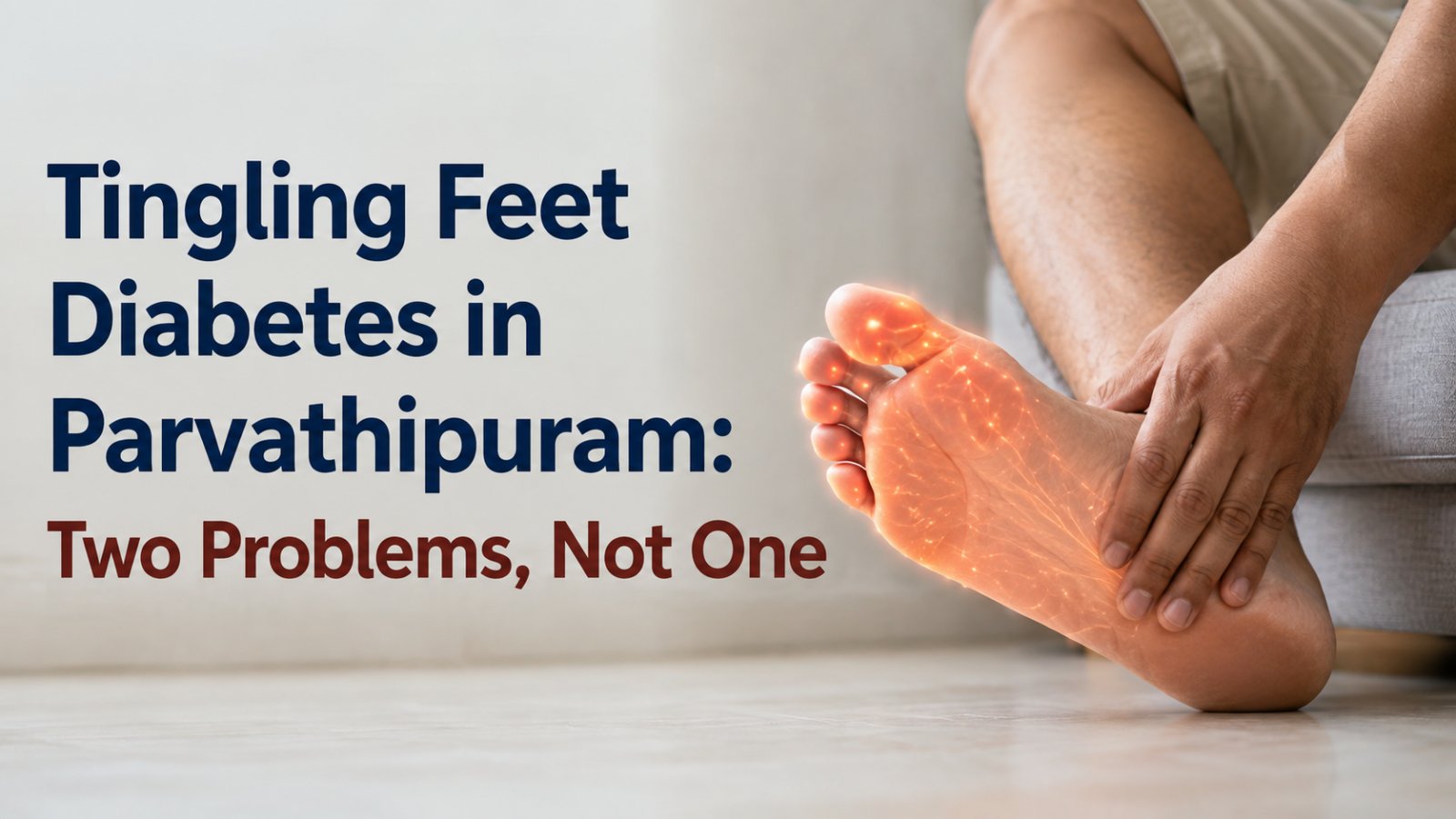
Tingling feet diabetes in Parvathipuram is usually diabetic peripheral neuropathy, nerve damage caused by years of raised blood sugar. It creates two separate problems: an uncomfortable sensation that needs relieving, and a loss of protective feeling that needs compensating for. They are treated differently.
Almost everyone focuses on the first problem, because it is the one they can feel. The second problem is silent, and it is the one that leads to ulcers and amputations. This post deals with both, separately, because treating one does nothing for the other.
What is actually happening to the nerves?
The smallest nerve fibres are being damaged first. Persistently high blood sugar injures the tiny nerves and the microscopic vessels that feed them, and because the longest nerves are affected earliest, symptoms begin in the toes and move upward over years.
That is why the pattern is symmetrical, starts at the feet, and is often described as a stocking distribution. Early on the damaged nerves fire abnormally, which produces tingling, burning and pins and needles. Later they stop transmitting altogether, which produces numbness.
What does diabetic nerve pain typically feel like?
Burning, tingling, pins and needles, or electric-shock sensations, usually worse at night and at rest. Many people describe walking on gravel, or feet that feel hot and cold at the same time. Bedsheets touching the feet can be uncomfortable.
- Both feet affected, roughly symmetrically.
- Starts in the toes and spreads upward slowly over years.
- Worse at night, often disturbing sleep.
- Better with movement in many people, unlike circulation pain which is worse on walking.
- Sometimes accompanied by cramps, weakness or unsteadiness.
One useful distinction: nerve pain is typically worse at rest, while pain from poor circulation comes on with walking and eases when you stop. The circulation pattern is described in our post on calf pain when walking with diabetes. The two can occur together.
Why are there two problems and not one?
Because a damaged nerve can be both noisy and deaf at the same time. It sends signals that should not be there, which you experience as tingling, and it fails to send signals that should be there, which you experience as nothing at all.
So there are two separate jobs. Track A is making the sensation tolerable so you can sleep and function. Track B is protecting a foot that can no longer warn you when it is injured. Track A improves quality of life. Track B is what keeps the foot.
These are not alternatives and they do not substitute for each other. Someone whose burning is completely controlled by medication has exactly the same ulcer risk as before, because the nerve damage underneath is unchanged.
Track A: how is the sensation itself treated?
By improving blood sugar control, treating any other contributing cause, and using prescribed medication for nerve pain. Ordinary painkillers are usually ineffective for neuropathic pain, which responds to a different class of medicines that must be prescribed and adjusted by your doctor.
- Tighter blood sugar control, which slows further nerve damage and is the foundation of everything else.
- Checking for other causes, including vitamin B12 deficiency, thyroid problems, alcohol intake and certain medicines.
- Prescribed neuropathic pain medication, started low and increased gradually under medical supervision, with attention to interactions.
- Sleep measures, including a bed cradle or loose bedding to keep sheets off sensitive feet.
- Regular walking and activity, where circulation and foot condition allow.
- Stopping smoking and limiting alcohol, both of which worsen nerve damage.
Two honest caveats. Medication reduces the pain; it does not repair the nerve. And relief is usually partial rather than complete, so the aim is a tolerable level, not zero sensation.
Track B: how do you protect a foot you cannot feel?
By substituting deliberate daily checking for the warning system you have lost. Your eyes and your hands now do the job your nerves used to do, and the routine has to be daily rather than occasional.
- Inspect both feet daily in good light, including soles and between the toes, using a mirror or asking someone.
- Never walk barefoot, indoors or outdoors, including at home and in temples.
- Check inside shoes before wearing them, feeling for stones, seams and worn patches.
- Test bath water with your hand or elbow, never your foot, because numb feet do not register scalding.
- Avoid hot water bottles, heaters and hot sand, which cause burns in numb feet regularly.
- Have callus and nails treated professionally, never at home.
- Wear properly fitted footwear, and break new shoes in gradually while checking the skin.
- Report any wound, blister or colour change within days, not weeks.
Blisters deserve particular attention, because in a numb foot they form and burst unnoticed, as covered in our post on blisters on the foot with diabetes. Regular reviews through preventive foot care are what catch problems while they are still small.
Why is the tingling stopping not good news?
Because it usually means the nerve has degenerated further, not healed. As damage progresses, the abnormal firing that caused the burning fades and is replaced by numbness. The symptom improves while the risk increases.
This is the most misunderstood part of diabetic neuropathy. Patients often report, with relief, that their feet stopped hurting last year. In many cases that is the point at which protective sensation was lost, and it is the point at which the foot became far more likely to ulcerate without warning.
If your feet have gone from painful to numb, that is a reason to increase daily checking and get formally assessed, not a reason to relax.
Is it always diabetes?
No, and it is worth checking. Several other conditions cause identical symptoms, some of them easily treatable, so a first assessment should look beyond the obvious explanation even in someone with long-standing diabetes.
| Cause | Typical clue |
|---|---|
| Diabetic neuropathy | Both feet, starts in toes, gradual over years, worse at night |
| Vitamin B12 deficiency | Similar pattern, sometimes with anaemia or balance problems; treatable |
| Thyroid disorder | Tiredness, weight and skin changes alongside |
| Alcohol-related nerve damage | History of sustained heavy intake |
| Spinal nerve compression | Often one leg, may follow a band or strip, back pain |
| Medication side effect | Onset after starting a new drug, including some chemotherapy |
| Poor circulation | Cold feet, weak pulses, pain on walking rather than at rest |
Symptoms in one foot only, or that came on suddenly, do not fit the usual diabetic pattern and should be assessed promptly rather than assumed.
How is it assessed?
By testing whether protective sensation is still present, and checking circulation at the same time. The core test is quick and painless: a fine monofilament is pressed against several points on the sole, and you say whether you feel it.
- Monofilament testing for protective sensation.
- Vibration testing with a tuning fork.
- Pulse examination, Doppler or toe pressures through our vascular services.
- Inspection of both feet, including callus, deformity and nails.
- Blood tests for sugar control, B12, thyroid and kidney function.
- Pressure and footwear assessment to find where an ulcer is most likely to form.
The result that matters most is whether you can feel the monofilament. If you cannot, you have lost protective sensation, and your foot care needs to change immediately regardless of how the tingling feels.
What happens if neuropathy is ignored?
Numb feet develop callus, then ulcers, then infection, without pain to warn you. Neuropathy also changes foot shape over time, creating new pressure points that ulcerate.
- Clawing of the toes and a dropped forefoot, concentrating pressure under the ball of the foot.
- Thick callus over those pressure points, which then bleeds underneath and ulcerates.
- Deformity such as bunions worsening the loading pattern, covered in our post on bunion treatment.
- Recurrent ulcers that may eventually need corrective surgery such as metatarsal osteotomy.
- Charcot foot, where the bones soften and the arch can collapse.
Wound treatment, if it reaches that stage, is managed under non-surgical wound management and diabetic foot surgery, with the broader range listed under foot conditions we treat.
When should you seek care urgently?
Same day for a red hot swollen foot, any wound or blister, or sudden weakness. Numbness itself is not an emergency, but what it hides usually is.
- A red, hot, swollen foot, with or without a wound, which may be early Charcot foot or infection.
- Any open wound, blister, or dark spot, however small and however painless.
- Sudden numbness, weakness or symptoms in one leg only.
- A cold, pale or blue foot.
- Fever with any foot problem.
- A burn, including from hot water, a heater or hot ground.
Nerve assessment and diabetic foot care for Parvathipuram
Elegance Diabetic Foot & Ulcer Clinic (EDFC), led by Dr. Ashutosh Shah, provides sensation and circulation testing, ulcer treatment, corrective surgery and limb salvage from its centre in Surat, with diabetic foot care expanding into the Parvathipuram Manyam district including Parvathipuram. If you are dealing with tingling feet diabetes in Parvathipuram, the assessment that matters most is whether protective sensation is still intact.
You can send a clear photo of your feet to our team on WhatsApp for initial guidance and book a foot assessment. If the foot is red, hot, swollen, or there is any wound or burn, seek care the same day. Follow EDFC on Facebook, Instagram and YouTube for foot care guidance and real limb salvage stories.
Treat the feeling, protect the foot
Getting the burning under control is worth doing, and it changes how you sleep. It does not change what your foot can warn you about. Run both tracks together: medication and sugar control for the sensation, daily inspection and proper footwear for the foot itself.
Next step: book a sensation and circulation assessment with Dr. Ashutosh Shah at Elegance Diabetic Foot & Ulcer Clinic, or send a photo of your feet on WhatsApp today for initial guidance.
Medical disclaimer: This article is for educational purposes only and is not a substitute for professional medical diagnosis or treatment. Medicines for nerve pain are prescription only and must be started and adjusted by your doctor, with attention to interactions and kidney function. Tingling that is sudden, one-sided or accompanied by weakness needs prompt assessment. Please consult Dr. Ashutosh Shah or a qualified specialist about your condition. For further guidance, see the NHS guide to peripheral neuropathy and the IWGDF diabetic foot guidelines.
quiz Frequently Asked Questions
This article is general education, not a diagnosis. If you have a diabetic foot wound, please have it assessed in person. Send a photo on WhatsApp or book a consultation.
About the Author

Dr. Ashutosh Shah, Plastic, Reconstructive & Diabetic Foot Surgeon, Elegance Diabetic Foot & Ulcer Clinic, Surat
Dr. Ashutosh Shah is a board certified plastic and reconstructive surgeon with over 22 years of experience and more than 10,000 limbs and feet saved. He founded Elegance Diabetic Foot & Ulcer Clinic, India's first chain of clinics dedicated to foot care, with centres in Surat and OPD partners across South Gujarat. He is known for a limb first approach, safe wound care and ethical, natural results.