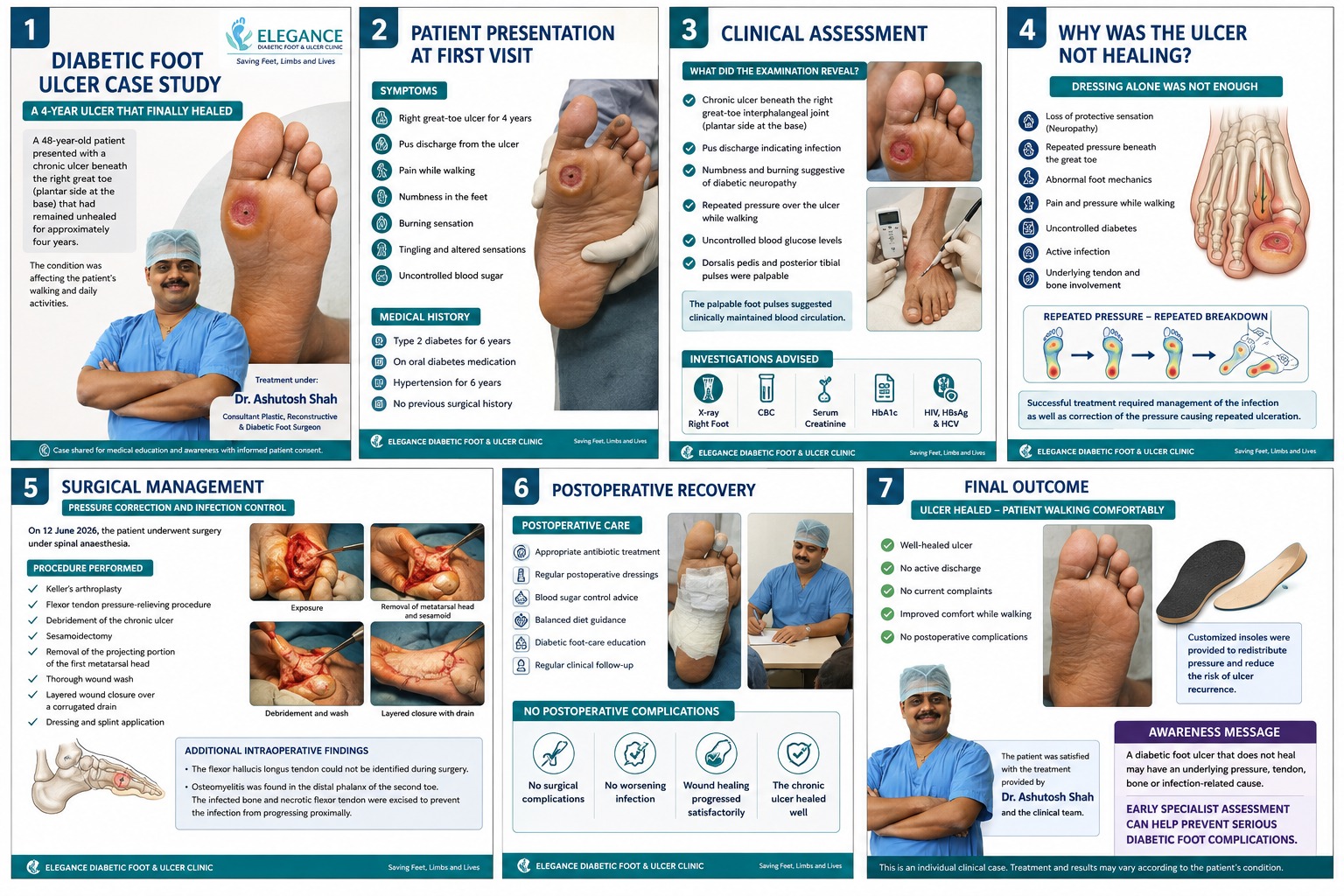
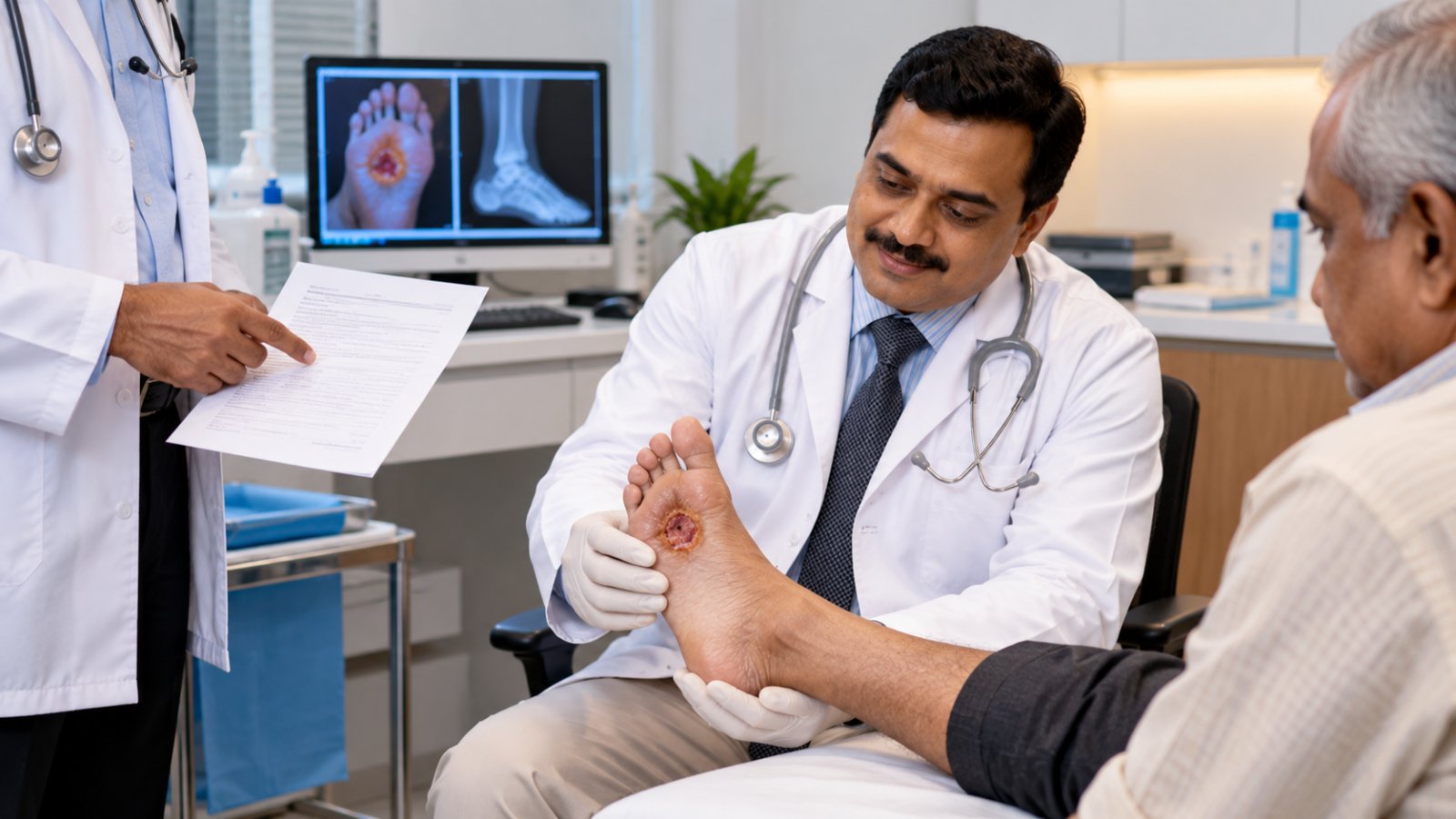
Your physician manages sugars and medical risk. Surgical review adds wound assessment, circulation testing, pressure mapping and the decision on debridement, offloading or revascularisation. Your diabetologist keeps prescribing your diabetes treatment throughout.
At Elegance Diabetic Foot & Ulcer Clinic, the aim of referral is coordinated care rather than replacing your regular physician. Dr. Ashutosh A Shah and the diabetic foot team assess the wound and the factors preventing healing, while your diabetologist or physician continues to manage your diabetes medicines and overall metabolic health.
What Does a Physician Manage and Where Does Surgical Review Begin?
Your diabetologist plays a central role in controlling diabetes. This may include monitoring blood glucose and HbA1c, prescribing insulin or other diabetes medicines, assessing kidney and cardiovascular risk, and treating other medical conditions associated with diabetes.
A foot ulcer, however, may involve more than high blood sugar.
The wound may be repeatedly exposed to pressure, infected, poorly supplied with blood or deeper than it appears from the surface. In some cases, infection may extend towards a tendon, joint or bone.
This is where assessment by a diabetic foot surgeon in Ahmedabad can add another layer to the treatment plan.
The surgical foot team may evaluate:
- wound depth, size and tissue condition;
- infection and possible deeper spread;
- foot pulses and blood supply;
- neuropathy and loss of protective sensation;
- pressure points and abnormal loading;
- exposed tendon, joint or bone;
- recurrent callus or deformity;
- whether dead or infected tissue needs debridement;
- whether offloading is required;
- whether vascular assessment or revascularisation should be considered.
A referral therefore does not mean that surgery is automatically required. It means the wound needs a more detailed foot-focused assessment.
For a structured assessment of the wound, circulation, sensation and pressure, see the comprehensive foot evaluation.
Which Findings Trigger a Referral From a Diabetes Clinic?
A diabetologist may refer a patient when an ulcer is not improving as expected or when findings suggest that wound care alone may not be sufficient.
Common reasons include an ulcer persisting for more than two weeks, recurrent breakdown at the same site, absent or weak pulses, increasing redness, deeper tissue exposure or a change in foot shape.
Referral may also be appropriate when a wound appears small but repeatedly returns after dressing.
The important question is not simply, "How large is the wound?"
The foot team also asks:
Why did the wound develop, and what is stopping it from healing?
A small plantar ulcer can continue reopening if pressure is not removed. A wound may also fail to heal when circulation is inadequate, even when the dressing itself is appropriate.
Doctors who want to arrange specialist assessment can use the Refer a Patient pathway.
When Does a Foot Ulcer Need Surgical Review?
| Finding | Why Surgical Review Is Needed | Urgency | What the Foot Team May Do |
|---|---|---|---|
| Ulcer present for more than two weeks | Healing may be stalled by pressure, infection or circulation problems | This week | Reassess wound depth, pressure, infection and blood supply |
| Exposed tendon or bone | Suggests a deep wound and possible deeper infection | Prompt review | Assess depth, infection and need for imaging/debridement |
| Absent or very weak pulses | May indicate inadequate arterial blood supply | Prompt review | Perform vascular assessment and determine whether further vascular testing is needed |
| Spreading redness | Can indicate progressing infection | Same day | Assess infection severity and whether hospital treatment is required |
| Fever with a foot wound | May indicate systemic infection | Same day | Urgent medical and surgical assessment |
| Recurrent ulcer at the same site | Persistent pressure or deformity may be driving recurrence | This week | Pressure assessment, offloading and evaluation of deformity |
| New foot deformity | Changes pressure distribution and can create new ulcer sites | Prompt review | Biomechanical and structural assessment |
Fever, rapidly spreading redness, foul smell, blackening of a toe or rapidly increasing swelling should not wait for a routine appointment.
What Does the Surgical Assessment Add That a Physician Visit Cannot?
A diabetes consultation and a surgical foot assessment answer different but complementary questions.
Your diabetologist may ask:
Is the diabetes adequately controlled for healing?
The foot team additionally asks:
Is there enough blood supply? Is pressure being removed? How deep is the wound? Is infected or dead tissue present? Is bone involved?
A specialist assessment may therefore include wound measurement, examination of surrounding skin and callus, circulation assessment, sensory testing and evaluation of the way pressure is distributed across the foot.
When appropriate, further investigations may be advised to look for deeper infection or poor circulation.
For more information about the condition itself, see diabetic foot ulcer.
Why Do I Need a Surgeon If My Sugars Are Controlled?
Good glucose control is important, but it does not correct every factor responsible for an ulcer.
For example, a patient can have acceptable blood sugar levels but still have:
- severe neuropathy;
- repeated pressure over one part of the foot;
- poor arterial circulation;
- dead or infected tissue;
- an underlying deformity;
- infection extending into deeper structures.
That is why referral may still be necessary even when diabetes itself appears reasonably controlled.
Seeing a surgeon also does not automatically mean an operation will be performed. Many patients first need assessment, pressure relief, wound care, imaging or circulation testing.
Debridement: When Does the Wound Need Cleaning?
Some diabetic ulcers contain dead tissue, thick callus or infected material that interferes with assessment and healing.
Debridement means removing selected non-viable or infected tissue when clinically appropriate. It can allow the wound bed to be assessed more clearly and may form part of infection control.
The decision depends on the wound, infection, circulation and overall condition of the foot. Debridement should therefore not be treated as an automatic procedure for every ulcer.
Why Is Circulation Testing Important?
A wound requires adequate blood supply to heal.
Weak or absent pulses, a cold foot, colour changes or tissue loss can raise concern about reduced arterial circulation. In such cases, the foot team may recommend vascular assessment before expecting the wound to close.
If blood flow is significantly impaired, vascular treatment may sometimes be considered as part of a limb-salvage plan.
This is one reason a referral to a diabetic foot surgeon in Ahmedabad may involve more than changing a dressing.
Why Does Pressure Mapping and Offloading Matter?
A neuropathic foot may continue to place pressure on an ulcer without producing enough pain to make the patient stop walking.
This can repeatedly damage healing tissue.
The foot team therefore looks at where the wound is located, footwear, callus patterns, deformity and areas exposed to excessive pressure.
Depending on the findings, offloading may involve specialised footwear, a removable device, casting or another pressure-relieving strategy.
Without adequate pressure relief, repeated dressing changes may not solve the underlying mechanical problem.
How Does Shared Care Work Between Your Regular Doctor and the Foot Team?
Shared care diabetic foot treatment means different clinicians manage the parts of treatment that fall within their expertise.
Your diabetologist may continue to manage:
- diabetes medicines;
- insulin;
- HbA1c and glucose monitoring;
- kidney and cardiovascular risk;
- blood pressure and other medical conditions.
The diabetic foot team manages the wound-related issues, including wound assessment, infection, circulation, pressure relief, debridement and surgical decisions when appropriate.
Communication between the teams is important because changes in infection, food intake, hospitalisation or surgery can affect glucose control.
Where an additional medical opinion is needed, the endocrinologist opinion service may form part of coordinated care.
Who Keeps Prescribing Your Diabetes Medicines During Treatment?
In most cases, your regular diabetologist, endocrinologist or physician continues prescribing your diabetes medicines.
Do not independently stop insulin or diabetes tablets because you have been referred to a foot surgeon.
If a procedure, hospital admission or fasting period is planned, the doctors may temporarily adjust medicines or insulin according to your clinical situation.
The surgical team and diabetes physician should coordinate these changes where necessary.
Do You Need to Change Your Regular Doctor?
Usually, no.
A referral for specialist foot assessment does not normally require you to leave the doctor who has been managing your diabetes.
The purpose is to add expertise for the ulcer while maintaining continuity of your medical care.
Your regular physician may remain involved before, during and after wound treatment.
What Happens After the Wound Heals?
Healing the skin is only one part of diabetic foot care.
The next priority is preventing another ulcer.
Follow-up may therefore focus on:
- regular foot inspection;
- appropriate footwear;
- callus management;
- pressure reduction;
- glucose control;
- circulation monitoring where required;
- early review of any new blister, crack or wound.
Patients with neuropathy, deformity or a previous ulcer can remain at increased risk of recurrence, so preventive care should continue even after the wound has closed.
Which Referrals Should Not Wait for the Next Available Slot?
Some foot problems should bypass routine appointment scheduling.
Seek urgent hospital assessment if a diabetic foot wound is associated with:
- fever or chills;
- rapidly spreading redness;
- rapidly increasing swelling;
- black or blue tissue;
- foul smell or significant pus;
- sudden deterioration in general health.
These findings can indicate serious infection or loss of tissue viability.
A routine referral appointment should not delay emergency assessment when the foot is deteriorating quickly.
Final Thoughts
A referral from your diabetologist to a diabetic foot surgeon in Ahmedabad is usually an extension of your diabetes care, not a replacement for it.
Your regular doctor continues managing blood sugar and medical risk, while the diabetic foot team investigates the wound itself particularly its depth, infection status, circulation and pressure pattern.
At Elegance Diabetic Foot & Ulcer Clinic, Dr. Ashutosh A Shah and the foot-care team can assess whether the next step involves wound care, offloading, debridement, vascular evaluation or another specialist intervention.
The most important point is timing. A stable ulcer may be assessed through a scheduled referral, but fever, spreading redness, blackening, foul smell or rapidly increasing swelling needs urgent hospital assessment rather than waiting for the next OPD slot.
quiz Frequently Asked Questions
This article is general education, not a diagnosis. If you have a diabetic foot wound, please have it assessed in person. Send a photo on WhatsApp or book a consultation.
About the Author

Dr. Ashutosh Shah, Plastic, Reconstructive & Diabetic Foot Surgeon, Elegance Diabetic Foot & Ulcer Clinic, Surat
Dr. Ashutosh Shah is a board certified plastic and reconstructive surgeon with over 22 years of experience and more than 10,000 limbs and feet saved. He founded Elegance Diabetic Foot & Ulcer Clinic, India's first chain of clinics dedicated to foot care, with centres in Surat and OPD partners across South Gujarat. He is known for a limb first approach, safe wound care and ethical, natural results.