Written by Dr. Ashutosh Shah, Plastic & Microvascular Surgeon – Diabetic Foot & Limb Salvage Specialist, Elegance Diabetic Foot & Ulcer Clinic (EDFC). Practising since 2004 (22+ years). Read full bio.
Medically reviewed by Dr. Ashutosh Shah
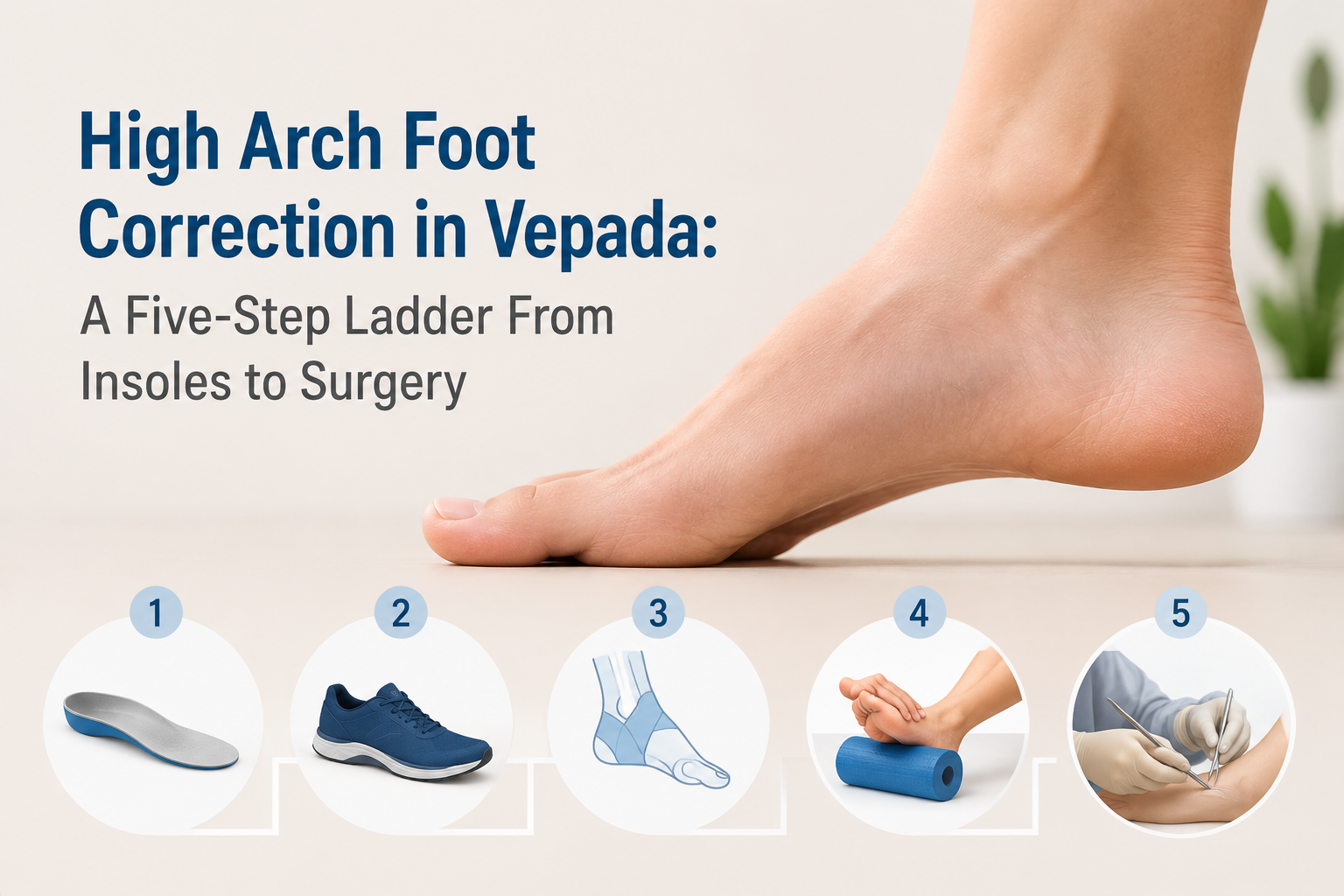
High arch foot correction in Vepada follows a ladder. It starts with finding the cause, moves to footwear and custom orthotics, then to physiotherapy and tendon-based procedures, and only reaches bone surgery when the arch has become rigid. Most people never need to climb past the third step.
A high arch, or cavus foot, is not one condition. It is a shape that can be inherited and stable, or a shape that is slowly worsening because of a nerve problem. Those two situations are treated very differently, and the whole plan depends on telling them apart first. This post walks the ladder from the bottom up.
Step 0 - Before anything else, is the arch changing?
This is the question that must be answered before any correction begins.
An arch that has looked the same since childhood is usually structural. An arch that is getting higher, with toes that are curling more, or a foot that is turning in, may be driven by an underlying nerve condition and needs neurological assessment rather than a new pair of insoles.
| Sign | Points towards |
|---|---|
| Arch unchanged for years, no weakness | Structural (inherited) cavus foot |
| Arch rising over months or years, toes clawing more | Possible nerve cause, needs assessment |
| One foot only, after an injury or back problem | Nerve or trauma related |
| Tripping, catching the toe, ankle giving way | Muscle imbalance, see foot drop and foot instability |
| Numbness, burning or tingling | Nerve involvement, see diabetic neuropathy |
Family members with the same foot shape is a useful clue and worth mentioning at your appointment.
Step 1 - Understand where the pressure is going
A high arch is mechanically inefficient. Instead of the load spreading across the whole sole, it concentrates on two small zones: the ball of the foot and the heel. The midfoot barely touches the ground.
That concentration is what produces the actual complaints - pain under the ball of the foot, thick calluses in the same two spots every time, corns on the tops of clawed toes, repeated ankle sprains, and heel pain resembling plantar fasciitis.
A pressure and biomechanical assessment maps exactly where the load lands. Correction is then aimed at those specific zones instead of the arch in general.
Step 2 - Footwear and custom orthotics
This is where most successful treatment happens, and it is the step people skip.
- Cushioned, shock-absorbing shoes with a wide toe box, so clawed toes are not pressed.
- Custom orthotics, not shop-bought arch supports. A high arch needs the load moved outward and the midfoot filled in, which is the opposite of what a flat-foot insole does. Ready-made supports often make cavus feet worse. See orthotics and bracing.
- Metatarsal pads or bars to lift pressure off the ball of the foot.
- Ankle support or bracing where sprains keep recurring.
- Therapeutic footwear where skin is already breaking down.
Give this step three to six months before deciding it has failed. Insoles change loading gradually, and comfort usually improves before the callus pattern does.
Step 3 - Stretching and strengthening
Tight calves make a high arch worse by driving even more pressure onto the forefoot. Gastrosoleus tightness is present in a large share of painful cavus feet and is treatable without surgery.
Physiotherapy targets calf stretching, ankle stabiliser strengthening, and toe flexor balance. It will not lower the arch - nothing non-surgical does - but it reduces pain, improves ankle control and slows deformity in flexible feet. Rehabilitation is often continued alongside orthotics rather than instead of them.
Step 4 - Soft-tissue surgery for a flexible foot
If the foot still corrects by hand when the surgeon tests it, correction can often be achieved without cutting bone.
| Procedure | What it does |
|---|---|
| Plantar fascia release | Releases the tight band along the sole limiting the arch |
| Calf or Achilles lengthening | Reduces forefoot overload from a tight calf |
| Tendon transfer | Rebalances a weak muscle using a working one, see nerve and tendon surgery |
| Toe correction | Straightens clawed hammer toes rubbing inside shoes |
These are usually combined rather than done singly, and recovery is faster than bone surgery.
Step 5 - Bone surgery for a rigid foot
When the deformity no longer corrects by hand, the bone shape itself must be changed. This is deformity correction surgery: calcaneal osteotomy to reposition the heel bone, midfoot or metatarsal osteotomy to lower the front of the arch, and fusion where joints are already arthritic.
| Phase | Typical duration | What happens |
|---|---|---|
| 0–2 weeks | Cast or splint | Non-weight-bearing, elevation, wound checks |
| 2–6 weeks | Cast or boot | Sutures out, bone begins uniting |
| 6–12 weeks | Boot to shoe | Graduated weight-bearing as X-rays allow |
| 3–6 months | Shoe with orthotic | Strength and gait retraining |
| 6–12 months | Normal footwear | Final result, swelling settles last |
Surgery is chosen for pain, ulceration and instability - not for appearance.
Why diabetes changes the whole calculation
In a diabetic foot, a high arch stops being a comfort problem and becomes a skin-survival problem. Pressure concentrated under the ball of the foot, in a foot that cannot feel it, is the classic recipe for a plantar ulcer. Neuropathy also causes cavus deformity in the first place, so the two arrive together.
- Never trim calluses yourself. A callus over a high-pressure point is a pre-ulcer and needs professional reduction.
- Get sensation tested, through neuropathy assessment, before assuming the foot will report a problem.
- Prioritise offloading. Offloading and preventive surgery may be advised early, before skin breaks, rather than after.
- Watch pressure points. Skin over the ball and heel behaves like the areas described in our post on pressure ulcers of the foot.
- Attend regular screening even when the foot feels fine.
Any wound over a bony prominence in a high-arched diabetic foot needs prompt review, not a home dressing.
High arch and diabetic foot care for Vepada
Elegance Diabetic Foot & Ulcer Clinic (EDFC), led by Dr. Ashutosh Shah, offers gait and pressure assessment, custom offloading, deformity correction and limb salvage surgery from its centre in Surat, with care extending into the Vizianagaram district including Vepada. If you are considering high arch foot correction in Vepada, the ladder above is the order in which options should be tried.
Send a photo of the sole of your foot and your usual footwear to our team on WhatsApp for initial guidance, or book a foot assessment. Related surgical options are outlined under diabetic foot surgery and limb preservation surgery. Follow EDFC on Facebook, Instagram and YouTube.
Climb the ladder in order
Find out first whether the arch is stable or progressing. Then correct the pressure, not the appearance. Most people get lasting relief from custom offloading and calf work, and surgery is reserved for feet that have become rigid, painful or ulcer-prone.
Next step: book a gait and pressure assessment with Dr. Ashutosh Shah at Elegance Diabetic Foot & Ulcer Clinic, or send a photo of your foot and footwear on WhatsApp today.
Medical disclaimer: This article is for educational purposes only and is not a substitute for professional medical diagnosis or treatment. A high arch that is worsening, or associated with weakness or numbness, requires in-person neurological and foot assessment. Please consult Dr. Ashutosh Shah or a qualified specialist about your condition. For further guidance, see the NHS guide to foot pain and the IWGDF diabetic foot guidelines.
quiz Frequently Asked Questions
This article is general education, not a diagnosis. If you have a diabetic foot wound, please have it assessed in person. Send a photo on WhatsApp or book a consultation.
About the Author
Dr. Ashutosh Shah, Plastic, Reconstructive & Diabetic Foot Surgeon, Elegance Diabetic Foot & Ulcer Clinic, Surat
Dr. Ashutosh Shah is a board certified plastic and reconstructive surgeon with over 22 years of experience and more than 10,000 limbs and feet saved. He founded Elegance Diabetic Foot & Ulcer Clinic, India's first chain of clinics dedicated to foot care, with centres in Surat and OPD partners across South Gujarat. He is known for a limb first approach, safe wound care and ethical, natural results.