
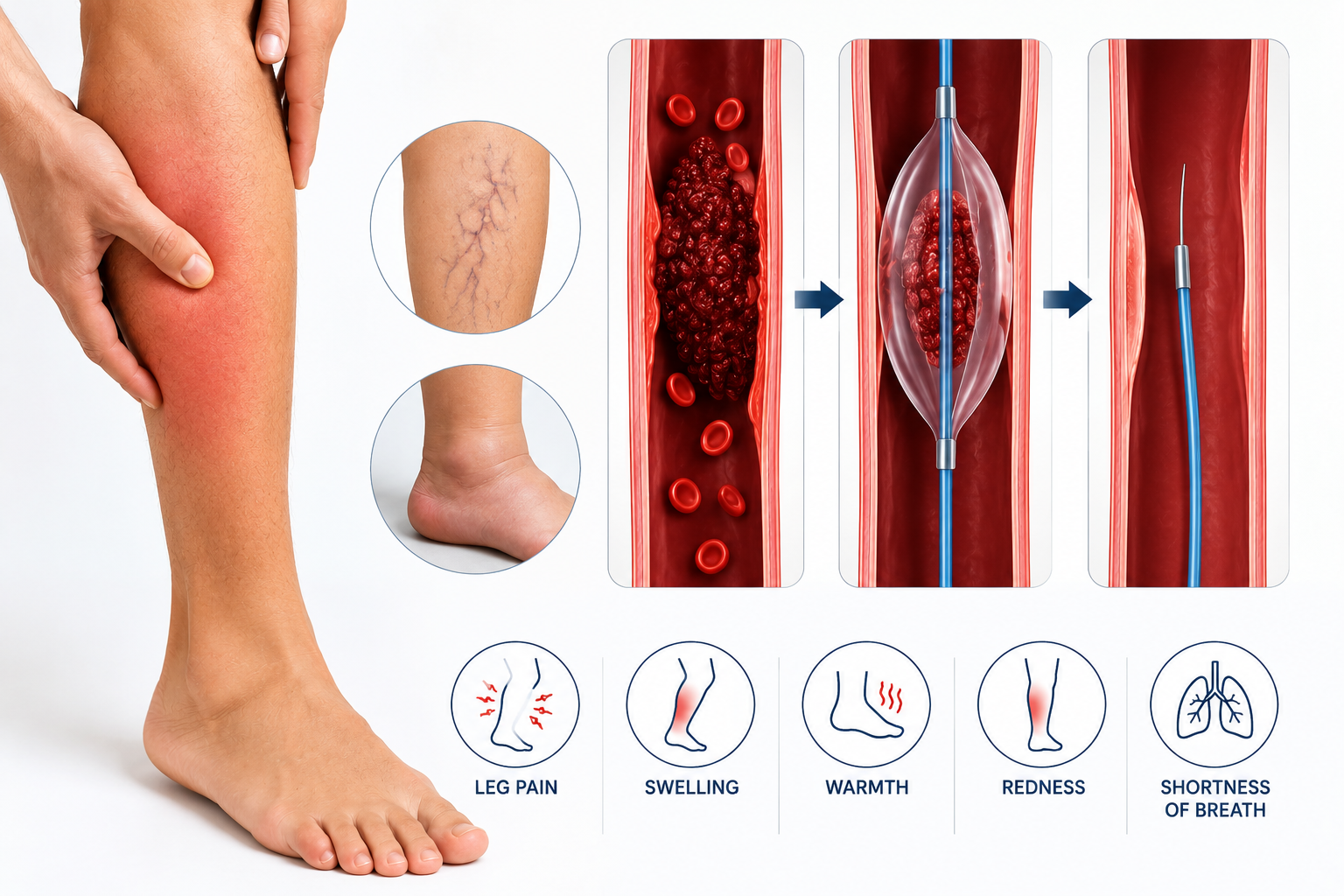
Catheter-directed thrombolysis delivers clot-dissolving drug through a catheter into a leg vein clot. It is considered mainly for extensive iliofemoral DVT with symptoms under 14 days, good function and low bleeding risk, to relieve severe swelling and reduce post-thrombotic syndrome. Most calf and thigh clots are treated with blood thinners alone.
Key Takeaways
-
Catheter-directed thrombolysis (CDT) is a minimally invasive procedure that delivers thrombolytic medication directly into a venous blood clot.
-
It is mainly considered for carefully selected patients with acute, extensive iliofemoral DVT.
-
A symptom duration of less than 14 days is an important selection factor, although it is not an absolute deadline.
-
Most patients with DVT are treated successfully with anticoagulants without catheter intervention.
-
Thrombolysis carries a significant bleeding risk, including rare but serious intracranial bleeding.
-
The ATTRACT trial did not demonstrate an overall reduction in post-thrombotic syndrome with routine catheter-based treatment.
-
Some patients with extensive iliofemoral DVT may experience earlier symptom relief.
-
Anticoagulation usually continues after catheter treatment because removing an existing clot does not eliminate the risk of new thrombosis.
What Is Catheter-Directed Thrombolysis?
Deep vein thrombosis (DVT) occurs when a blood clot develops inside a deep vein, most commonly in the leg.
The clot can partially or completely block venous blood flow, causing swelling, pain, heaviness and discomfort.
Most DVTs are treated with anticoagulant medicines, commonly called blood thinners.
These medicines prevent the clot from growing and reduce the risk of additional clots while the body's natural processes gradually break down the existing clot.
However, some patients develop extensive clots involving the major veins of the pelvis and upper thigh.
In carefully selected cases, doctors may consider catheter-based treatment to remove or dissolve the clot more quickly.
How Does the Procedure Work?
During catheter-directed thrombolysis, an interventional specialist inserts a thin catheter into the affected venous system using imaging guidance.
The catheter is positioned within or across the blood clot.
A thrombolytic medicine, such as alteplase, may then be delivered directly into the clot.
The medicine helps break down fibrin, an important structural component of blood clots.
Depending on the technique, treatment may involve:
-
Ultrasound-guided venous access.
-
Venography to identify the clot's location and extent.
-
Catheter placement within the thrombosed vein.
-
Delivery of clot-dissolving medication.
-
Monitoring during the infusion.
-
Repeat imaging to assess treatment response.
-
Additional intervention if a significant venous obstruction remains.
Some procedures also use mechanical devices to remove clot material.
These techniques are not identical, and the treating team chooses an approach based on anatomy, urgency and bleeding risk.
Is Catheter Treatment the Same as Blood Thinners?
No.
Anticoagulants reduce further clot formation and allow the body to clear the clot naturally.
Catheter-directed thrombolysis actively delivers medication into the existing clot.
Importantly, catheter directed thrombolysis for DVT is generally an additional treatment rather than a replacement for anticoagulation.
Patients usually still require blood thinners after the procedure.
Which Clots Qualify and Why Does the 14-Day Window Matter?
Not every leg DVT requires catheter treatment.
The most important considerations include clot location, symptom duration, severity, functional status and bleeding risk.
Iliofemoral DVT: The Main Group Considered
Iliofemoral DVT involves the iliac veins, common femoral vein or both.
These major veins drain blood from the leg toward the heart.
When they become extensively blocked, patients may develop:
-
Marked swelling of the entire leg
-
Significant pain
-
Difficulty walking
-
Venous congestion
-
Persistent heaviness
-
Reduced mobility
Selected patients with severe symptoms may benefit from early clot-removal strategies.
However, catheter treatment is not automatically recommended for every iliofemoral DVT.
Why Is the 14-Day Window Important?
The clot's age influences how easily it may respond to thrombolytic medication.
Fresh clots are generally less organised than older clots.
As time passes, the clot may become more fibrotic and incorporated into the vein wall.
For this reason, many treatment protocols and guidelines focus on patients whose symptoms began within approximately 14 days.
The 14-day period is a selection criterion, not a guarantee of successful treatment or an absolute cutoff applicable to every case.
A specialist must also consider when symptoms truly began and whether imaging suggests acute or chronic thrombosis.
What About Calf and Thigh DVT?
Isolated calf DVT usually does not require catheter-directed thrombolysis.
Similarly, DVT limited to the femoral and popliteal veins is generally managed with anticoagulation rather than early clot-removal intervention.
The potential benefit of catheter treatment is less established in these groups, while the bleeding risk remains important.
Who Is a Suitable Candidate for Catheter Treatment?
Before recommending catheter directed thrombolysis for DVT, specialists compare the potential benefits of faster clot clearance with the risks of thrombolytic medication.
Catheter Treatment vs Blood Thinners: Candidacy Table
| Clinical Factor | May Favour Catheter Treatment | Usually Favours Anticoagulation Alone |
|---|---|---|
| Clot location | Extensive iliofemoral DVT | Isolated calf or femoropopliteal DVT |
| Symptom duration | Acute symptoms, usually less than 14 days | Older or chronic thrombosis |
| Symptom severity | Severe swelling, pain or functional limitation | Mild or improving symptoms |
| Bleeding risk | Low bleeding risk | Moderate or high bleeding risk |
| Recent surgery | No major recent procedure increasing bleeding risk | Recent major surgery or significant tissue injury |
| Stroke history | No relevant contraindication | Recent stroke or intracranial bleeding history |
| Functional status | Good mobility and functional capacity | Substantial frailty or limited functional capacity |
| Expected benefit | Potential meaningful improvement in severe symptoms | Limited additional benefit from intervention |
This table provides general selection principles rather than an individual treatment recommendation.
When Is Emergency Clot Removal Considered?
A rare but serious complication of extensive DVT is phlegmasia cerulea dolens.
This condition can cause severe venous obstruction and threaten the affected limb.
Warning signs may include:
-
Sudden, severe leg swelling
-
Intense pain
-
Blue or purple skin discolouration
-
Marked venous congestion
-
Reduced circulation
-
Rapid deterioration
This requires emergency hospital assessment.
Urgent clot-removal treatment may be considered even when the usual elective selection criteria do not apply.
Who Should Not Have Catheter-Directed Thrombolysis Because of Bleeding Risk?
Thrombolytic medicines can dissolve harmful blood clots, but they also interfere with normal clot stability.
This increases the risk of bleeding.
Bleeding may occur at the catheter insertion site, internally or, rarely, inside the brain.
Therefore, catheter directed thrombolysis for DVT should only be considered after careful screening.
Important Contraindication Checklist
The treating team should specifically assess for:
- Active internal bleeding
-
Previous intracranial haemorrhage
-
Recent stroke, particularly haemorrhagic stroke
-
Recent major surgery or significant trauma
-
Recent intracranial or spinal procedures
-
Known intracranial lesions associated with bleeding risk
-
Severe uncontrolled hypertension
-
Significant bleeding disorder
-
Severe thrombocytopenia
-
Other conditions or medicines that substantially increase bleeding risk
Some factors are absolute contraindications, while others are relative contraindications depending on their severity and timing.
The interventional team must evaluate the complete medical history before proceeding.
What Tests Are Done Before Thrombolysis?
Pre-procedure assessment may include:
-
Complete blood count
-
Haemoglobin level
-
Platelet count
-
Kidney function
-
Coagulation profile
-
Current anticoagulant use
-
Ultrasound or other venous imaging
-
Assessment of recent bleeding, surgery and stroke
Additional tests depend on the patient's condition.
The purpose is to determine whether the likely benefit justifies the bleeding risk.
What Did the ATTRACT and CAVA Trials Show?
Clinical trials are important because catheter procedures may appear attractive when described as a way to remove a clot quickly.
However, faster clot clearance does not automatically translate into better long-term outcomes for every patient.
ATTRACT Trial: Did Catheter Treatment Prevent Post-Thrombotic Syndrome?
The ATTRACT trial, published in the New England Journal of Medicine in 2017, compared anticoagulation alone with anticoagulation plus pharmacomechanical catheter-directed thrombolysis in patients with acute proximal DVT.
The main findings were:
-
Routine catheter-based treatment did not significantly reduce the overall occurrence of post-thrombotic syndrome.
-
Major bleeding was more frequent in the intervention group.
-
Selected patients with iliofemoral DVT appeared to experience improvements in some symptom-related outcomes in subsequent analyses.
-
These findings did not justify routine catheter intervention for all proximal DVT.
The practical message is that treatment selection matters.
CAVA Trial: What Did It Find?
The CAVA trial evaluated ultrasound-accelerated catheter-directed thrombolysis in patients with acute iliofemoral DVT.
It did not demonstrate a statistically significant reduction in post-thrombotic syndrome compared with standard treatment.
The study reinforced the need to balance possible benefits against procedural risks.
What Do Vascular Guidelines Recommend?
The European Society for Vascular Surgery (ESVS) 2021 venous thrombosis guideline supports considering early thrombus removal in selected patients with symptomatic iliofemoral DVT.
It does not recommend routine early thrombus removal for DVT limited to the femoral, popliteal or calf veins.
This distinction is important because clot location strongly influences the potential value of intervention.
What Does This Mean for Patients?
The evidence does not support the claim that every patient with a leg DVT benefits from catheter treatment.
For many people, anticoagulation remains the safest and most appropriate approach.
Selected patients with extensive, recent iliofemoral DVT and severe symptoms may be considered for intervention after careful risk assessment.
What Happens During and After the Procedure?
Catheter-directed thrombolysis is performed by an appropriately trained interventional radiologist, vascular surgeon or other qualified endovascular specialist.
The procedure takes place in a hospital equipped for imaging-guided intervention and close monitoring.
During the Procedure
The specialist obtains venous access and advances the catheter under imaging guidance.
A thrombolytic infusion may be delivered over several hours or longer, depending on the technique and response.
Some patients require a repeat venogram or additional catheter intervention.
The treatment plan varies according to clot burden, anatomy and clinical condition.
How Is the Patient Monitored?
Patients receiving a thrombolytic infusion require close observation because bleeding complications can develop during treatment.
Monitoring may include:
-
Blood pressure and pulse
-
Catheter insertion site
-
Leg swelling and circulation
-
Signs of internal bleeding
-
Haemoglobin and platelet levels
-
Coagulation tests
-
Fibrinogen levels when required by the protocol
-
Neurological symptoms suggesting intracranial bleeding
The treating team may adjust or stop treatment if significant bleeding or other complications occur.
Will a Venous Stent Be Needed?
Not every patient requires a vein stent.
However, some patients have an underlying narrowing or compression of the iliac vein.
After clot removal, the specialist may identify a significant residual obstruction.
In selected cases, venous stenting for DVT may be considered to improve venous outflow.
The decision depends on imaging findings, symptoms and the patient's overall condition.
Will Blood Thinners Still Be Required?
Yes, in most cases.
Removing or dissolving a clot does not remove the underlying risk of recurrent thrombosis.
Anticoagulation generally continues for at least three months after a proximal DVT, although some patients require longer treatment.
Duration depends on factors such as:
-
Whether the DVT was provoked or unprovoked
-
Previous clotting events
-
Persistent risk factors
-
Bleeding risk
-
Presence of a venous stent
-
Other medical conditions
The treating physician determines the appropriate medication and duration.
What Is Post-Thrombotic Syndrome?
Post-thrombotic syndrome (PTS) is a long-term complication that can develop after DVT.
It occurs when venous valves or outflow pathways remain damaged or obstructed.
Symptoms may include:
-
Persistent leg swelling
-
Heaviness
-
Aching
-
Skin discolouration
-
Tightness
-
Reduced walking comfort
-
Venous eczema
-
Venous ulceration in severe cases
Not every patient develops post-thrombotic syndrome.
Can Catheter Treatment Prevent It?
The evidence does not show that routine catheter treatment prevents post-thrombotic syndrome in all DVT patients.
Some selected patients with extensive iliofemoral DVT may experience reduced early symptoms or improvements in the severity of later symptoms.
However, the potential benefit must be weighed against bleeding risk.
Patients with persistent swelling can read more about chronic leg swelling.
Severe long-term venous disease may contribute to venous ulcers.
DVT Specialist in Vizianagaram: When Should You Seek an Assessment?
Patients with suspected DVT should seek prompt medical evaluation, especially when swelling affects one leg or develops suddenly.
A vascular assessment helps establish whether a clot is present and how extensively it involves the venous system.
For patients searching for a dvt specialist in vizianagaram, important questions include whether the clot involves the iliac or common femoral veins, how long symptoms have been present, and whether catheter intervention offers a meaningful benefit over anticoagulation.
At Elegance Diabetic Foot & Ulcer Clinic (EDFC), Dr. Ashutosh Shah is associated with evaluation of complex lower-limb conditions and vascular-related complications. Decisions about catheter-directed thrombolysis require appropriate imaging, bleeding-risk assessment and coordination with a qualified interventional team. The clinic's availability of this particular procedure should be confirmed rather than assumed.
Patients can explore the clinic's information about vascular services and endovascular procedures.
When Is Emergency Care Necessary?
Seek emergency medical care if leg swelling is accompanied by:
-
Sudden breathlessness
-
Chest pain
-
Coughing up blood
-
Fainting
-
Severe unexplained weakness
-
Rapidly worsening leg pain or swelling
-
Blue or severely discoloured skin
These symptoms may indicate pulmonary embolism or limb-threatening venous obstruction.
They should not be managed through a routine appointment.
Conclusion
Catheter directed thrombolysis for DVT is not the first treatment for every leg blood clot.
It may be appropriate for selected patients with extensive iliofemoral DVT, recent symptom onset, significant symptoms and low bleeding risk.
The 14-day symptom window is an important selection factor, but clot location and overall clinical condition are equally important.
The ATTRACT and CAVA trials show why routine catheter treatment should not be recommended to every patient with proximal DVT.
For most patients, anticoagulation remains the foundation of treatment.
Patients with severe swelling, extensive thrombosis or suspected limb-threatening complications need prompt specialist assessment.
Dr. Ashutosh Shah and the team at Elegance Diabetic Foot & Ulcer Clinic can be referenced for lower-limb assessment, with catheter treatment decisions requiring an appropriately qualified interventional team.
quiz Frequently Asked Questions
This article is general education, not a diagnosis. If you have a diabetic foot wound, please have it assessed in person. Send a photo on WhatsApp or book a consultation.
About the Author

Dr. Ashutosh Shah, Plastic, Reconstructive & Diabetic Foot Surgeon, Elegance Diabetic Foot & Ulcer Clinic, Surat
Dr. Ashutosh Shah is a board certified plastic and reconstructive surgeon with over 22 years of experience and more than 10,000 limbs and feet saved. He founded Elegance Diabetic Foot & Ulcer Clinic, India's first chain of clinics dedicated to foot care, with centres in Surat and OPD partners across South Gujarat. He is known for a limb first approach, safe wound care and ethical, natural results.