Written by Dr. Ashutosh Shah, Plastic & Microvascular Surgeon - Diabetic Foot & Limb Salvage Specialist, Elegance Diabetic Foot & Ulcer Clinic (EDFC). Practising since 2004 (22+ years). Read full bio.
Medically reviewed by Dr. Ashutosh Shah
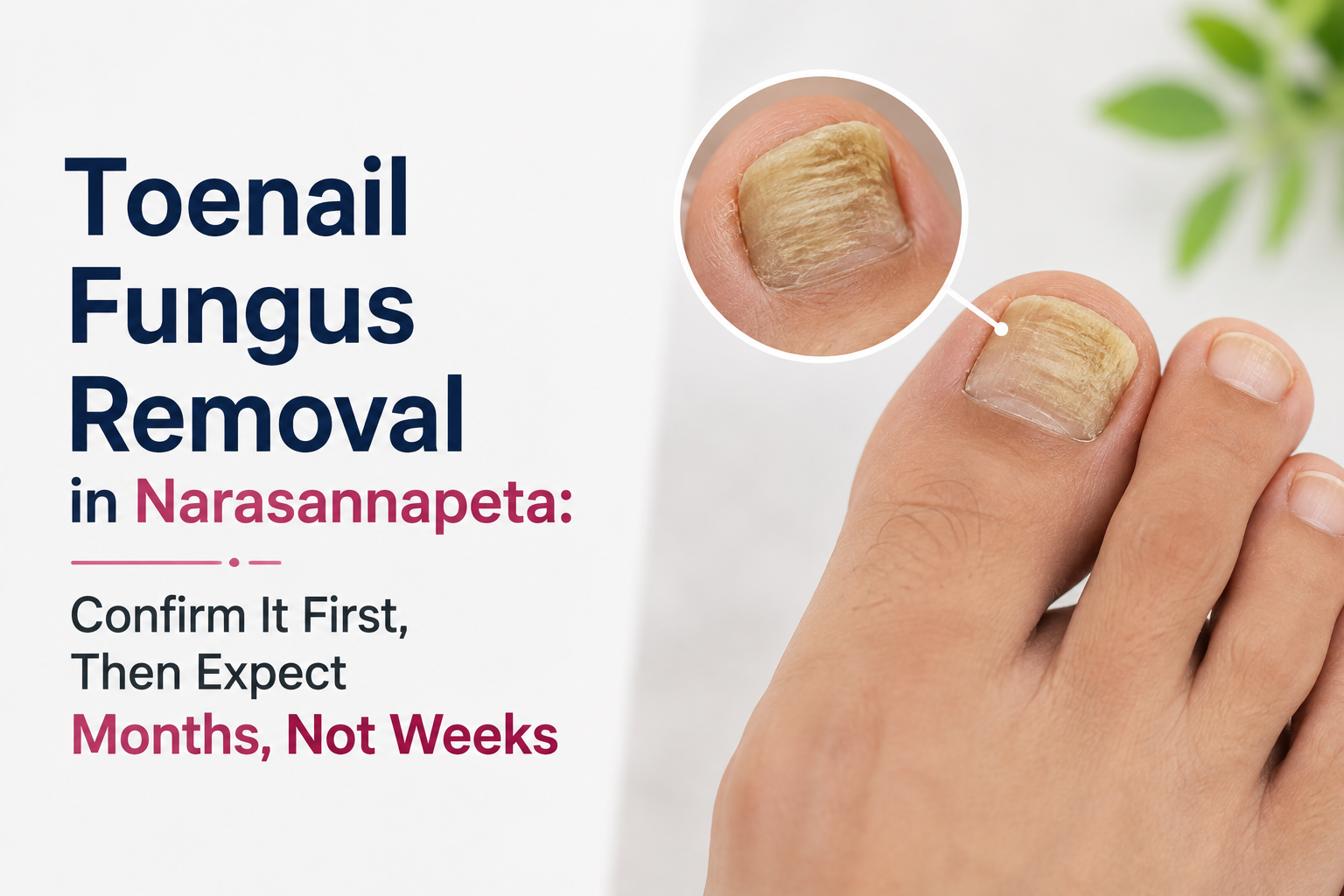
Toenail fungus removal in Narasannapeta works best when the diagnosis is confirmed by testing a nail clipping first. Treatment is then topical or oral antifungal medication, sometimes with partial nail removal. A toenail takes nine to eighteen months to fully replace itself, so patience matters.
Two things derail most fungal nail treatment. The first is treating a nail that was never fungal. The second is stopping at three months because the nail still looks bad, when at three months it is supposed to still look bad. This post deals with both.
Is it definitely fungus?
Not necessarily. A large proportion of thick, discoloured toenails are caused by something other than fungus, and antifungal treatment does nothing for those. Confirming the diagnosis with a nail clipping sent for testing is what prevents months of pointless treatment.
| Cause | Typical appearance | Clue |
|---|---|---|
| Fungal infection | Yellow-brown discolouration, thickening, crumbling edge, debris under the nail | Often starts at one edge and spreads; athlete's foot may be present too |
| Repeated trauma | Thickened, sometimes darkened nail, usually one nail | Tight shoes, running, or a bunion pressing the toe. See our post on bunions |
| Nail psoriasis | Pitting, ridging, oil-drop patches, lifting nail | Skin or scalp changes elsewhere |
| Pincer or curved nail | Nail curling inwards, thickened edges | Pain out of proportion, see pincer nail correction |
| Poor circulation | Slow growing, thickened, brittle nails, cold foot | Weak pulses, calf pain on walking |
One appearance always needs urgent review rather than antifungal treatment: a dark brown or black streak running lengthwise in a nail, especially if it is new, widening, or the skin at the base is pigmented. That needs assessment, not a nail lacquer.
How is it confirmed?
A clipping of the affected nail, along with debris from underneath it, is sent to a laboratory for microscopy and culture. This confirms whether fungus is present and often identifies the type, which guides treatment.
Testing takes time but earns it back. Oral antifungal courses run for months and need monitoring, so it is worth knowing the target is real before starting. If testing is negative and the nail is still abnormal, the cause is usually mechanical, and the treatment is completely different.
Does removing the nail cure the infection?
No, and this is the most common misunderstanding. The fungus lives in the nail bed and the growth zone beneath, so removing the visible nail leaves the infection behind and a new infected nail simply grows back.
Nail removal has a real but limited role. It is used to reduce a very thick nail so topical treatment can penetrate, to relieve pain and pressure, or where the nail is causing skin damage. It is a supporting step alongside antifungal treatment, not a cure in itself.
What are the treatment options?
Options are topical antifungal lacquers or solutions, oral antifungal tablets, partial or complete nail removal as an adjunct, and simply managing the nail without cure. The right choice depends on how much nail is involved, whether the base of the nail is affected, and your general health.
- Topical antifungals: suitable for mild infection affecting the outer part of one or two nails. Safe, but slow, and they penetrate thick nails poorly.
- Oral antifungals: more effective for extensive infection or when the nail base is involved. They require a prescription, and may need liver monitoring and a review of your other medicines for interactions.
- Nail reduction or partial removal: thinning or removing part of the nail so topical treatment reaches the nail bed, and to relieve pressure.
- Managing without cure: a legitimate choice for some, especially where tablets are unsuitable. Regular professional nail reduction keeps the nail comfortable and safe.
- Treating the skin too: athlete's foot between the toes must be treated as well, or the nail is simply reinfected.
What does the timeline actually look like?
A toenail grows slowly, so improvement is measured in months. The visible nail does not heal; a new healthy nail grows out from the base and gradually replaces the damaged one. Full replacement of a big toenail takes roughly nine to eighteen months.
| Time point | What is happening | What you will see |
|---|---|---|
| Month 0 | Diagnosis confirmed, treatment started, athlete's foot treated | No change. This is expected |
| Months 1 to 3 | New nail begins growing from the base | Often still no visible improvement. Most people quit here, too early |
| Months 3 to 6 | A band of clearer nail appears near the cuticle | First real sign it is working. The old damaged nail is still there ahead of it |
| Months 6 to 12 | Healthy nail advances, damaged nail grows forward and is trimmed away | Steadily more normal nail, still an abnormal tip |
| Months 12 to 18 | Full replacement of a big toenail | Final result becomes clear |
The practical rule: judge progress by the new nail at the base, not by the old nail at the tip. If there is a clear band near the cuticle at four to six months, treatment is working even if the toe still looks unattractive.
Why does diabetes change the approach?
In diabetes a fungal nail is not a cosmetic problem. A thickened nail presses on the nail bed and the neighbouring toe, the surrounding skin cracks, and those cracks are entry points for bacteria into a foot that heals badly.
- Never cut, dig or remove nails at home, and avoid roadside or salon nail cutting.
- Have thick nails reduced professionally, which is often the main treatment in itself.
- Treat athlete's foot promptly, since cracks between the toes let bacteria in. Blisters and skin breaks matter for the same reason, as covered in our post on blisters on the foot with diabetes.
- Get circulation checked, since poor blood flow both mimics and worsens nail disease. Clues are covered in our post on calf pain when walking with diabetes, and testing is available through our vascular services.
- Discuss oral antifungals carefully, as they interact with several common medicines.
Any redness, swelling, discharge or pain around a nail in a diabetic foot needs prompt assessment rather than waiting. Related problems are listed under foot conditions we treat, and wound care sits under non-surgical wound management, with surgical options under diabetic foot surgery.
Why does it come back?
Recurrence is common, usually because the source was never removed. The fungus survives in shoes, on the skin between the toes, and in shared damp floors, so a cured nail meets the same fungus again.
- Untreated athlete's foot between the toes, which reinfects the nail.
- Old shoes still carrying spores.
- Damp feet in closed shoes all day.
- Shared bathrooms and temple or pool floors, where feet are bare.
- Treatment stopped early, before the new nail had fully grown out.
- Nail trauma from tight footwear, which lets fungus back in.
Practical prevention: dry between the toes properly, rotate shoes so each pair dries out, use antifungal powder in footwear during treatment, wear footwear in shared wet areas, and keep nails trimmed straight across through preventive foot care.
Fungal nail and diabetic foot care for Narasannapeta
Elegance Diabetic Foot & Ulcer Clinic (EDFC), led by Dr. Ashutosh Shah, provides nail assessment and reduction, diabetic foot care, ulcer treatment and limb salvage from its centre in Surat, with care expanding into the Srikakulam district including Narasannapeta. If you are considering toenail fungus removal in Narasannapeta, the step that saves the most time is confirming whether it is fungus at all.
You can send a clear photo of the nail to our team on WhatsApp for initial guidance and book a foot assessment. If there is redness, swelling, discharge or pain around the nail, seek care promptly rather than starting treatment yourself. Follow EDFC on Facebook, Instagram and YouTube for foot care guidance and real limb salvage stories.
Confirm it, then give it time
Fungal nails are treatable, but only on the nail's timescale rather than yours. Test first so you are treating the right thing, treat the skin as well as the nail, and judge progress by the new growth at the base rather than the old nail at the tip.
Next step: book a nail and foot assessment with Dr. Ashutosh Shah at Elegance Diabetic Foot & Ulcer Clinic, or send a photo of the nail on WhatsApp today to find out whether testing and treatment are worth starting.
Medical disclaimer: This article is for educational purposes only and is not a substitute for professional medical diagnosis or treatment. Oral antifungal medicines require prescription and medical supervision, including checks for drug interactions. Nail changes in diabetes, and any new dark streak in a nail, should be assessed in person. Please consult Dr. Ashutosh Shah or a qualified specialist about your condition. For further guidance, see the NHS guide to fungal nail infection and the IWGDF diabetic foot guidelines.
quiz Frequently Asked Questions
This article is general education, not a diagnosis. If you have a diabetic foot wound, please have it assessed in person. Send a photo on WhatsApp or book a consultation.
About the Author

Dr. Ashutosh Shah, Plastic, Reconstructive & Diabetic Foot Surgeon, Elegance Diabetic Foot & Ulcer Clinic, Surat
Dr. Ashutosh Shah is a board certified plastic and reconstructive surgeon with over 22 years of experience and more than 10,000 limbs and feet saved. He founded Elegance Diabetic Foot & Ulcer Clinic, India's first chain of clinics dedicated to foot care, with centres in Surat and OPD partners across South Gujarat. He is known for a limb first approach, safe wound care and ethical, natural results.