Written by Dr. Ashutosh Shah, Plastic & Microvascular Surgeon - Diabetic Foot & Limb Salvage Specialist, Elegance Diabetic Foot & Ulcer Clinic (EDFC). [Reg. No.]. Practising since 2004 (22+ years). Read full bio.
Medically reviewed by Dr. Ashutosh Shah
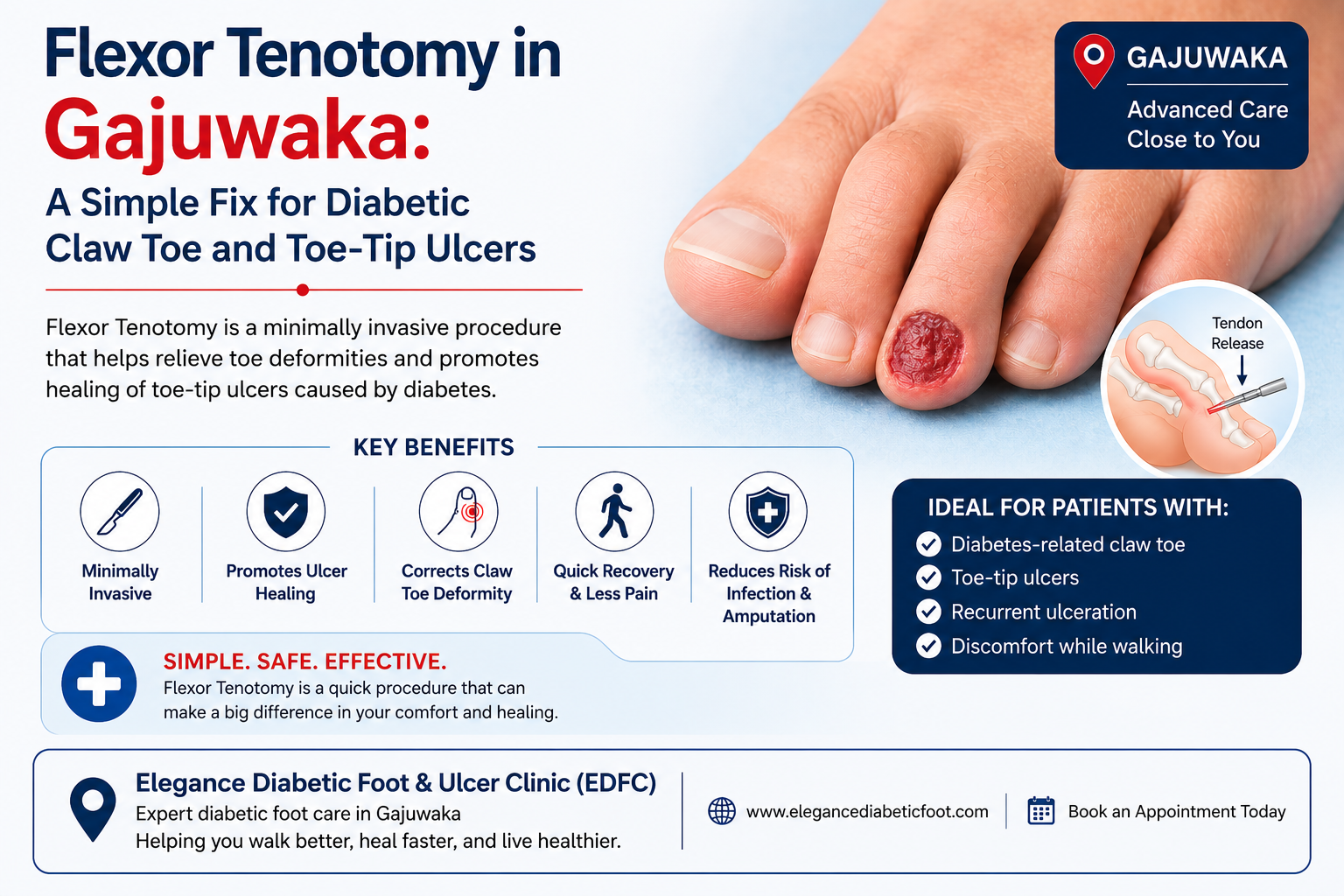
Flexor tenotomy in Gajuwaka is a quick, minimally invasive procedure that releases a tight toe tendon to straighten a curled (claw or hammer) toe. For people with diabetes, it relieves pressure on the toe tip so ulcers heal and are far less likely to return, usually done in minutes under local anaesthesia.
When a diabetic toe curls, the tip presses hard against the floor or shoe and a stubborn ulcer can form. This guide explains what flexor tenotomy does, who it suits, how it works, and the warning signs that mean you should get a toe checked early.
What is a flexor tenotomy?
A flexor tenotomy is a minor procedure that cuts (releases) the tight flexor tendon under a curled toe so the toe can straighten. The medical name is percutaneous flexor tenotomy - "percutaneous" means it is done through the skin with a fine needle or blade, without open surgery.
Once the tendon is released, the toe lies flat instead of clawing downward. That takes pressure off the toe tip, which is exactly where diabetic ulcers tend to form.
Why do people with diabetes need it?
People with diabetes need flexor tenotomy because nerve damage can make the small toe muscles pull unevenly, curling the toe into a claw or hammer shape. The raised knuckle and pressed-down tip then rub inside the shoe, and on a numb foot this quietly leads to callus and an ulcer.
An ulcer on the tip or apex of a toe is hard to offload with padding alone, because the toe keeps pressing down. International IWGDF guidelines recommend flexor tenotomy for a thick callus or ulcer on the apex of a flexible (non-rigid) hammer toe, to heal a current ulcer and prevent the next one. In our diabetic foot practice we often see toe-tip ulcers that had been dressed for months but kept returning until the underlying claw toe was corrected.
What are the signs you might need a flexor tenotomy?
The signs you might need a flexor tenotomy include a curled toe, hard callus on the tip of a toe, or a wound on the end of a toe that will not heal. These suggest the toe shape itself is driving the pressure that breaks down the skin.
- A toe that curls downward (claw toe or hammer toe), often the 2nd to 5th toes.
- Thick callus on the tip or knuckle of a toe - a sign of repeated high pressure.
- A sore or ulcer at the end of a toe that keeps coming back despite dressings.
- Redness, blister, or dark spot under the toe tip.
- The toe still bends easily by hand (flexible deformity) - this responds best to tenotomy.
Because diabetic nerve damage can mute pain, these toe problems are easy to ignore. Diabetic foot deformities and ulcers are among the conditions we treat, and early correction prevents far more serious complications.
How is a flexor tenotomy performed?
A flexor tenotomy is performed in the clinic under local anaesthesia, through a tiny puncture at the base of the toe, and usually takes only a few minutes per toe. No stitches or cast are normally needed, and most people walk out the same day.
- The toe and forefoot are cleaned and numbed with local anaesthetic.
- A fine needle or small blade is passed through the skin to release the tight flexor tendon.
- The toe is gently straightened and the toe tip lifts off the ground.
- A small dressing is applied - usually no sutures, and you can bear weight soon after.
If several toes are curled, the surgeon may release them in the same sitting to balance the foot and avoid shifting pressure to a neighbouring toe.
How well does flexor tenotomy work?
Flexor tenotomy works very well for toe-tip ulcers caused by flexible claw or hammer toes. Published studies report high healing rates - frequently around 90% or more of treated toe ulcers - usually within a few weeks, with low recurrence and few complications.
The procedure treats the cause (the curled toe) rather than just dressing the wound, which is why ulcers that resisted months of dressings often heal quickly afterward. Results are best when the toe is still flexible and the foot has reasonable blood supply.
Flexor tenotomy vs open toe surgery: how do they compare?
Flexor tenotomy is usually preferred for flexible diabetic toe deformities because it is quick and done through the skin, while open corrective surgery is reserved for rigid, fixed toes. The right choice depends on whether the toe still bends and on your circulation.
| Factor | Percutaneous flexor tenotomy | Open toe (corrective) surgery |
|---|---|---|
| Approach | Through the skin, fine needle/blade | Open incision on the toe |
| Anaesthesia | Local, in clinic | Local or regional, theatre |
| Best for | Flexible (non-rigid) claw/hammer toe | Rigid, fixed toe deformity |
| Recovery | Walk same day, heal in weeks | Longer, may need stitches/pins |
| Stitches / cast | Usually none | Often required |
A specialist confirms whether your toe is flexible or rigid before recommending one approach over the other, so an in-person assessment is essential.
What is recovery like after the procedure?
Recovery after flexor tenotomy is usually quick and comfortable - most people walk the same day and feel little pain because the foot is often numb. You will be advised on dressing care, suitable footwear, and follow-up so the toe tip stays offloaded while the skin heals.
Healing the skin is only part of the job. Ongoing protection matters: proper footwear, daily foot checks, callus care, and good blood-sugar control all help prevent the next ulcer. Explore the full diabetic foot pathway in our diabetic foot & limb-salvage services.
How can you prevent diabetic toe ulcers?
You can prevent diabetic toe ulcers by checking your feet daily, treating curled toes and callus early, wearing protective footwear, and keeping blood sugar controlled. Catching a deformity before it ulcerates is far easier than healing an open wound.
- Inspect your toes and soles every day for callus, redness, or sores.
- Get any curled toe or hard toe-tip callus assessed before it breaks down.
- Wear well-fitting, roomy footwear and never walk barefoot.
- Keep blood sugar, blood pressure, and cholesterol within target.
- Have a non-healing toe wound checked within days, not weeks.
Flexor tenotomy for patients in the Gajuwaka and Visakhapatnam region
Elegance Diabetic Foot & Ulcer Clinic (EDFC) treats diabetic foot problems from its centre in Surat, and a new Centre of Excellence for diabetic foot care and limb salvage is opening soon in Vizianagaram, close to Gajuwaka and Visakhapatnam. As part of a structured limb-salvage pathway, our team assesses toe deformities and toe-tip ulcers and performs procedures such as flexor tenotomy alongside wound care, offloading, and diabetes management. To find out whether your toe needs correcting, book a consultation with our team.
You can also follow EDFC on Facebook, Instagram, and YouTube for diabetic foot care tips and real limb-salvage stories.
Book your assessment
If you have diabetes and a curled toe, stubborn toe-tip callus, or a wound that will not heal, don't wait. Book an appointment with Elegance Diabetic Foot & Ulcer Clinic for a toe and circulation assessment and personalised advice.
Medical disclaimer: This article is for educational purposes only and is not a substitute for professional medical diagnosis or treatment. Please consult Dr. Ashutosh Shah or a qualified diabetic-foot specialist about your individual condition. For authoritative guidance, see the IWGDF diabetic foot guidelines and this systematic review of percutaneous flexor tenotomies.
quiz Frequently Asked Questions
This article is general education, not a diagnosis. If you have a diabetic foot wound, please have it assessed in person. Send a photo on WhatsApp or book a consultation.
About the Author

Dr. Ashutosh Shah, Plastic, Reconstructive & Diabetic Foot Surgeon, Elegance Diabetic Foot & Ulcer Clinic, Surat
Dr. Ashutosh Shah is a board certified plastic and reconstructive surgeon with over 22 years of experience and more than 10,000 limbs and feet saved. He founded Elegance Diabetic Foot & Ulcer Clinic, India's first chain of clinics dedicated to foot care, with centres in Surat and OPD partners across South Gujarat. He is known for a limb first approach, safe wound care and ethical, natural results.